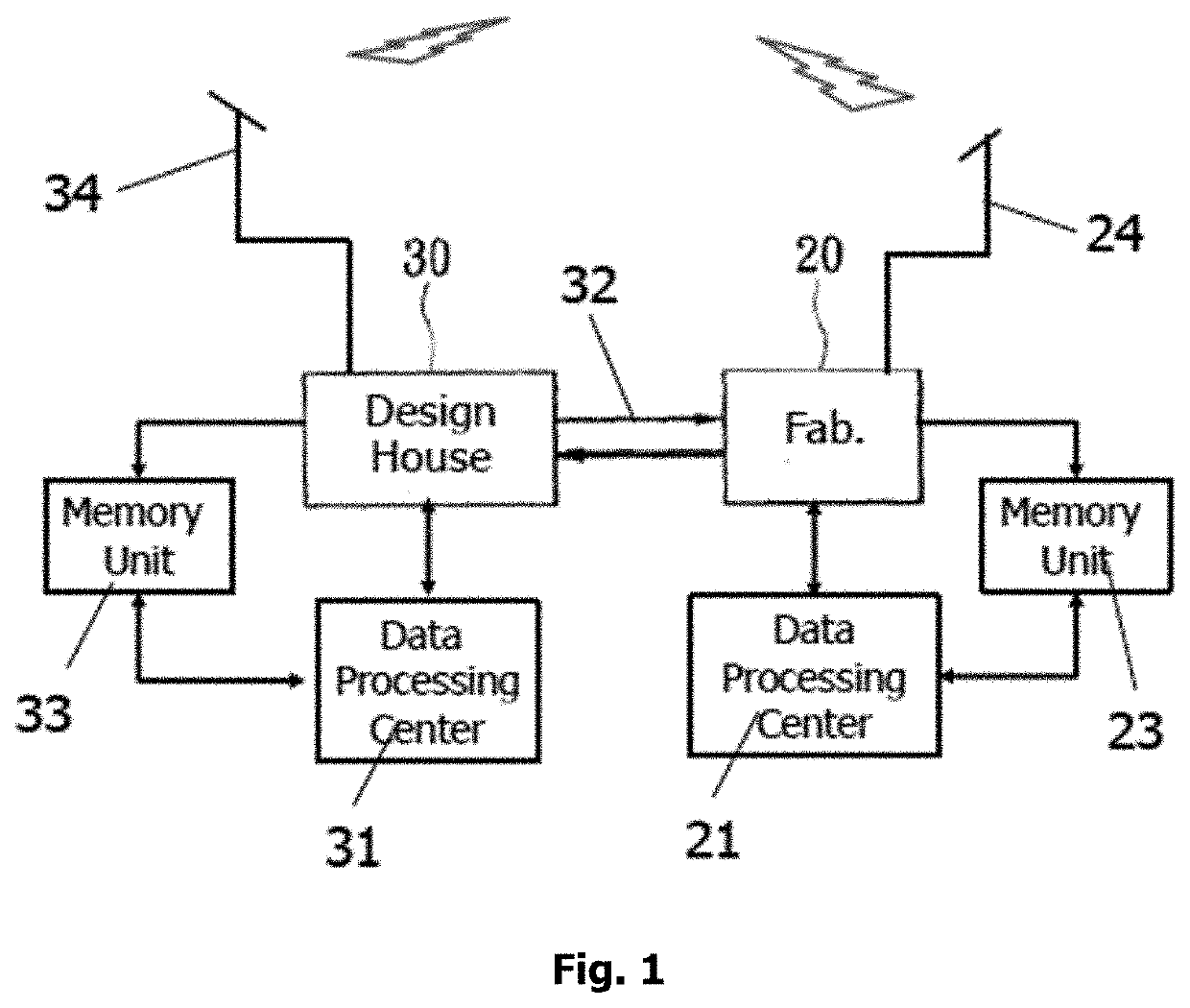
Obviously, IC design house authorize
semiconductor Fab to manufacture wafer, but IC design house doesn't invest to build Fab or purchase equipment tools.
In the manufacturing procedure, random defect and systematic defect are produced probably because of resolution deviation of equipment itself, abnormal incidence, particle induced in a process, pattern defect in the design
layout pattern, and insufficient
lithography process window.
Those defects will cause open or short failure die.
Then, it could
delay the
pilot production or the schedule to be on the market.
Based on current manufacturing procedure, the semiconductor Fab and IC design house might not be able to increase revenue and profit earlier when the capability to resolve defect issue in a semiconductor Fab is insufficient.
But, Fab did not release this potential wafer risk information or various
metrology information o customers (IC design houses).
But, those information impacting wafer yield, like defect data,
line width, thickness data are not provided to IC design houses.
For example: Abnormal equipment problem leads to low wafer yield problem.
However, this low wafer yield problem impacts on-time delivery to design house's customer after the incidence happened a few weeks ago.
Currently, the management of semiconductor Fab by an IC design house is only limited to trace wafer progress.
In term of on-time wafer delivery, design house lacks a real-time monitor apparatus to monitor defect data and abnormal wafer lot.
But, there is no method or
system available.
Obviously, if the management of semiconductor Fab by IC design house is still the same as before (semiconductor Fab in charge of all the defect issue) and not involved on the defect
problem solution, then the time to improve wafer yield cannot be shortened.
It will
delay the delivery time of product from an advanced process Fab.
Following the shrinked geometry size toward advanced semiconductor process, systematic defect issue becomes a more and more severe problem.
In addition, the characteristic of systematic defect is that the systematic defects will happen at various repeated defect pattern locations.
So, there are many systematic defect patterns happen at various design layout pattern groups.
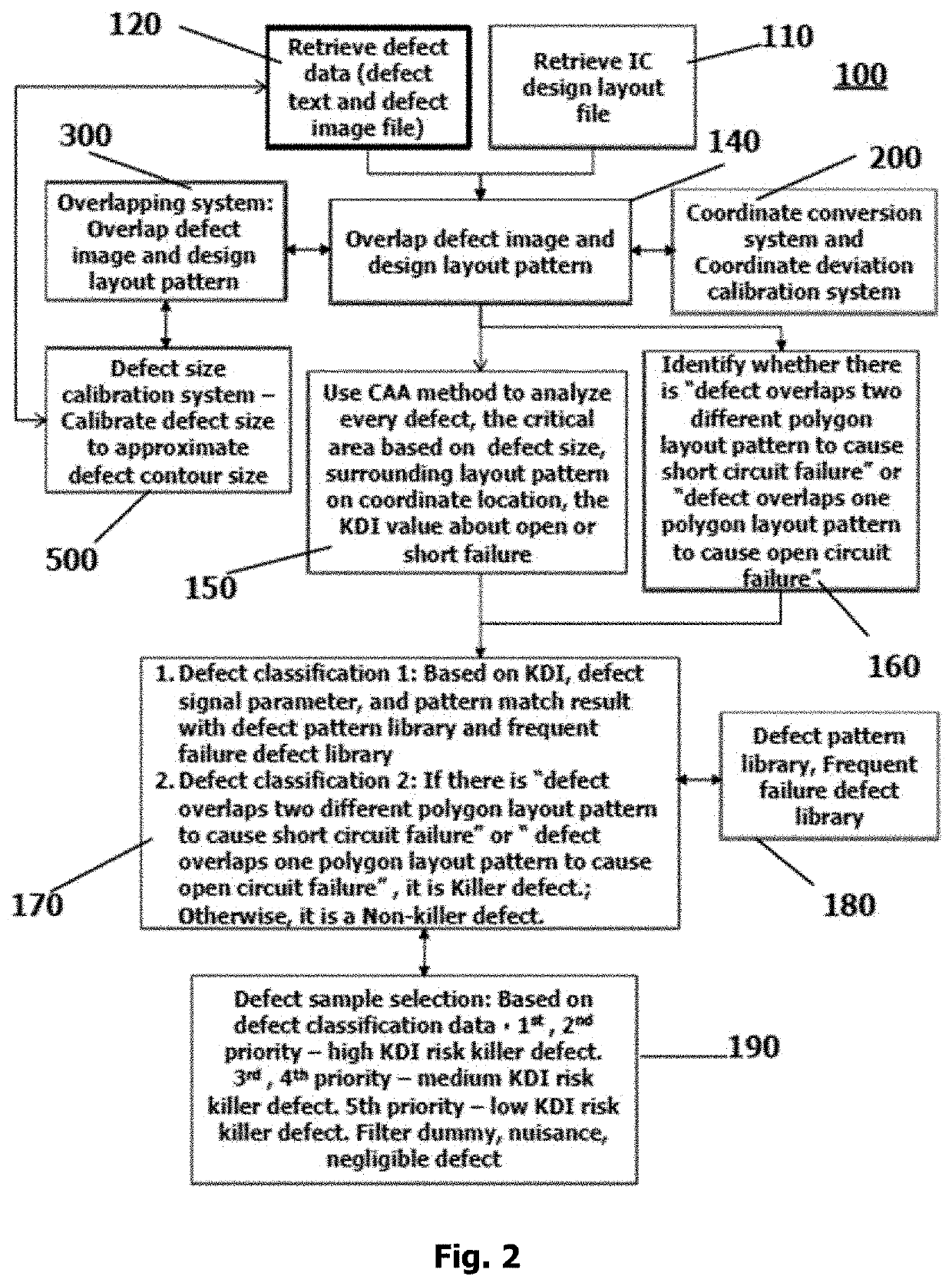
Obviously, it is very difficult to find the real open or short failure systematic defect through such defect
sample selection procedure.
If the real systematic defect is not inside the 500 defect design layout pattern groups, then semiconductor Fab cannot immediately provide accurate systematic defect SEM images to process engineer.
This will
delay the time to improve systematic defect yield problem.
In the end, this raises cost of semiconductor Fab and IC design house.
Similarly, the slow SEM imaging
throughput of SEM limits the defect
sample selection quantities, i.e. only several tens to several hundred defect samples will be selected for SEM imaging.
But, that method can hardly find failure killer random defect in the defect analysis of nanometer scale semiconductor process.


 Login to View More
  Login to View More