
Chemiluminescent reagents and chemiluminescence analysis methods with the use of the same
a technology of chemiluminescent reagents and reagents, which is applied in the field of chemiluminescent reagents and chemiluminescence analysis methods with, can solve the problems of time-consuming reagent preparation and handling, inability to always show sufficient sensitivity, and difficulty in applying chemiluminescent enzyme immunoassay, etc., and achieves the effects of short time, high sensitivity and easy production
- Summary
- Abstract
- Description
- Claims
- Application Information
AI Technical Summary
Benefits of technology
Problems solved by technology
Method used
Image

Examples
example 1
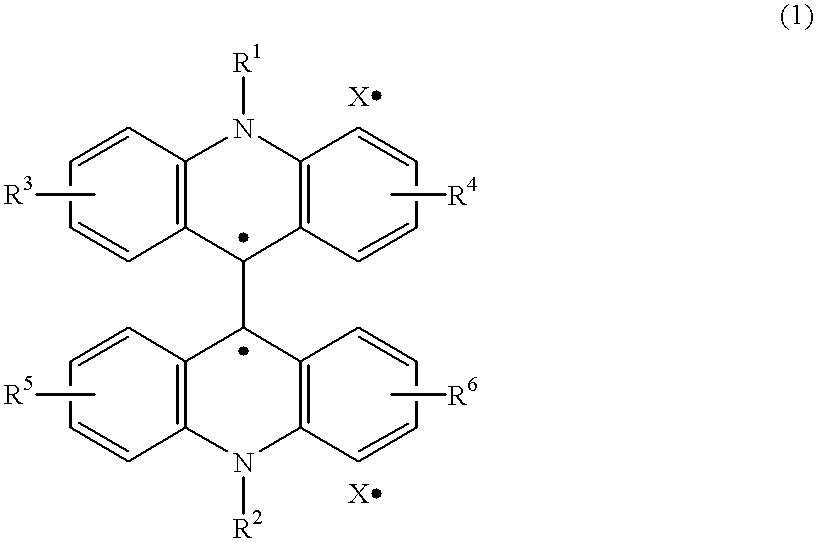
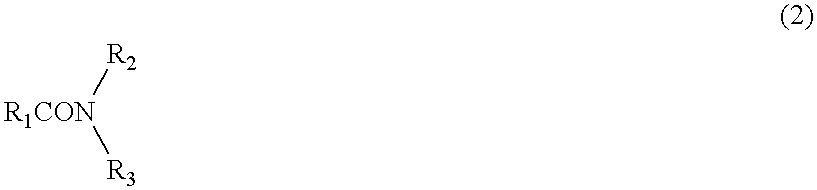
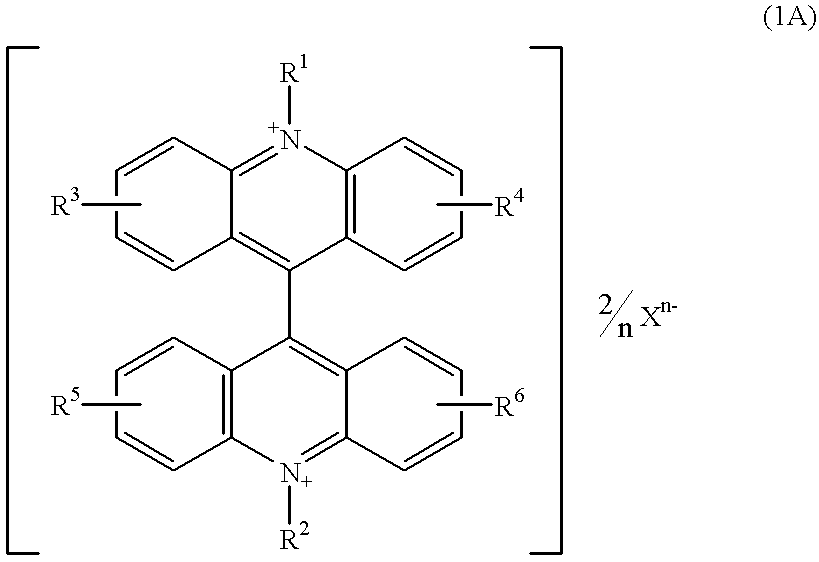
Preparation of Chemiluminescent Reagent Containing a Charge-transferring Complex of N,N'-dimethyl-9,9'-bisacridinium Dihydroiodide Salt and N,N'-dimethylacetoamide
A mixture of a 1.times.10.sup.-2 mol / L aqueous solution of lucigenin and solid potassium iodide (molar ratio: 1:2) was stirred at room temperature for 1 hour, to produce a red precipitate. The precipitate-containing reaction solution was put in an eggplant-shaped flask and heated by a rotary evaporator at 60.degree. C. under a vacuum to distill off water serving as the solvent. The residuum of the solidified red precipitate was washed with benzene to remove by-products, and the benzene-insolubles were separated by filtration and dried, to produce the raw product. The raw product was dissolved in a small quantity of water by heating at 95.degree. C. in a water bath, while light was shielded. It was cooled back to room temperature, and then kept at 4.degree. C. The resultant precipitate was separated by filtration and dried,...
example 1-1
Measurement of Peroxidase Activity
Each of a plurality of wells supported by a micro plate for chemiluminescence measurement was charged with 100 .mu.L of a 0.1 M trishydrochloric acid buffer solution (pH: 7.8) containing a varying concentration of horseradish peroxidase (HRP), 800 .mu.L of a 10 mM p-iodophenol solution, and 100 .mu.L of the chemiluminescent reagent solution (20 .mu.L of the chemiluminescent reagent prepared by EXAMPLE 1 dissolved in 9.18 mL of a 10 mM trishydrochloric acid buffer solution (pH: 7.8)), to which 50 .mu.L of a 0.0034% aqueous solution of hydrogen peroxide was added, to produce the chemiluminescence. Extent of the chemiluminescence was added up for 1 to 5 sec by a luminometer, to determine luminescent intensity, shown in Table A. It is thus confirmed that HRP concentration can be measured up to 1.times.10.sup.-19 mol / assay.
example 1-2
Measurement of .alpha.-fetoprotein (AFP) by the Simultaneous Sandwich CLEIA Method Using the Chemiluminescent Reagent Prepared by EXAMPLE 1
50 .mu.L of a PBS solution (pH: 7.4) containing 2% BSA which contained 0 to 800 ng / mL of purified human AFP (standard material) and 100 .mu.L of a PBS solution (pH: 7.4) containing 2% BSA which contained approximately 3 .mu.g / mL of mouse antihuman AFP monoclonal antibody marked with the peroxidase enzyme prepared by REFERENCE EXAMPLE 2 were charged to wells supported by a micro plate, white in color, immobilizing the rabbit antihuman AFP polyclonal antibody prepared by REFERENCE EXAMPLE 1, and the mixture was incubated at 37.degree. C. for 1 hour. The solution was removed from each well under a vacuum, and the well inside was washed with normal saline solution. Then, each well was charged with 100 .mu.L of a 75 mM trishydrochloric acid buffer solution (pH: 7.8), 100 .mu.L of the chemiluminescent reagent solution prepared by EXAMPLE 1, and 50 .mu....
PUM
 Login to View More
 Abstract
Description
Claims
Application Information
 Login to View More