Supercharge Your Innovation With Domain-Expert AI Agents!

Process for chemical conversion of cellulose isolated from aromatic spent biomass to hydroxymethyl furfural

a technology of cellulose and hydroxymethyl furfural, which is applied in the field of preparation of hydroxymethyl furfural (hmf) from cellulose isolated from aromatic spent biomass, can solve the problems of indirect determination of the inferior quality of food products, limited researchers around the world are able to produce hmf from lignocellulosic waste biomass, and environmental problems, etc., to achieve similar efficiency, limited solubility, and similar efficiency

Active Publication Date: 2015-12-01
COUNCIL OF SCI & IND RES
View PDF1 Cites 0 Cited by
  • Summary
  • Abstract
  • Description
  • Claims
  • Application Information

AI Technical Summary

Benefits of technology

This process provides a cost-effective, environmentally friendly method for producing HMF with high yields and purity, utilizing recyclable catalysts and solvents, suitable for large-scale production and commercial adaptation.

Problems solved by technology

People generally used this spent distilled biomass for burning purpose which also leads to environment related problems.
But very limited researchers around the world are able to produce HMF from lignocellulosic waste biomass.
It is reported that some food grade carbohydrates (fructose, glucose, sucrose, etc) also contained HMF as degraded chemical in heat processing of these reducing carbohydrates, which indirectly determines the inferior quality of food product.
Very limited researchers around the world are able to produce HMF from lignocellulosic waste biomass.
But this process is not commercially viable due to the expensive nature of ILs.
This process is also not commercially viable due to the expensive nature of ILs and recoverable limitation of organic acid as catalyst.
Though this process offered appreciable yield of HMF, but it cannot be practiced in the industrial scale due to expensive ILs.
In this process, they mainly targeted the easily soluble hemicellulose for the furfural production and failed to explain the dissolution of cellulose in a solvent system and the production of HMF.
In this process, they have used low cost solvents but the main constraint arises in this system is the isolation of HMF from the reaction mixture.
Hence, it is very difficult to separate the product HMF from the reaction solution i.e dimethyl acetamide.
This separation problem of HMF added cost to this process.
The use of ILs along with DMA-LiCl, make this process expensive.
All this processes discussed above are expensive and having separation limitation.
Regardless, the mechanism of HMF formation, the intermediate species formed during the reaction may in turn undergo further reactions such as condensation, rehydration, reversion and other rearrangements, resulting in a plethora of unwanted side products.
Although preparation of HMF has been known for many years, a method which provides HMF with good selectivity and in high yields has yet to be discovered.
The complications arose from the rehydration of HMF, which yielded the by-products such as levulinic acid and formic acid.
Another unwanted side reaction included the polymerization of HMF and / or fructose resulting in humin polymers, which were solid waste products.
Further complications could arise as a result of solvent selection.
Water is easy to dispose of and dissolves fructose, but unfortunately low selectivity and increased formation of polymers and humin increased under aqueous conditions.
However, these initial syntheses were not practical methods for commercial scale production of HMF due to very low conversion of the starting material.
These acid catalysts were used in solution and are very difficult to regenerate and dispose.
The purification of HMF has also proved to be a troublesome operation.
Because of this heat instability, a falling film vacuum still must be used.
Even in such an apparatus, resinous solids form on the heating surface causing a stalling in the rotor and frequent shut down time making the operation inefficient.
On the other hand, the use of polyglycols leads to the formation of HMF-PEG ethers.
The prior art processes also fail to provide a method for producing HMF that can be performed economically.
Although preparation of HMF has been known since 1895, but a method which provides HMF with eco-friendly route, good selectivity and high yields has not been developed so far.
But no work on synthesis of HMF from cellulose (Complicated plant based biopolymer) using this combination has been reported.
Hence it is very difficult to dissolve and break this β-1,4 glycoside linkage of cellulose molecule.
But, they used the expensive ionic liquid (1-ethyl-3-methyl imidazolium chloride) as the reaction medium for dissolution of cellulose.(c) Limited reports are available on the use of mixture of dimethyl acetamide-LiCl (DMA-LiCl) for dissolving the cellulose.
Though, DMA-LiCl is able to solubilise the cellulose but conversion of cellulose to HMF is poor in this solvent system.
Second category (b) process needs very expensive imidazolium based ionic liquids for dissolving the cellulose.
Though it provides appreciable yield of HMF, but the process cannot be practiced in the industrial scale due to expensive ionic liquid.
In the third category (c) process, the cellulose is dissolved by using cheap solvent (DMA-LiCl) system, but it has the separation limitation of reaction product (HMF) from the solvent system.
The appreciable yield is only obtained, when DMA-LiCl along with the imidazolium ionic liquid is used as the reaction medium, but major constraint of the process is isolation of HMF from the reaction medium.
Also, both solvents boiling point are very high, so it is very difficult and also quite expensive to separate the product (HMF) from the reaction solution (dimethyl acetamide).
Finally, the third category process is not completely free from ionic liquid solvent.
From the above literature survey, it is clear that imidazolium based ionic liquids or DMA-LiCl system can solubilise the cellulose, but former one is costly process and later one is reasonably costly along with separation (HMF) limitations.

Method used

the structure of the environmentally friendly knitted fabric provided by the present invention; figure 2 Flow chart of the yarn wrapping machine for environmentally friendly knitted fabrics and storage devices; image 3 Is the parameter map of the yarn covering machine
View more

Image

Smart Image Click on the blue labels to locate them in the text.
Viewing Examples
Smart Image
  • Process for chemical conversion of cellulose isolated from aromatic spent biomass to hydroxymethyl furfural
  • Process for chemical conversion of cellulose isolated from aromatic spent biomass to hydroxymethyl furfural
  • Process for chemical conversion of cellulose isolated from aromatic spent biomass to hydroxymethyl furfural

Examples

Experimental program
Comparison scheme
Effect test

example 1

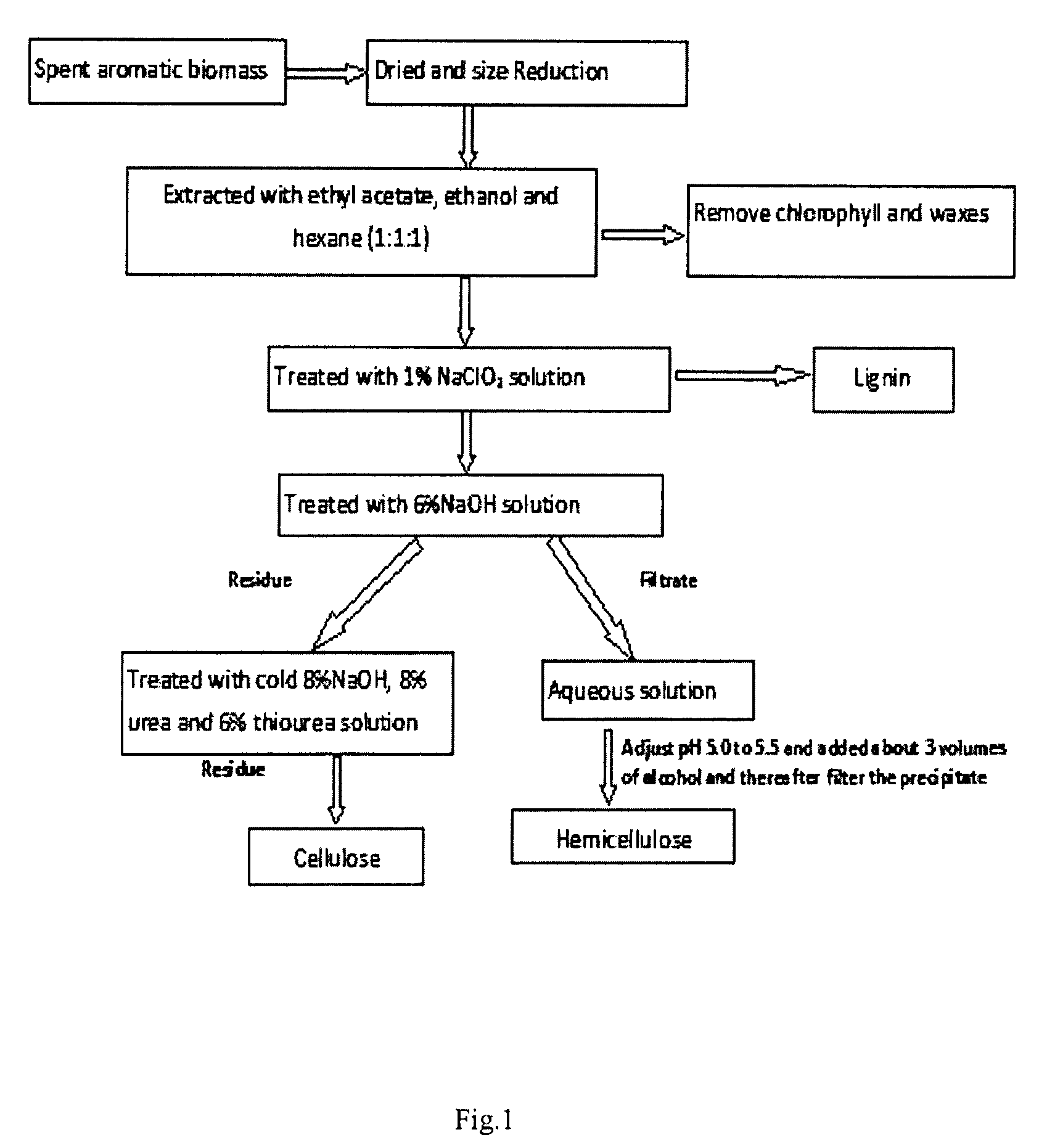
[0090]Air dried and pulverized spent mentha biomass (100 g) was extracted with mixture of hexane (about 150 mL), ethyl acetate (about 150 mL) and ethanol (about 150 mL) in Soxhlet apparatus for about 5 h. The mixture of solvents was concentrated under vacuum and weight of the extract was 7.3 g (7.3%). This extract contains chlorophyll, lipids and hydrocarbons along with trace amounts of other components. After drying, the weight of the biomass was 87 g (approx). The extracted biomass (10 g) was treated with 1% NaClO2 solution and kept at 80° C. for 30 minutes. Then the solution was filtered and concentrated and the lignin content was 1.5 g. The delignified biomass (residue) was treated with 6% of NaOH solution (about 30 mL) for about 15 minutes at 80° C. and filtered. The pH of the filtrate was adjusted to 5.5 and then, about 80 mL of ethanol was added in the solution to precipitate the hemicellulose. The hemicellulose was isolated from the solution by filtration and washed in disti...

example 2

[0092]Air dried and pulverized spent biomass of palmarosa (100 g) was extracted with mixture of hexane (about 150 mL), ethyl acetate (about 150 mL) and methanol (about 150 mL) in Soxhlet apparatus for about 5 h. The mixture of solvents was concentrated under vacuum and weight of the extract is 7.5 g (7.5%). The extract contains chlorophyll, lipids and hydrocarbons along with trace amounts of other components. After drying, the weight of the biomass was 86 g (approx). The extracted biomass (10 g) is treated with 1% NaClO2 solution and kept at 80° C. for 30 minutes. Then filtered the solution and concentrated, the lignin content is 1.6 g. The delignified biomass (residue) was treated with 6% of NaOH solution (about 30 mL) for about 15 minutes at 65° C. and filtered. The pH filtrate was adjusted to 5.2 and then, about 80 mL of ethanol was added in the solution to precipitate the hemicellulose. The hemicellulose was isolated from the solution by filtration and washed in distilled water....

example 3

[0094]Air dried and pulverized spent biomass of lemongrass (100 g) was extracted with mixture of hexane (about 150 mL), ethyl acetate (about 150 mL) and ethanol (about 150 mL) in Soxhlet apparatus for about 5 h. The mixture of solvents was concentrated under vacuum and weight of the extract was 7.5 g (7.5%). The extract contains chlorophyll, lipids and hydrocarbons along with trace amounts of other components. After drying, the weight of the biomass was 88 g (approx). The extracted biomass (10 g) was treated with 1.2% NaClO2 solution and kept at 70° C. for 30 minutes. Then the solution was filtered and lignin content in the filtrate was found to be 1.6 g. The delignified biomass (residue) was treated with 5.5% of NaOH solution (about 30 mL) for about 15 minutes at 75° C. and filtered. The pH of the filtrate was adjusted to 5.2 and then, about 75 mL of ethanol was added in the solution to precipitate the hemicellulose. The hemicellulose was isolated from the solution by filtration an...

the structure of the environmentally friendly knitted fabric provided by the present invention; figure 2 Flow chart of the yarn wrapping machine for environmentally friendly knitted fabrics and storage devices; image 3 Is the parameter map of the yarn covering machine
Login to View More

PUM

PropertyMeasurementUnit
temperatureaaaaaaaaaa
sizeaaaaaaaaaa
temperatureaaaaaaaaaa
Login to View More

Abstract

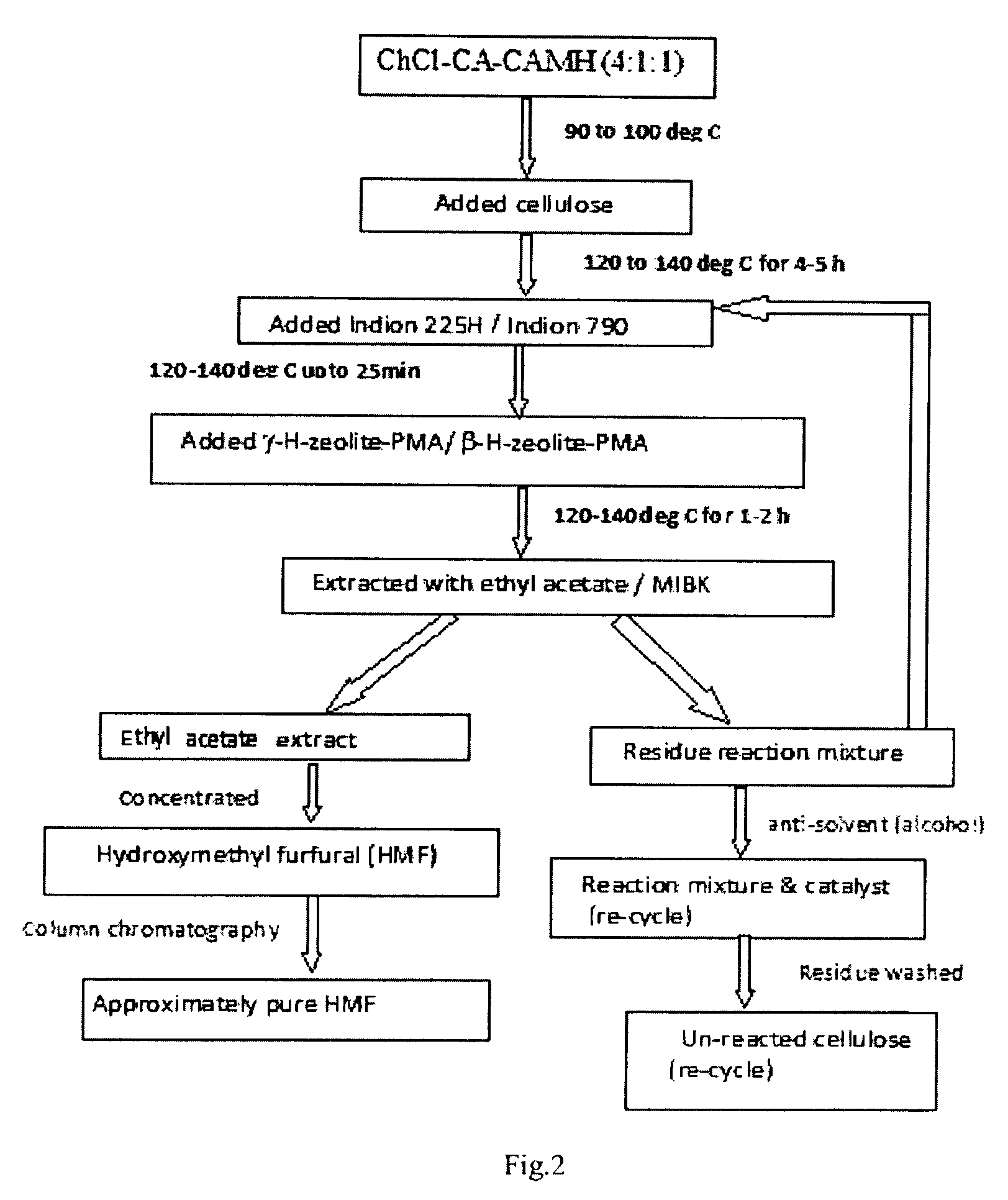
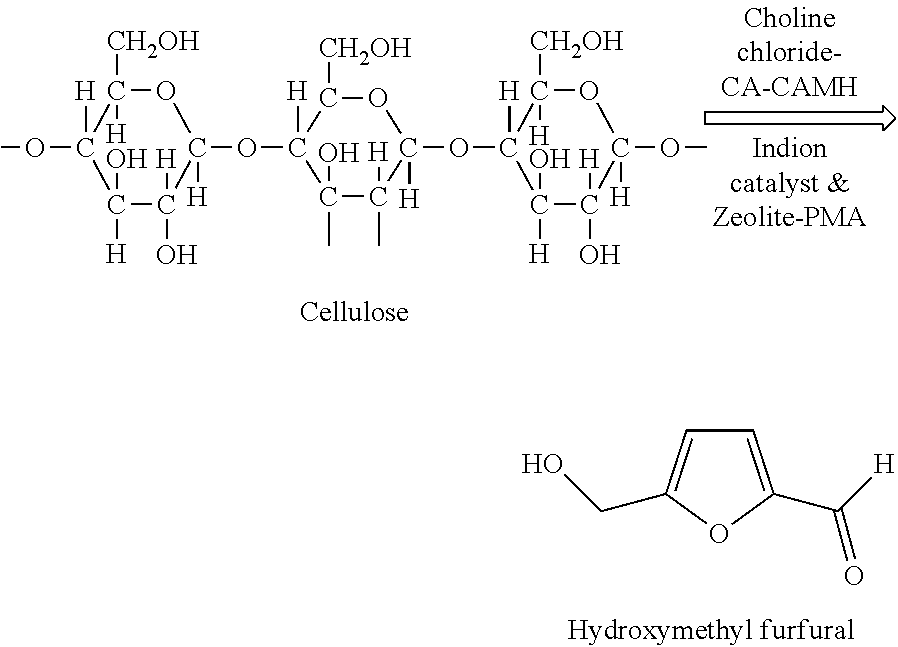
The present invention relates to a process for chemical conversion of cellulose isolated from aromatic spent biomass to hydroxymethyl furfural using an eco-friendly and economical liquids system with recoverable and reusable solid Indion catalysts and zeolite-phosphomolybdic acid hybrid catalysts. The present invention further relates to the preparation of an effective hybrid catalyst i.e. zeolite-phosphomolybdic acid catalyst for synthesis of HMF. The selectivity and yield of HMF is nearly doubled in zeolite-phosphomolybdic acid hybrid catalyst compared to the individual catalysts (zeolite or phosphomolybdic acid) or combination of catalysts viz. zeolite and phosphomolybdic acid.

Description

CROSS-REFERENCE TO RELATED APPLICATIONS[0001]This application is a National Phase of PCT / IN2012 / 000663, filed Oct. 3, 2012, which claims the priority of Indian Application No. 12 / DEL / 2012, filed Jan. 3 2012, the disclosures of which are incorporated herein by reference.FIELD OF THE INVENTION[0002]The present invention relates to the development of green process for preparation of hydroxymethyl furfural (HMF) from cellulose isolated from aromatic spent biomass. The synthesis of HMF from cellulose is completely environment-friendly and economical process. The present invention particularly relates to the preparation of hydroxymethyl furfural (HMF) from cellulose using solid Indion catalysts and zeolite-phosphomolybdic acid hybrid catalysts. The present invention further relates to the preparation of an effective hybrid catalyst i.e. zeolite-phosphomolybdic acid catalyst for synthesis of HMF.BACKGROUND OF THE INVENTION[0003]A major product in the acid catalysed dehydration of glucose o...

Claims

the structure of the environmentally friendly knitted fabric provided by the present invention; figure 2 Flow chart of the yarn wrapping machine for environmentally friendly knitted fabrics and storage devices; image 3 Is the parameter map of the yarn covering machine
Login to View More

Application Information

Patent Timeline
no application Login to View More
Patent Type & Authority Patents(United States)
IPC IPC(8): C07D307/46C07D307/48C07D307/50
CPCC07D307/46C07D307/50C07D307/48
Inventor ROUT, PRASANTA KUMARNANNAWARE, ASHWEEN DEEPAKRAJASEKHARAN, RAM
Owner COUNCIL OF SCI & IND RES
Features
  • R&D
  • Intellectual Property
  • Life Sciences
  • Materials
  • Tech Scout
Why Patsnap Eureka
  • Unparalleled Data Quality
  • Higher Quality Content
  • 60% Fewer Hallucinations
Social media
Patsnap Eureka Blog
Learn More