
Penicillin G acylase mutant, and coding gene and application thereof
A technology of acylase mutants and penicillin, which is applied in the fields of application, genetic engineering, plant gene improvement, etc., can solve problems such as long time, heavy calculation workload, and inability to achieve, and achieve the effect of improving enzyme activity and high activity
- Summary
- Abstract
- Description
- Claims
- Application Information
AI Technical Summary
Problems solved by technology
Method used
Image

Examples
Embodiment 1
[0026] Example 1 Site-directed mutation
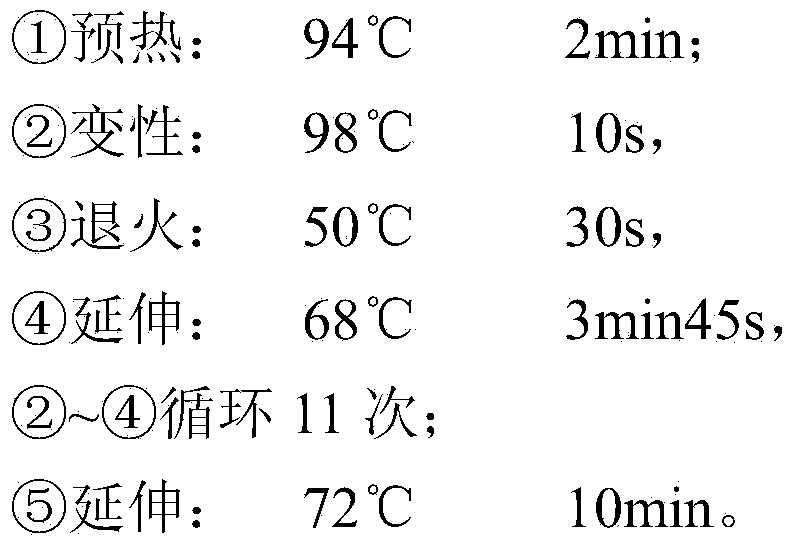
[0027] The Ser621 of penicillin G acylase was mutated to Gly, so oligo7 software was used to design blunt-end primers, and then PCR site-directed mutation was performed. This PCR mutation uses the KOD-Plus-Neo DNA polymerase kit (purchased from Toyobo Technology Co., Ltd., Shanghai). The base sequence of the primer is:
[0028] Ser-gly-F: 5’-GGGGCTCTGCCGCGTCTGGCTGGTGACG
[0029] Ser-gly-anti: 5’-CGCGGCAGAGCAGAGTCGATAGCA
[0030] The PCR reaction system is shown in Table 1.
[0031] Table 1 Site-directed mutagenesis reaction system
[0032] 10×reaction buffering
5μl
dNTPs (each 2mM)
5μl
Mg 2+ (25mM)
3μl
Template
1μl
Ser-gly-F (10mM)
1.5μl
Ser-gly-anti (10mM)
1.5μl
KOD enzyme (1U / μl)
1μl
ddH2O
32μl
Total
50μl
[0033] The template is a plasmid containing wild-type penicillin G acylase gene, which was commissioned to synthesize by the company. Among them, the plasmid vector is PET-28a, the wild-type penicillin G acylas...
Embodiment 2
[0042] Example 2 Expression and Purification of Penicillin G Acylase Mutant
[0043] 1. Expression of Penicillin G Acylase Mutant
[0044] The recombinant plasmid obtained in Example 1 was transformed into E. coli JM109 competent cells. After 10 hours, the growth of the bacteria was observed, the recombinant transformants were selected for activation, and the culture was expanded for translation and expression.
[0045] (1) Inoculate the recombinant transformants in 5ml of LB medium containing kanamycin (50μg / ml), and place them in a shaker at 37°C and 200rpm for shaking culture until the OD600 reaches about 0.4-0.5 to obtain seeds liquid.
[0046] (2) The seed solution was inoculated into the auto-induction medium at 1% of the inoculum, and cultivated at 25°C for 48 hours.
[0047] The auto-induction medium formula is: arabinose 3g / L, glucose 0.5g / L, glycerol 5g / L, peptone 10g / L, phosphate 6.8g / L, sulfate 1.2g / L, NH 4 Cl2.65g / L, MgSO 4 0.98g / L, CaCl 2 0.1g / L.
[0048] (3) The bacterial...
Embodiment 3
[0056] Example 3 Application of Penicillin G Acylase Mutant in the Synthesis of Cefprozil
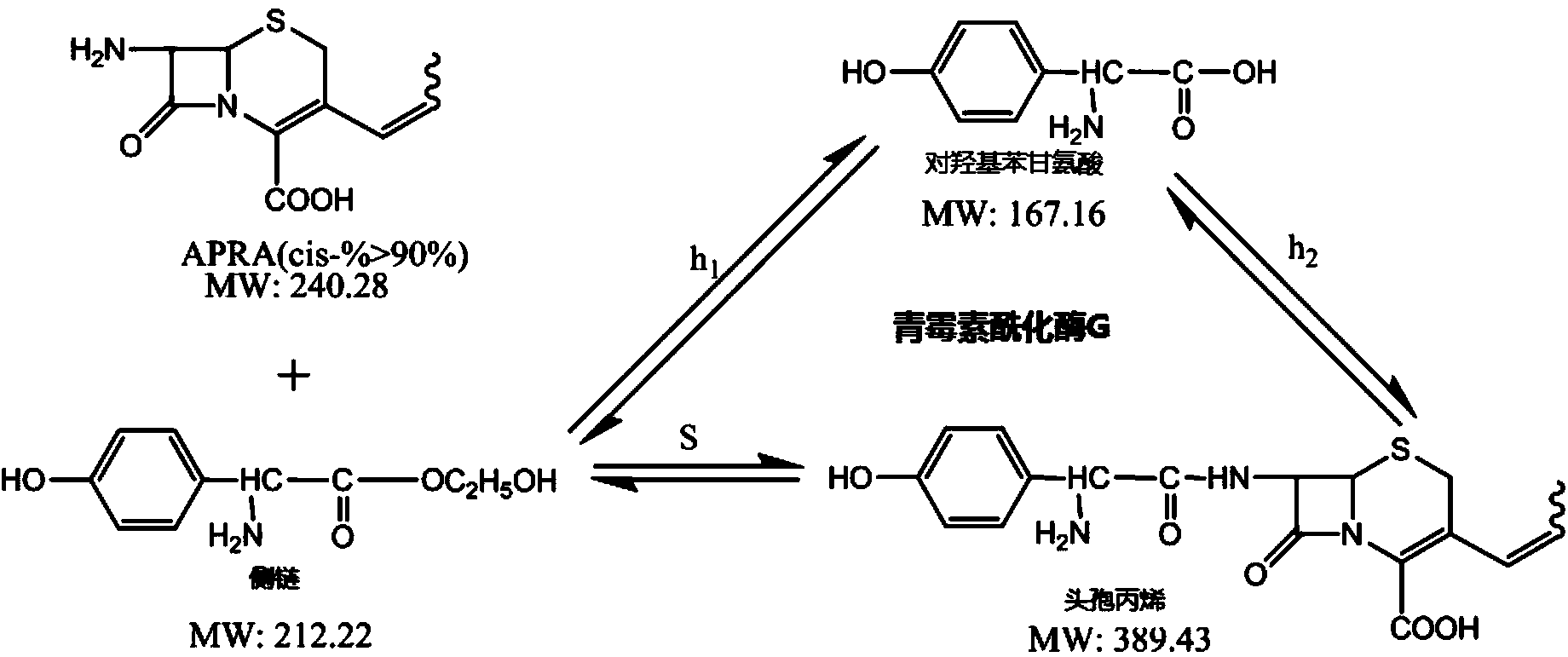
[0057] The technical solution adopted in this embodiment is as follows figure 2 Shown.
[0058] by figure 2 The reaction formula shows that penicillin G acylase can not only condense the nucleus and side chains to produce products, but also decompose the products to produce nuclei and side chains. The reversibility of the reaction depends on the equilibrium constant of the reaction. However, 2-hydroxyethyl p-hydroxyphenylglycinate itself can be decomposed into p-hydroxyphenylglycine, so it is of great significance to improve the synthetic activity of penicillin G acylase.
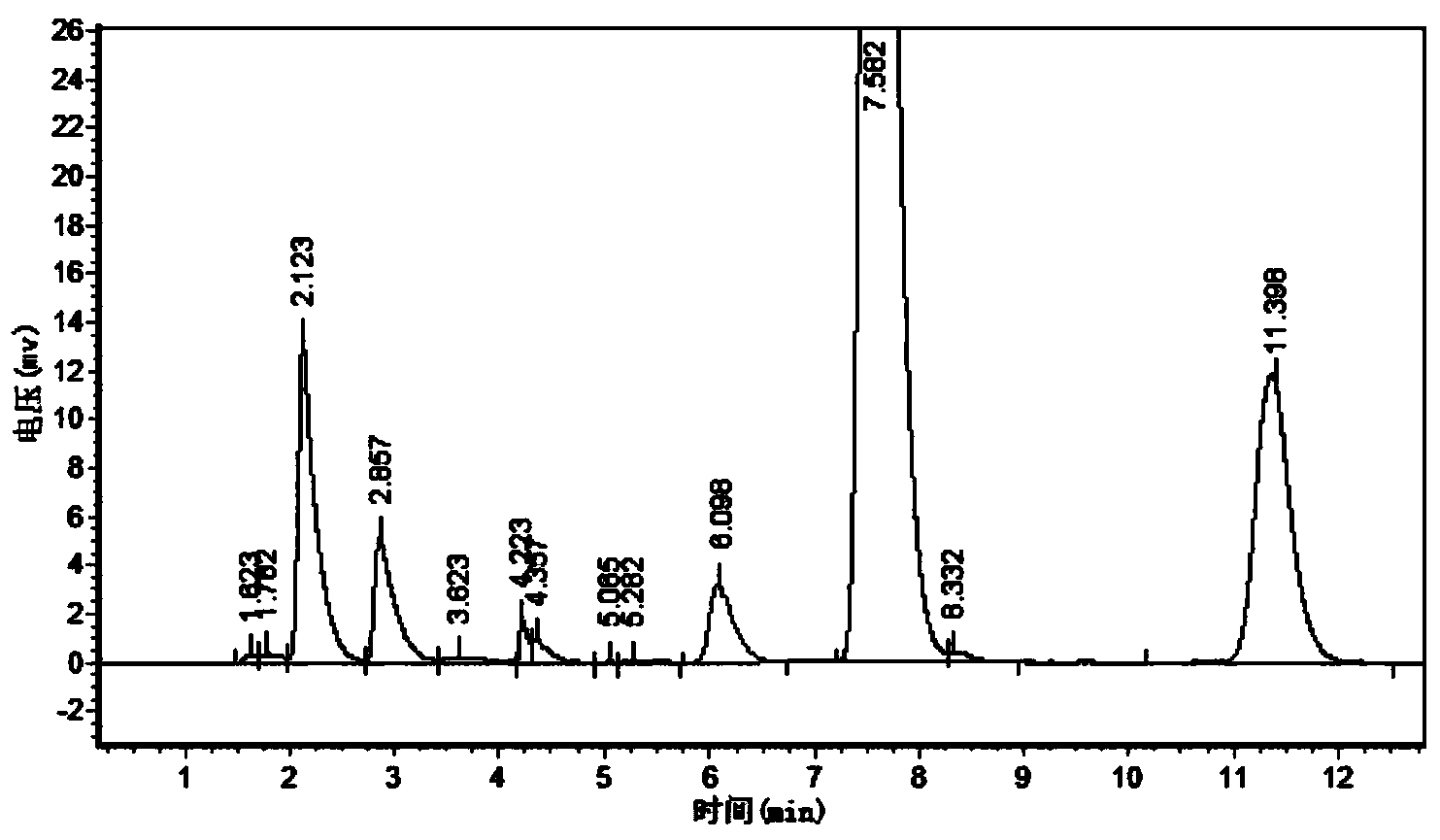
[0059] Reaction system: substrate solution (40mM 7-amino-3-[(Z)-allyl-1-yl]-3-cephalosporin-4-carboxylic acid (7-APRA, CAS number: 120709-09-3) , 40mM 2-hydroxyethyl p-hydroxyphenylglycinate (CAS number: 2030007-73-2)) 0.525ml, 0.1ml enzyme solution, 28℃ water bath reaction, after 20min, take 10μl reaction solution and d...
PUM
 Login to View More
 Abstract
Description
Claims
Application Information
 Login to View More