
High-water-solubility rhodamine-based polyion liquid and preparation method and application thereof
A polyionic liquid, ionic liquid technology, applied in color/spectral property measurement, organic chemistry, etc., can solve the problems of limited probe molecule loading, low probe molecule grafting rate, slow response rate, etc., to achieve the best application potential , Detect the effect of fast response speed and short response time
- Summary
- Abstract
- Description
- Claims
- Application Information
AI Technical Summary
Problems solved by technology
Method used
Image


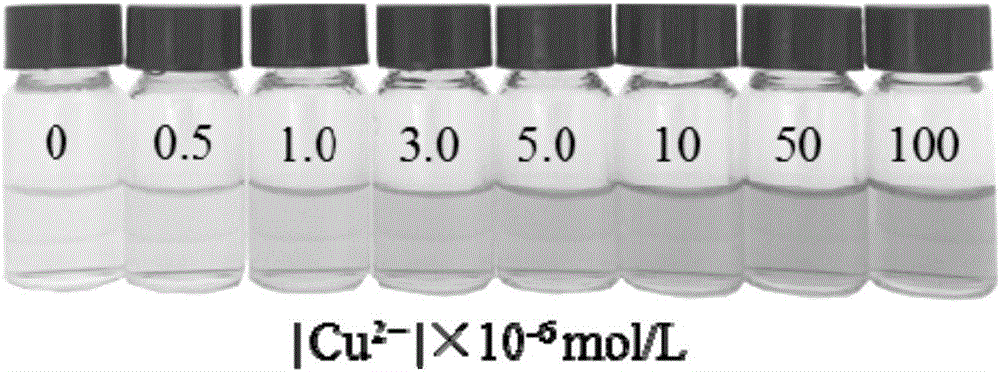
Examples
Embodiment 1
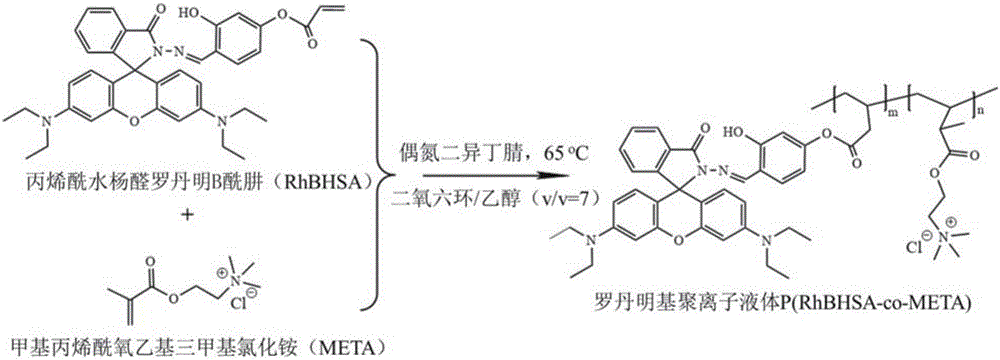
[0036] A highly water-soluble rhodamine-based polyionic liquid, the molecular structure of which is shown in Formula 1, where m / (n+m)=0.02-0.05, and the abbreviation is P(RhBHSA-co-META).
[0037]
[0038] Formula 1 Structural formula of highly water-soluble rhodamine-based polyionic liquid
[0039] The synthetic method of above-mentioned rhodamine-based polyionic liquid P (RhBHSA-co-META), main steps are as follows:
[0040] 1) Synthesis of RhBH: Dissolve 4.8g of rhodamine B (RhB) and 12mL of hydrazine hydrate in 130mL of absolute ethanol, heat to reflux at 80°C, react for 2.5h, cool to room temperature, and rotate to evaporate, then add water and adjust the pH to about 8.5 , suction filtered and washed with distilled water for purification, and vacuum dried to obtain RhBH, yield: 90.1%;
[0041] 2) Synthesis of RhBHS: 2.3g of rhodamine B hydrazide (RhBH) and 1.6g of 2,4-dihydroxybenzaldehyde were dissolved in 120mL of absolute ethanol, heated to 80°C and refluxed under n...
Embodiment 2
[0049] Determination of Functional Group Concentration of Rhodamine B Derivatives in Rhodamine-Based Polyionic Liquid P(RhBHSA-co-META)
[0050] Synthesized rhodamine derivative monomer RhBHSA and Cu in embodiment 1 2+ Dissolve in a mixed solvent (acetonitrile / water, v / v=3:1) to prepare 20μM RhBHSA and 20mM Cu 2+ The standard mother liquor (note, where Cu 2+ Large excess compared to RhBHSA).
[0051] Take 8 100mL volumetric flasks, dilute them to the standard solution with RhBHSA content of 10, 8, 6, 5, 4, 3, 2, 1 μM respectively, and carry out UV-Vis spectrophotometric test, and make a standard curve: A= 0.10694c-0.00118 (R 2 = 0.99993).
[0052] Synthesized rhodamine-based polyionic liquid P (RhBHSA-co-META) and Cu 2+ Dissolve in deionized water to make 100mg / L rhodamine-based polyionic liquid and 100mM Cu 2+ Aqueous solutions were subjected to UV-Vis spectrophotometric testing.
[0053] Combined with the calculation of the standard curve, it is determined that the mo...
Embodiment 3
[0055] Selectivity of rhodamine-based polyionic liquid P(RhBHSA-co-META) for colorimetric detection of copper ions
[0056] The rhodamine-based polyionic liquid P (RhBHSA-co-META) synthesized in Example 1 was dissolved in deionized water to form a 90 mg / L rhodamine-based polyionic liquid stock solution, and the rhodamine B derivative was measured in Example 2 The functional group concentration was 12.5 μM.
[0057] Take 16 5mL sample bottles, add 2mL rhodamine-based polyionic liquid stock solution, and then add 0.5mL 500μM Ag + 、Al 3+ 、Ba 2+ , Ca 2+ 、Cd 2+ 、Co 2+ 、Cr 2+ 、Cu 2+ 、K + , Mg 2+ , Mn 2+ 、Na + 、Ni 2+ , Pb 2+ , Zn 2+ and H 2 O, the final solution contains 72 mg / L of rhodamine-based polyionic liquid (the functional group concentration of rhodamine B derivatives is 10 μM) and 100 μM of one of the above metal ions. UV-visible spectrophotometric tests were carried out on the solutions to verify the selective detection effect of rhodamine-based polyionic li...
PUM
 Login to View More
 Abstract
Description
Claims
Application Information
 Login to View More