Method for electrochemical synthesis of N-acetyl-L-cysteine from L-cystine
A cysteine and cystine technology, applied in the field of organic electrochemical synthesis, can solve the problems of easy racemization of L-type amino acids, high L-cysteine content, increased cost and investment, etc., and achieve easy production and operation. , The effect of simple process and low production cost
- Summary
- Abstract
- Description
- Claims
- Application Information
AI Technical Summary
Problems solved by technology
Method used
Image

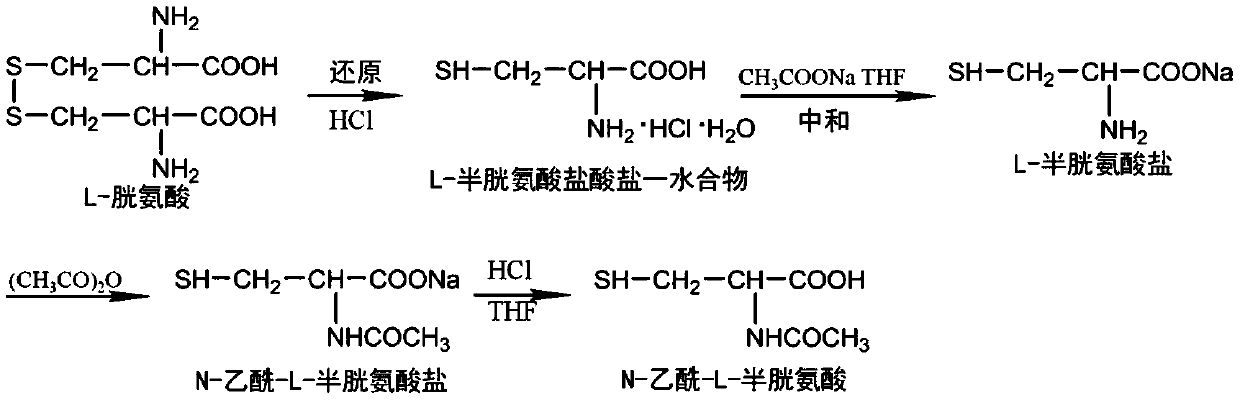

Examples
example 1
[0031] (1) Acetylation of L-cystine to prepare N,N'-diacetyl-L-cystine
[0032] Take 24g L-cystine and dissolve it in 250mL of 1mol L -1 In the sodium hydroxide solution, stir vigorously in an ice water (0°C) bath, then add 40mL of acetic anhydride dropwise, during the process of adding acetic anhydride, continuously add 1mol L -1 Sodium hydroxide, to keep the pH of the reaction solution at about 10, continue stirring for 30min after the addition of acetic anhydride, and then add 1.5mol L -1 hydrochloric acid to adjust the pH to 2. Put the reaction solution in an electrodialyzer to remove salt, when the conductivity of the dilute chamber reaches 500μS cm -1 The electrodialysis was stopped at the following time. Heat the desalinated solution to 60°C, stir and add activated carbon for decolorization, keep warm for 30 minutes for decolorization, and obtain a clear solution after filtration. The solution after electrodialysis was distilled under reduced pressure until all the ...
example 2
[0036] (1) Acetylation of L-cystine to prepare N,N'-diacetyl-L-cystine
[0037] Dissolve 24g of L-cystine into 125mL of 2mol L -1 In the sodium hydroxide solution, stir vigorously in an ice water (0°C) bath, then add 40mL of acetic anhydride dropwise, and continuously add 2mol L of acetic anhydride during the dropwise addition of acetic anhydride-1 Sodium hydroxide, to keep the pH of the reaction solution at about 10, continue stirring for 30min after the addition of the acid anhydride, and then add 3mol L -1 hydrochloric acid to adjust the pH to 2. Put the reaction solution in an electrodialyzer to remove salt, when the conductivity of the dilute chamber reaches 500μS cm -1 The electrodialysis is stopped at the following time. Heat the desalinated solution to 60°C, stir and add activated carbon for decolorization, keep warm for 30 minutes for decolorization, and obtain a clear solution after filtration. The electrodialysis solution was distilled under reduced pressure unti...
example 3
[0041] (1) Acetylation of L-cystine to prepare N,N'-diacetyl-L-cystine
[0042] Take 1200g L-cystine and dissolve it into 6.25L of 2mol L -1 Sodium hydroxide solution, then placed in a double-layer reactor, vigorously stirred in a circulating ice water (0°C) bath, then slowly added 1.5L of acetic anhydride, in the process of dropping acetic anhydride, continuously added 2mol L -1 Sodium hydroxide, to keep the pH of the reaction solution at about 10, continue stirring for 30min after the addition of the acid anhydride, and then add 3mol L -1 hydrochloric acid to adjust the pH to 2. Put the reaction solution in an electrodialyzer to remove salt, when the conductivity of the dilute chamber reaches 500μS cm -1 The electrodialysis is stopped at the following time. Heat the desalinated solution to 60°C, stir and add activated carbon for decolorization, keep warm for 30 minutes for decolorization, and obtain a clear solution after filtration. The electrodialysis solution was dist...
PUM
 Login to View More
 Abstract
Description
Claims
Application Information
 Login to View More
 - R&D
- Intellectual Property
- Life Sciences
- Materials
- Tech Scout
- Unparalleled Data Quality
- Higher Quality Content
- 60% Fewer Hallucinations
Browse by: Latest US Patents, China's latest patents, Technical Efficacy Thesaurus, Application Domain, Technology Topic, Popular Technical Reports.
© 2025 PatSnap. All rights reserved.Legal|Privacy policy|Modern Slavery Act Transparency Statement|Sitemap|About US| Contact US: help@patsnap.com