
Micro-nano structure formed by self-assembly of small organic molecule compounds and application of micro-nano structure
A technology of micro-nano structures and compounds, applied in the directions of non-active ingredients medical preparations, medical preparations containing active ingredients, organic chemistry, etc., can solve the problems of metabolic difficulties, toxicity, clinical development and application limitations, etc. The effect of light-to-heat conversion efficiency
- Summary
- Abstract
- Description
- Claims
- Application Information
AI Technical Summary
Problems solved by technology
Method used
Image

Examples
Embodiment 1
[0163] Synthesis and fluorescence properties of embodiment 1 compound II-1
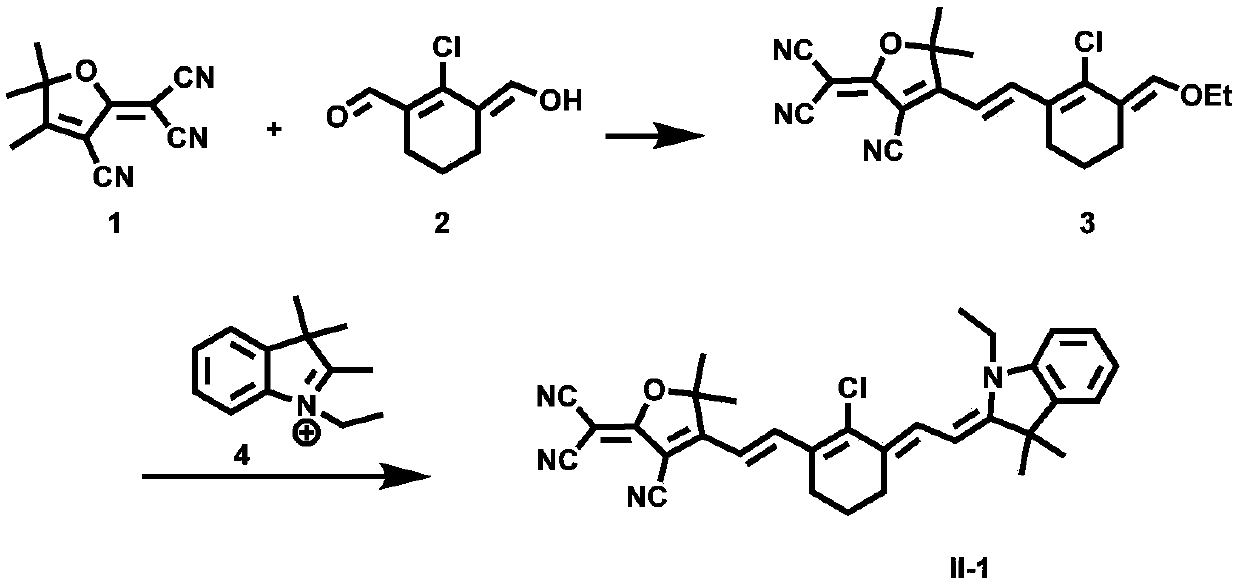
[0164] Such as figure 2 Shown, the synthesis of compound II-1 comprises the following steps:
[0165] 1) Synthesis of Compound 1: 0.97 g of malononitrile and 0.62 g of magnesium ethoxide were added to 10 mL of ethanol, and 0.5 mL of 3-hydroxy-3-methylbutan-2-one was added. Heated to 60°C for 12 hours. The solvent was distilled off under vacuum, and the obtained solid was the target compound 1 purified by column chromatography. 1 H NMR (400MHz, CDCl 3 ): δ (ppm): 2.36 (s, 3H), 1.63 (s, 6H).
[0166] 2) Synthesis of Compound 2: Add 20mL of dichloromethane and 20mL of DMF into the bottle under ice bath and stir, add 17.5mL of phosphorus oxychloride under constant pressure and stir, then add 5.3mL of cyclohexanone, heat to 80°C for 3 hours . After the reaction was complete, the product was poured into crushed ice to quench the reaction, and placed in the refrigerator overnight. The solvent was eva...
Embodiment 2
[0170] The synthesis of embodiment 2 compound Ⅱ-2 to Ⅱ-15
[0171] Compounds II-2 to II-15 can be prepared in a similar manner to Example 1.
[0172] 1. Synthesis of Compound Ⅱ-2
[0173]
[0174] Compound 5 was used to replace Compound 1 in Example 1, and the remaining reagents and preparation methods were the same as step 4) of Example 1 to prepare Compound II-2,
[0175] 1 HNMR (400MHz, CDCl 3 )δ:8.60-8.59(d,2H),8.13-8.10(d,1H),7.98-7.96(d,1H),7.30-7.28(d,2H),7.08-7.05(t,1H),6.86- 6.85(d,1H),6.36-6.33(d,1H),5.71-5.69(d,1H),3.87-3.72(q,2H),3.20-3.18(t,2H),2.60-2.57(t,4H ), 1.91-1.88(m,2H), 1.75(s,3H), 1.66(s,6H), 1.56-1.53(m,4H), 1.36-1.33(t,3H).
[0176] 2. Synthesis of Compound Ⅱ-3
[0177]
[0178] Compounds 1 and 4 in Example 1 were replaced by Compounds 5 and 6, and the remaining reagents and preparation methods were the same as Step 4 of Example 1), and Compound II-3 was prepared.
[0179] 1 HNMR (400MHz, CDCl 3 )δ:8.60-8.59(d,2H),8.13-8.10(d,1H),7.98-7....
Embodiment 3
[0228] The preparation method of embodiment 3 micro-nano structure
[0229] Taking the self-assembled micro-nano structure of compound II-1 as an example, dissolve II-1 in DMSO (or organic solvents such as ethanol) to make a 2mM storage solution, take a small amount of the storage solution and add it to deionized water to make it 20μM working fluid. Take 10 μL dropwise onto the silicon wafer, observe and take pictures under the transmission electron microscope (TEM) and atomic force microscope (AFM), the micro-nano structure in the form of vesicles can be clearly observed, and the attached Figure 5 That is the result of transmission electron microscope photography. From the observation results, it is found that the particle size of the micro-nano structure self-assembled by compound II-1 is about 30-150nm.
PUM
| Property | Measurement | Unit |
|---|---|---|
| particle diameter | aaaaa | aaaaa |
| particle diameter | aaaaa | aaaaa |
| photothermal conversion efficiency | aaaaa | aaaaa |
Abstract
Description
Claims
Application Information
 Login to View More