[0002] With the development of science and technology, frequency-using equipment in various fields is increasing, including high-
power frequency-using equipment. Especially in the military field, with the use of strong
electromagnetic pulse weapons and high-power frequency-using equipment, the location of equipment The
electromagnetic environment is becoming increasingly harsh; this high-intensity
radiation field (HIRF) interference may make the equipment unable to maintain normal work, not only that, it may also cause hard damage or even
scrap the equipment; therefore, through the electromagnetic radiation effect on the equipment Tests to evaluate the safety performance of equipment are becoming more and more urgent; the current requirements for
electromagnetic compatibility and
field strength test standards for electromagnetic
radiation sensitivity are constantly improving. GJB1389A-2005 pointed out that the harsh
electromagnetic environment faced by army helicopters is in the 2.7-3.6GHz
frequency band The internal peak
field strength may be as high as 27460V / m, and the peak
field strength exceeds 2000V / m in most frequency bands; usually, the
electromagnetic interference coupling channels of weaponry mainly include: antennas, cables, holes, shielding transmission, etc. ; Nowadays, most advanced weapon systems in various countries tend to be functionally integrated and complex, with various electronic devices all over the interior, and cables are often used to interconnect each device or subsystem to achieve
information transmission or
power transmission; the
interconnection system relies on cables As a result, the cable
coupling channel has become one of the weak links in the electromagnetic protection of the interconnection system; therefore, whether the
electromagnetic interference introduced by the interconnection cable
coupling will lead to the generation of electromagnetic effects must be evaluated in advance through the
strong field electromagnetic
environment effect test; however, the traditional Due to the limitations of the full-level electromagnetic radiation test method, it is unrealistic to simulate such a high-field electromagnetic environment under current laboratory conditions, and it is even more difficult to simulate a large spatial range; how to Responding to the contradiction between the laboratory electromagnetic environment
simulation conditions and the
electromagnetic compatibility test requirements is the top priority in the research of electromagnetic radiation effect testing; in this context, the method of using current injection to replace
radiation sensitivity came into being, and It has gradually been applied and developed in many fields; however, the current current injection method is mainly used for conduction
sensitivity test, and there are relatively few studies on its use in equivalent
radiation sensitivity test; the current injection method mainly includes large current injection ( BCI) method,
direct current injection (DCI) method and pulsed current injection (PCI) method, etc.; BCI is a common mode injection method using a ferrite injection probe, and the interference
signal is first coupled to the interconnection cable through the injection probe, and further The EUT coupled to the cable terminal in a conductive manner; as a conductive susceptibility test method, BCI has been widely accepted, especially in the military and automotive industries; A series of test methods for electromagnetic safety
verification; Among them, for the case where the cable is the coupling path, it is proposed to use the large current injection method (BCI) to carry out the equivalent test; the current injection method has the advantages of high efficiency and good
repeatability, and can be used in a certain Under the limited conditions, this method has high
engineering application value; however, this method also has its own problems, the most important of which is about the nonlinear response of the
equipment under test (EUT). The method of linear extrapolation of the relationship between induced currents may lead to large errors in the test; usually, only one BCI injection probe is used on the same interconnection cable in the test of BCI used for radiation susceptibility assessment; this kind of test The configuration is suitable for the case where only one end of the interconnection cable is connected to the EUT, and the other end of the cable is connected to auxiliary equipment, and its electromagnetic susceptibility generally does not need to be assessed; however, sometimes the electromagnetic susceptibility of the equipment at both ends of the cable needs to be assessed at the same time. If only one injection probe is used, it is impossible to ensure that the response of the
equipment under test at both ends can be consistent with the radiation test under general conditions; to solve this problem, SergioPignari et al. proposed a double-ended
high current injection technology; this technology is in An injection probe is connected to each end of the cable. By controlling the amplitude and
phase difference of the two injection
voltage sources, it can ensure that the response of the equipment at both ends of the cable is consistent with the radiation time; this method obtains the parameters of the injection source through calculation, so the test results The accuracy largely depends on whether the relevant system parameter values can be accurately known in advance, and these parameters are difficult to obtain accurately in
engineering tests; in addition, the existing double-terminal
high current injection technology still does not consider how to generate In the case of nonlinear response, the equivalent of strong
electric field radiation effect test is realized; parallel twin wires and
twisted pair wires are commonly used cables in
engineering, how to carry out high current injection equivalent for the two-wire interconnection system where the equipment at both ends is nonlinear
Strong field radiation effect test is a key technical problem to be solved



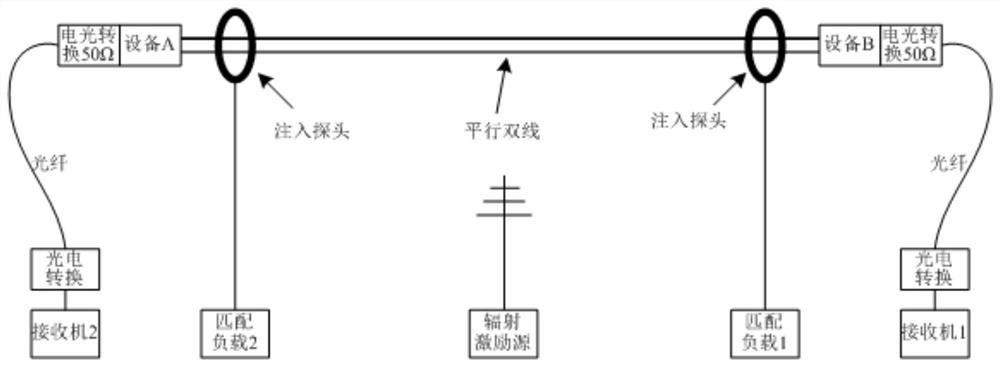
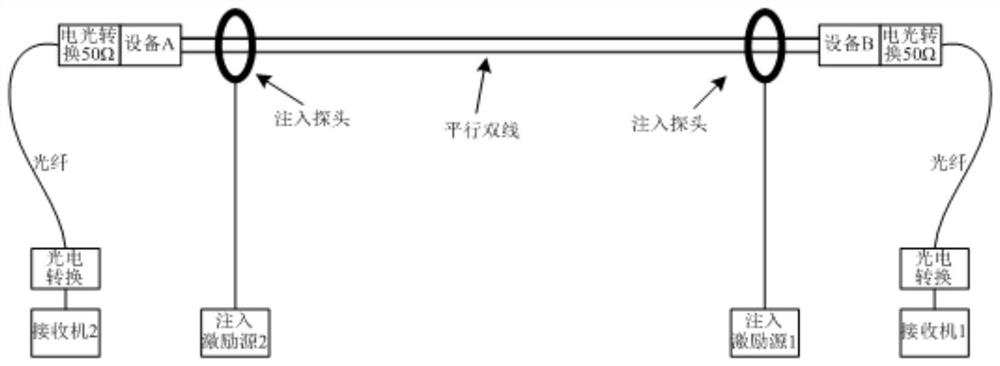
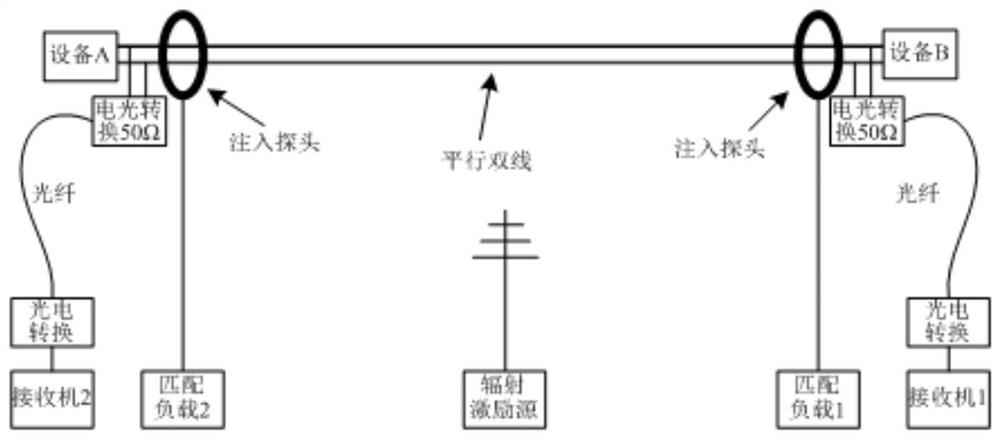
 Login to View More
  Login to View More