
High-efficiency single-frequency thulium-doped fiber laser based on in-band pumping
A fiber laser, high-efficiency technology, applied in the direction of lasers, laser components, phonon exciters, etc., can solve the problems of difficulty in improving laser efficiency, low absorption cross-section, and difficulty in achieving it, so as to achieve convenient and high-efficiency Absorption coefficient, effect of reducing thermal deposition
- Summary
- Abstract
- Description
- Claims
- Application Information
AI Technical Summary
Problems solved by technology
Method used
Image

Examples
Embodiment 2
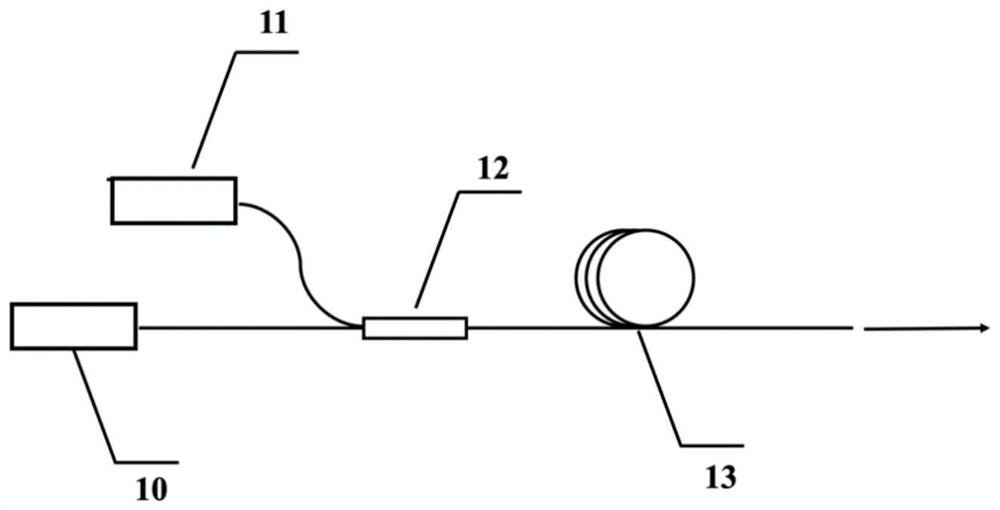
[0043] In the above-mentioned embodiment 1, the pump laser 5 is a Raman laser amplifier, see image 3 , including a 1650nm single-mode semiconductor laser 10, a Raman pump source 11, a pump coupling device 12, and a second Raman fiber 13.
[0044] Preferred 1650nm single-mode semiconductor laser 10 center wavelength 1650nm, output power 10mW; Raman pump source 11 is a 1570nm fiber laser, pigtail SMF-28 optical fiber, center wavelength 1570nm maximum output power 10W; Pump coupling device 12 is 1650 / 1570nm wavelength division multiplexer, the maximum withstand power is 5W, the pigtail type is SMF-28, and the insertion loss is <0.5dB; the second Raman fiber 13 is SMF-28 ordinary single-mode fiber, and the length is 2km.
[0045] Further, the output laser of 1650nm single-mode semiconductor laser 10 is injected into the second Raman optical fiber 13 to provide the laser seed needed for Raman amplification; In the Raman fiber 13 , the second Raman fiber 13 provides Raman gain, s...
PUM
| Property | Measurement | Unit |
|---|---|---|
| reflectance | aaaaa | aaaaa |
| reflectance | aaaaa | aaaaa |
| reflection | aaaaa | aaaaa |
Abstract
Description
Claims
Application Information
 Login to View More