Unlock instant, AI-driven research and patent intelligence for your innovation.

Preparation method of bionic bone tissue engineering scaffold capable of resisting inflammation and promoting bone defect repair

A technology of tissue engineering scaffold and bionic bone, which is applied in tissue regeneration, prosthesis, medical science, etc., can solve the problems affecting the efficiency of bone repair, limit the application of bioactive materials for bone repair, etc., and reduce the possibility of immune rejection, Strengthen the ability of osteogenesis and inflammation elimination, and promote the effect of bone repair

Active Publication Date: 2022-05-20
FUZHOU UNIV
View PDF11 Cites 0 Cited by
  • Summary
  • Abstract
  • Description
  • Claims
  • Application Information

AI Technical Summary

Problems solved by technology

These two points seem insignificant, but they really affect the efficiency of bone repair and limit the application of bioactive materials for bone repair

Method used

the structure of the environmentally friendly knitted fabric provided by the present invention; figure 2 Flow chart of the yarn wrapping machine for environmentally friendly knitted fabrics and storage devices; image 3 Is the parameter map of the yarn covering machine
View more

Image

Smart Image Click on the blue labels to locate them in the text.
Viewing Examples
Smart Image
  • Preparation method of bionic bone tissue engineering scaffold capable of resisting inflammation and promoting bone defect repair
  • Preparation method of bionic bone tissue engineering scaffold capable of resisting inflammation and promoting bone defect repair
  • Preparation method of bionic bone tissue engineering scaffold capable of resisting inflammation and promoting bone defect repair

Examples

Experimental program
Comparison scheme
Effect test

Embodiment 1

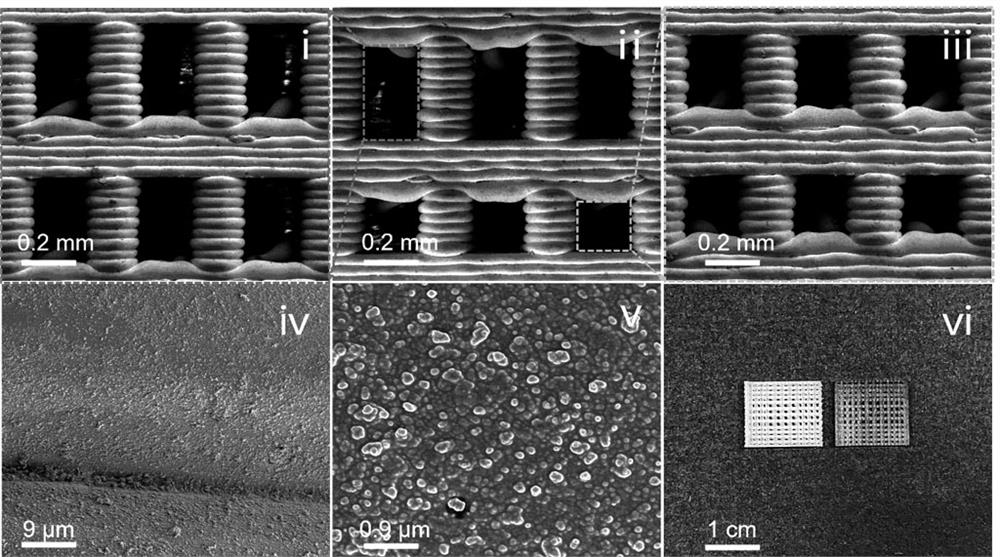
[0044] Embodiment one: if Figure 1~13 As shown, a method for preparing a bionic bone tissue engineering scaffold capable of anti-inflammation and promoting bone defect repair, comprising the following steps:

[0045] (1) Through the modeling software Rhino modeling, the gradient pore structure of cortical bone-cancellous bone of natural bone is simulated to obtain a three-dimensional model.

[0046] (2) Polylactic acid scaffolds with biomimetic gradient pore diameters were prepared by a fused deposition 3D printer, and the gradient pore diameters of the polylactic acid scaffolds were 200 μm and 500 μm, respectively.

[0047] (3) Soak the polylactic acid scaffold in the polydopamine solution to obtain the polydopamine-polylactic acid scaffold; the specific operation is: soak the polylactic acid scaffold in the polydopamine solution with a concentration of 1 mg / mL at room temperature, and add Stir at the speed of rpm for 12 h, then repeatedly wash the polydopamine-coated polyl...

Embodiment 2

[0066] Embodiment 2: A method for preparing a bionic bone tissue engineering scaffold capable of anti-inflammation and promoting bone defect repair, comprising the following steps:

[0067] (1) Through the modeling software Rhino modeling, the gradient pore structure of cortical bone-cancellous bone of natural bone is simulated to obtain a three-dimensional model.

[0068] (2) Polylactic acid scaffolds with biomimetic gradient pore sizes were prepared by a fused deposition 3D printer, and the gradient pore sizes of the polylactic acid scaffolds were 150 μm and 450 μm, respectively.

[0069] (3) Soak the polylactic acid scaffold in the polydopamine solution to obtain the polydopamine-polylactic acid scaffold; the specific operation is: soak the polylactic acid scaffold in the polydopamine solution with a concentration of 1 mg / mL at room temperature, and add Stir at the speed of rpm for 12 h, then repeatedly wash the polydopamine-coated polylactic acid stent with deionized water...

Embodiment 3

[0076] Embodiment 3: A method for preparing a bionic bone tissue engineering scaffold capable of anti-inflammation and promoting bone defect repair, comprising the following steps:

[0077] (1) Through the modeling software Rhino modeling, the gradient pore structure of cortical bone-cancellous bone of natural bone is simulated to obtain a three-dimensional model.

[0078] (2) Polylactic acid scaffolds with biomimetic gradient pore diameters were prepared by a fused deposition 3D printer, and the gradient pore diameters of the polylactic acid scaffolds were 200 μm and 500 μm, respectively.

[0079] (3) Soak the polylactic acid stent in the polydopamine solution to obtain the polydopamine-polylactic acid stent; the specific operation is: at room temperature, soak the polylactic acid stent in the polydopamine solution with a concentration of 0.5 mg / mL, and run at 300 rpm The speed was stirred for 12 h, and then the polydopamine-coated polylactic acid stent was repeatedly washed ...

the structure of the environmentally friendly knitted fabric provided by the present invention; figure 2 Flow chart of the yarn wrapping machine for environmentally friendly knitted fabrics and storage devices; image 3 Is the parameter map of the yarn covering machine
Login to View More

PUM

PropertyMeasurementUnit
Apertureaaaaaaaaaa
Concentrationaaaaaaaaaa
Login to View More

Abstract

The invention relates to a preparation method of a bionic bone tissue engineering scaffold capable of resisting inflammation and promoting bone defect repair, which comprises the following steps: preparing a polydopamine-polylactic acid scaffold through a fused deposition 3D printing technology and a surface coating mode, and injecting a methacrylic acid gelatin prepolymer, a black phosphorus nanosheet solution and a manganese carbonyl methanol mixed solution into the scaffold to prepare the bionic bone tissue engineering scaffold capable of resisting inflammation and promoting bone defect repair. And carrying out ultraviolet crosslinking to obtain the bionic multifunctional bone tissue engineering scaffold. The 3D printing technology is introduced into the field of bone tissue engineering scaffolds, the microstructure of compact bone-cancellous bone of bionic bone tissue is facilitated, and multi-layer structure bionics of the scaffolds are achieved. The black phosphorus nanosheet is added, so that the uniform distribution of calcium phosphate is enhanced by the black phosphorus at the defect part through the biomineralization effect, and the bone formation inducing capability is enhanced. The introduced manganese carbonyl can react with hydrogen peroxide in an acidic microenvironment of a bone defect part to form carbon monoxide gas, so that gas treatment of inflammation is realized.

Description

technical field [0001] The invention belongs to the technical field of biomaterials, in particular to a method for preparing a bionic bone tissue engineering scaffold capable of anti-inflammation and promoting bone defect repair. Background technique [0002] With the acceleration of urbanization and the increasingly serious problem of population aging, the number of patients with bone defects caused by osteoarthritis, external trauma and primary tumors is increasing, which not only increases the burden of life for patients, but also threatens The safety of patients' lives also makes bone defect repair one of the most difficult clinical problems to solve. As a living tissue, although the bone has the ability to heal itself, there is a critical bone defect for the bone. When the defect exceeds this range, it cannot fully repair itself. Today, the main strategies for bone repair include metallic bone grafts, autologous bone grafts, and allogeneic bone grafts, all of which are...

Claims

the structure of the environmentally friendly knitted fabric provided by the present invention; figure 2 Flow chart of the yarn wrapping machine for environmentally friendly knitted fabrics and storage devices; image 3 Is the parameter map of the yarn covering machine
Login to View More

Application Information

Patent Timeline
no application Login to View More
IPC IPC(8): A61L27/22A61L27/18A61L27/02A61L27/12A61L27/50A61L27/54A61L27/56
CPCA61L27/18A61L27/222A61L27/12A61L27/025A61L27/56A61L27/50A61L27/54A61L2430/02A61L2300/41A61L2300/108A61L2300/102C08L67/04C08L79/04
Inventor 魏伟胜阮任杰张进童冬梅王子义
Owner FUZHOU UNIV
Features
  • R&D
  • Intellectual Property
  • Life Sciences
  • Materials
  • Tech Scout
Why Patsnap Eureka
  • Unparalleled Data Quality
  • Higher Quality Content
  • 60% Fewer Hallucinations
Social media
Patsnap Eureka Blog
Learn More