Unlock instant, AI-driven research and patent intelligence for your innovation.

Fluorescence detection method for copper ions

A fluorescence detection and copper ion technology, applied in the field of analysis and detection, can solve the problems that the system to be tested is easily polluted, the solid particles are not easy to be recovered, and the cost of the fluorescent probe is high, and achieves favorable fluorescence detection performance, good fluorescence detection performance, and method. Simple and easy effects

Pending Publication Date: 2022-05-31
HEBEI UNIV OF TECH
View PDF0 Cites 0 Cited by
  • Summary
  • Abstract
  • Description
  • Claims
  • Application Information

AI Technical Summary

Problems solved by technology

When performing fluorescence detection in the liquid phase, due to the influence of solvation, the detection performance is limited, and there are also disadvantages such as a large amount of waste liquid and easy contamination of the system to be tested.
Adding solid particles into the liquid phase can increase the fluorescence intensity, but there are disadvantages such as easy sedimentation of solid particles, reduced uniformity of the liquid phase, affecting detection performance, and difficult recovery of solid particles.
Although the synthesis of new fluorescent probes can improve the detection performance, there are defects of high cost and poor stability of fluorescent probes, and there are still shortcomings of liquid phase detection.

Method used

the structure of the environmentally friendly knitted fabric provided by the present invention; figure 2 Flow chart of the yarn wrapping machine for environmentally friendly knitted fabrics and storage devices; image 3 Is the parameter map of the yarn covering machine
View more

Image

Smart Image Click on the blue labels to locate them in the text.
Viewing Examples
Smart Image
  • Fluorescence detection method for copper ions
  • Fluorescence detection method for copper ions
  • Fluorescence detection method for copper ions

Examples

Experimental program
Comparison scheme
Effect test

Embodiment 1

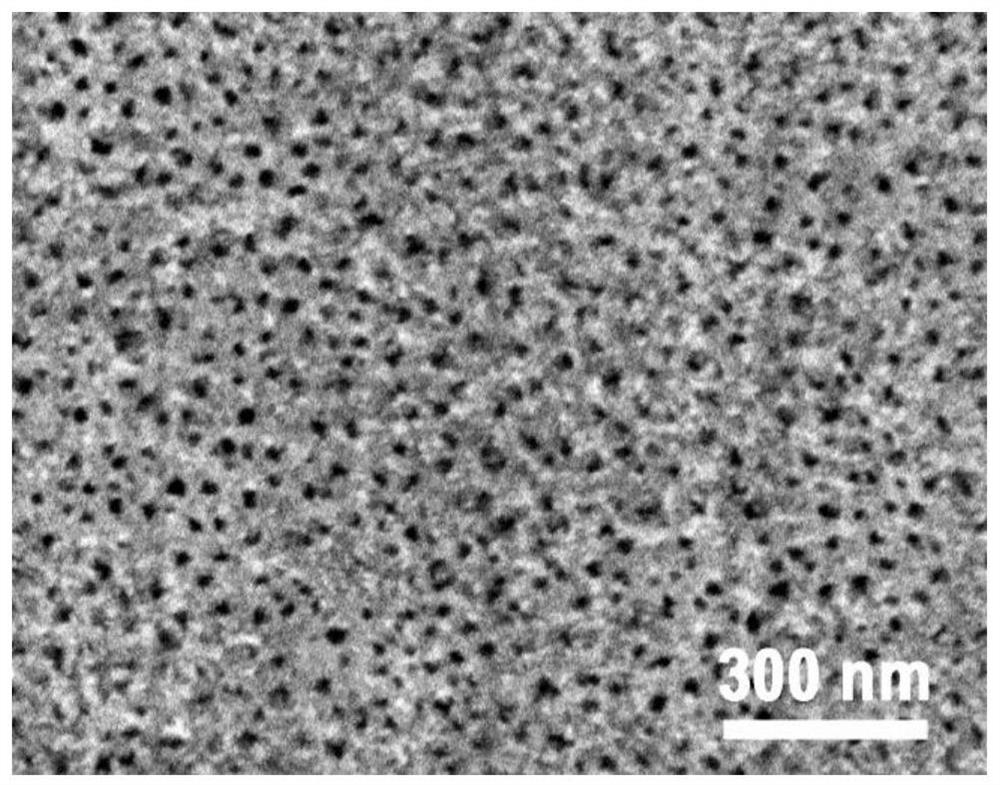
[0040] (1) The zirconium sheet (15mm×30mm×0.2mm) was ultrasonically cleaned with ethanol and deionized water. Weigh 0.1 g of ammonium fluoride and 13.2 g of ammonium sulfate, add 86.7 g of deionized water, stir and dissolve, and prepare an electrolyte. Insert the 20 mm of the lower end of the zirconium sheet into the electrolyte, use the zirconium sheet as the anode, and use the platinum sheet as the cathode, and anodize at 40°C and 30V for 3 hours. After the reaction, the sample was washed with deionized water, dried, and calcined at 500°C for 2 hours to obtain a zirconia nanotube array film (ZNAF), whose surface morphology was as follows: figure 1 shown. It can be seen from the figure that the surface of ZNAF is flat, the structure is uniform, the diameter of the tube is small (about 25nm), and the distance between the tube openings is relatively large.

[0041] (2) Add γ-aminopropyltriethoxysilane into 90% (volume percent) ethanol, stir and dissolve evenly, and prepare an...

Embodiment 2

[0050] (1) ZNAF was prepared with the same process conditions and steps as in Example 1 (1), and was calcined at 400° C. for 2 hours.

[0051] (2) use gamma-aminopropyltrimethoxysilane and 95% (volume percentage) ethanol preparation concentration to be the amino coupling agent solution of 0.5M, other conditions and steps are prepared ZNAF-NH with embodiment 1 (2) 2 .

[0052] (3) Prepare the detection sample sheet with 15 mg / L Rhodamine B solution, and perform the fluorescence detection of copper ions with the same process steps as in Example 1 (3).

Embodiment 3

[0054] (1) ZNAF was prepared with the same process conditions and steps as in Example 1 (1), and calcined at 600° C. for 1 hour.

[0055] (2) use gamma-aminopropyltriethoxysilane and 85% (volume percent) ethanol preparation concentration to be the amino coupling agent solution of 0.01M, other conditions and steps are prepared ZNAF-NH with embodiment 1 (2) 2 .

[0056] (3) Use 5 mg / L rhodamine B solution to prepare test samples, and perform fluorescence detection of copper ions with the same process steps as in Example 1 (3).

the structure of the environmentally friendly knitted fabric provided by the present invention; figure 2 Flow chart of the yarn wrapping machine for environmentally friendly knitted fabrics and storage devices; image 3 Is the parameter map of the yarn covering machine
Login to View More

PUM

No PUM Login to View More

Abstract

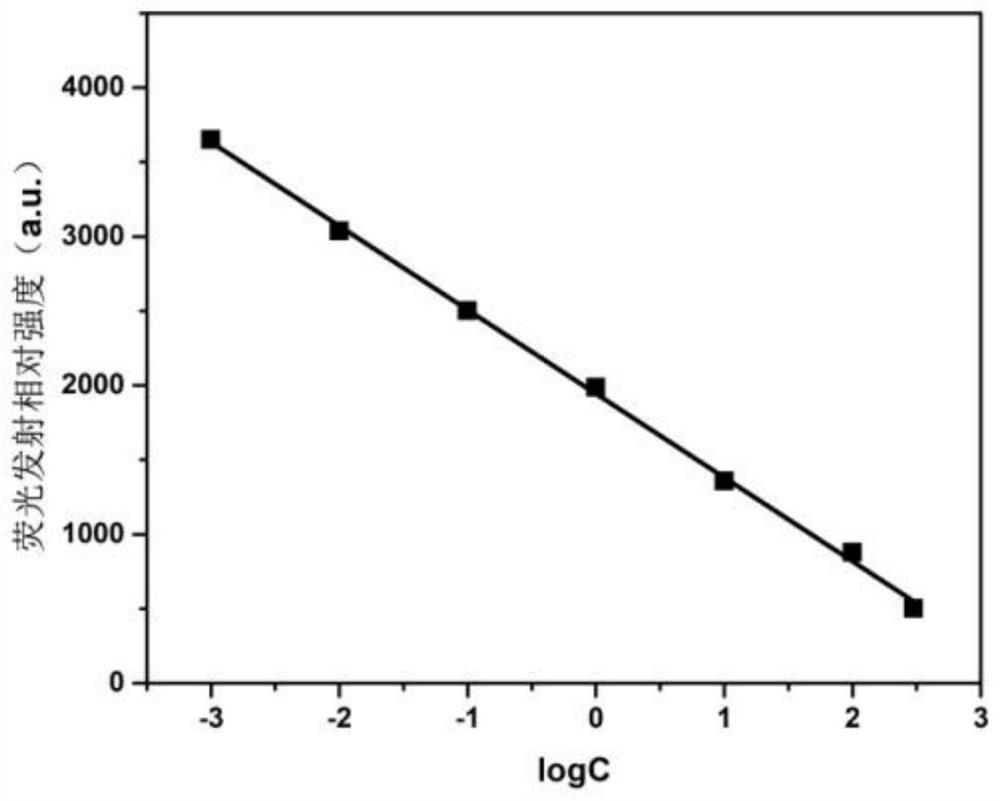
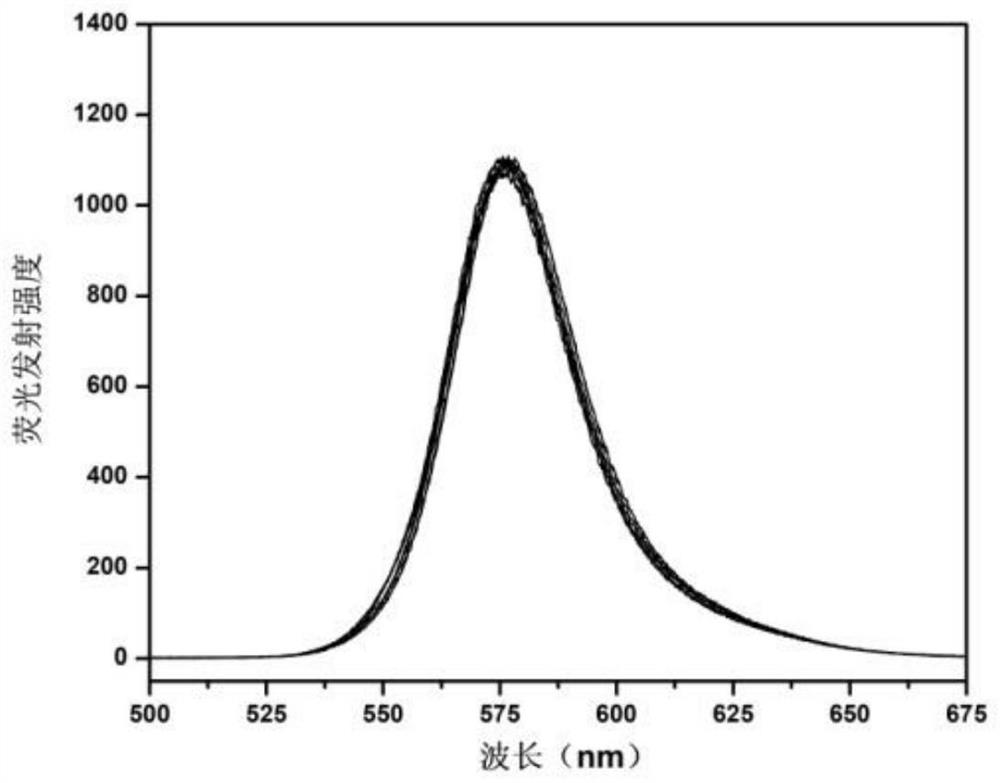
The invention relates to a fluorescence detection method for copper ions. According to the method, an amino-functionalized zirconium dioxide nanotube array film is used as a carrier, rhodamine B is used as a fluorescent probe, copper ions and rhodamine B are immobilized on the amino-functionalized zirconium dioxide nanotube array film carrier to prepare a detection sample, and the copper ions can be detected by testing the fluorescence intensity of the detection sample. The method is simple and easy to implement, good in detection performance, low in cost and small in waste liquid amount, and the amino-functionalized zirconium dioxide nanotube array film carrier can be regenerated and reused.

Description

technical field [0001] The invention belongs to the technical field of analysis and detection, in particular to a fluorescence detection method for copper ions. Background technique [0002] Because heavy metal elements are widely used in many fields, a large number of heavy metal ions enter the water body, causing heavy metal ion pollution, which will cause serious harm to human health, animals and plants. For example, copper is an important component of human health and many biological tissues. This micronutrient element plays a vital role in bone formation, cellular respiration, and synthesis of hemoglobin and elastin; however, if copper ions cannot maintain At appropriate physiological concentrations, it can cause serious syndromes such as osteoporosis, Wilson's disease and Alzheimer's disease. [0003] The detection of heavy metal ions is the basis for preventing and controlling heavy metal ion pollution. Therefore, it is of great significance to detect copper ions. ...

Claims

the structure of the environmentally friendly knitted fabric provided by the present invention; figure 2 Flow chart of the yarn wrapping machine for environmentally friendly knitted fabrics and storage devices; image 3 Is the parameter map of the yarn covering machine
Login to View More

Application Information

Patent Timeline
no application Login to View More
IPC IPC(8): G01N21/64
CPCG01N21/643G01N2021/6432
Inventor 赵建玲刘东鑫王西新李奉霖刘冬
Owner HEBEI UNIV OF TECH