
N-terminal modified recombinant human endostatin and its production
a technology of human endostatin and n-terminal modification, which is applied in the direction of angiogenin, peptide/protein ingredients, peptide sources, etc., can solve the problems of hardly refolding into soluble form, writer's inability to give satisfactory explanation, and 99% of protein loss during protein refolding, etc., to achieve better in vivo stability, reduce clearance rate, and increase half-life
- Summary
- Abstract
- Description
- Claims
- Application Information
AI Technical Summary
Benefits of technology
Problems solved by technology
Method used
Image

Examples
example 1
[0134] Construction of the N-Terminal Modified rhEndostatin
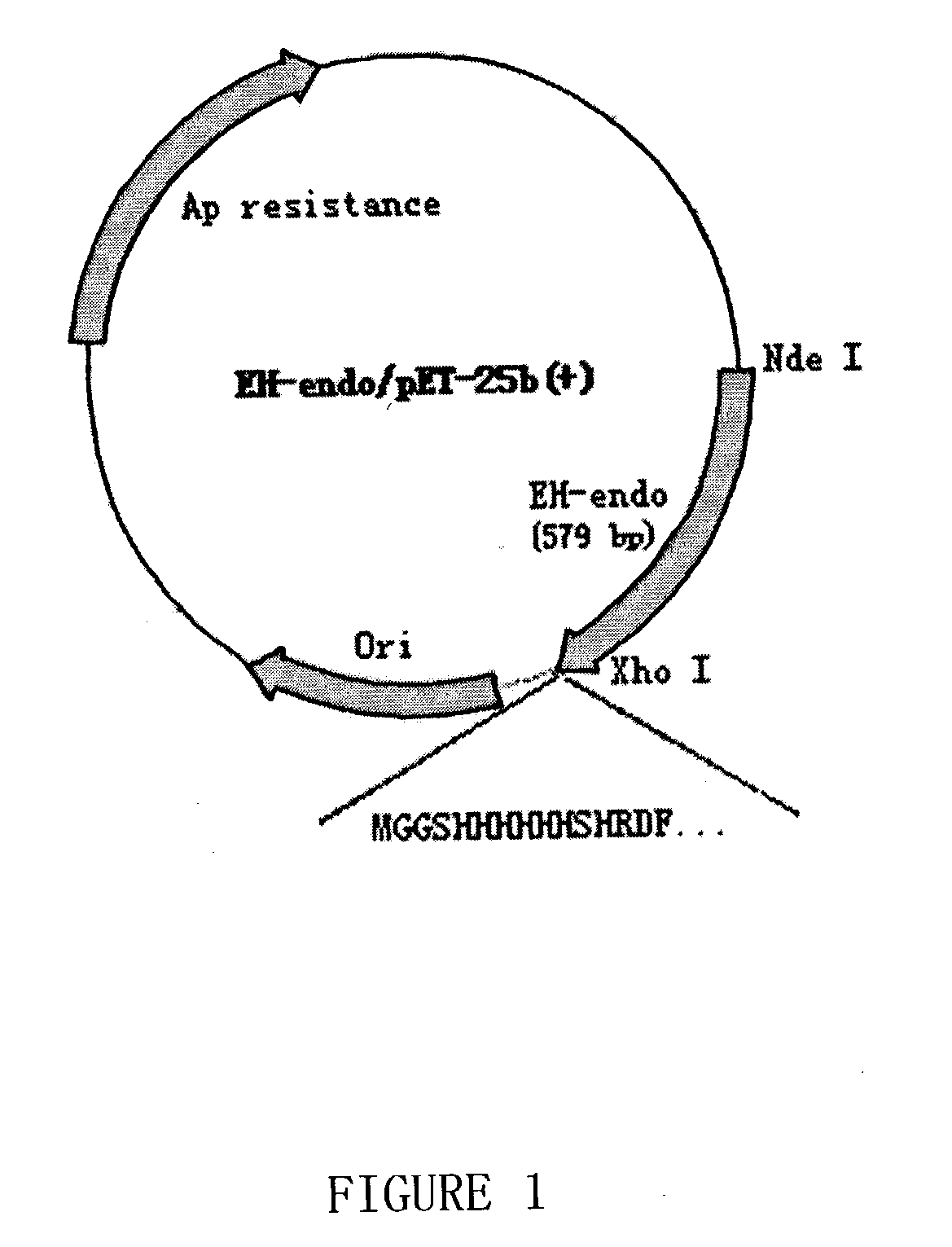
[0135] Based on known amino acid sequence of endostatin protein and intended additional N-terminal sequence, PCR primers were designed and synthesed to amplify endostatin-coding DNA sequence from human liver cDNA library (Invitrogen) using Pfu DNA polymerase (Stratagene). The forward primer includes the following additional sequence CATATGGGGGGTTCTCATCACCA-TCACCATCAC (SEQ ID NO:3), introducing an NdeI site and another 27 nucleotides that together code for 10 additional amino acids in front of native endostatin. The reverse primer CTCGAGCTACTTGGAGGCAGTCATGAAGC (SEQ ID NO:4), which can anneal to the sequence at the end of endostatin, has an introduced XhoI site. PCR reaction was performed as 94.degree. C., 1' for denaturation, 60.degree. C., 1' for annealing and 72.degree. C., 1'30" for extension, and for 30 cycles all together.
[0136] After amplification, QIAquick PCR product purification kit (Qiagen) was used to purify the am...
example 2
[0137] Expression and Purification of the Modified rhEndostatin with the Additional N-Terminal Sequence
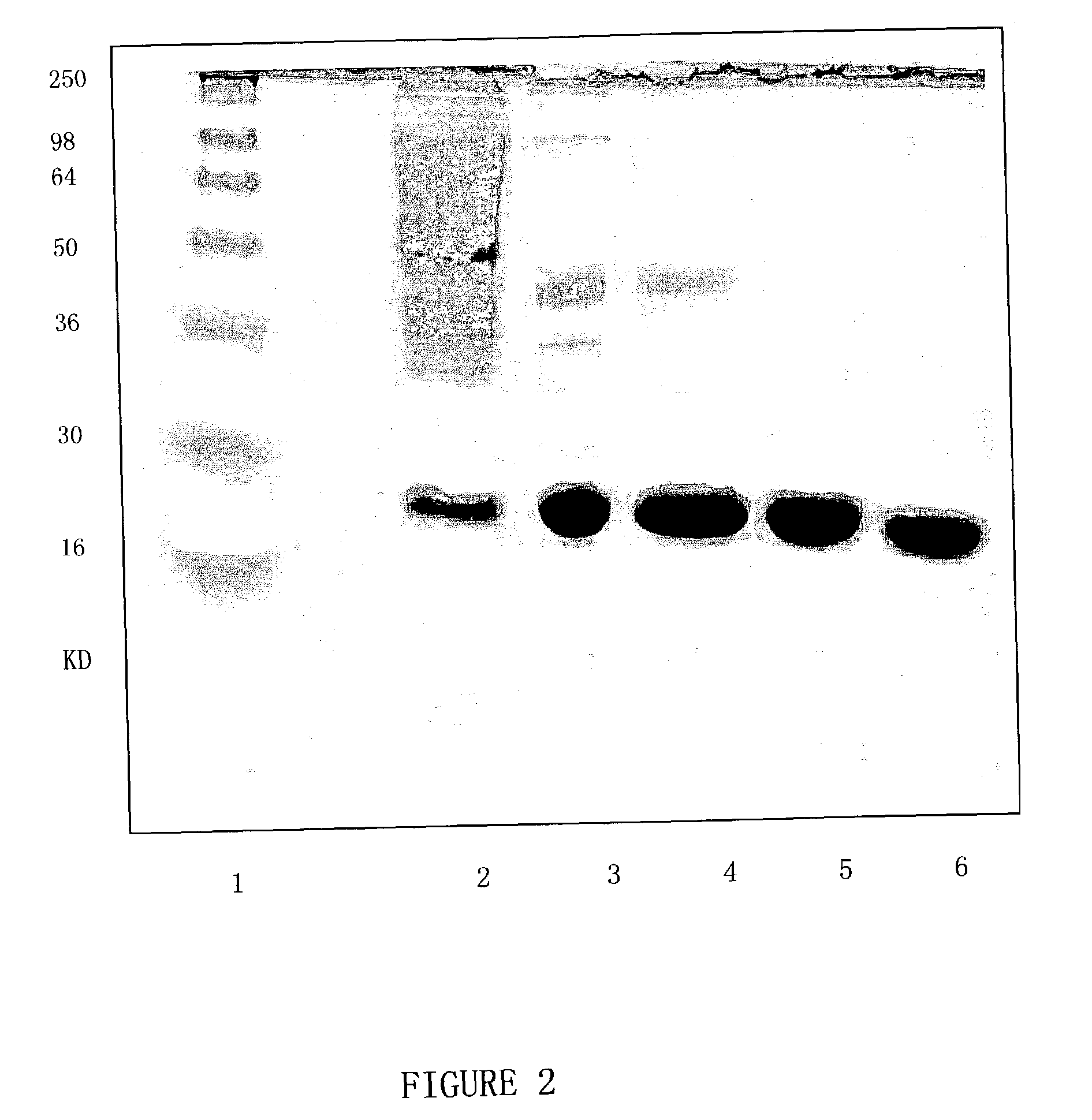
[0138] EH-ENDO / pET25B transformed BL21(DE3) clone was inoculated in a flask with LB medium and grown in 37.quadrature. shaker. After enough bacteria was obtained, this bacteria was seeded into 20 liter fermentor for further incubation. When OD.sub.600 reached about 10, the bacteria was again transferred to 300 liter fermentor and grew until OD reached about 30. 1 mM isopropyl-beta-D-thiogalactoside (IPTG) was added to induce expression of the protein. After 3-4 hours, the bacterial cells were pelleted and resuspended in a buffer supplemented with 8 M urea, 10 mM Tris-HCl (pH 8) and 100 mM sodium phosphate and incubated for an hour at room temperature.
[0139] Mechanical method was used to disrupt the bacterial cells. Inclusion body was obtained with centrifugation (20,000 g, 20 minutes) and was washed with deoxycholic acid that contains 2% Triton X-100. Inclusion body was dissolved i...
example 3
[0143] Construction of Native rhEndostatin in Yeast Expression System, its Expression and Purification
[0144] Briefly, the sequence encoding human endostatin was amplified by PCR using Taq DNA polymerase (Stratagene), forward PCR primer (5'-CGCTCGAGAAAAGAAGCCCACCCGCCCACAGCCA-3') ( SEQ ID NO:5 ) containing a linker with XhoI site, and reverse primer (5'-GTCAGGATCCTTACTTGGAGGCAGTCA-TGA-3') ( SEQ ID NO:6 ) containing a linker with BamHI site, respectively, and liver cDNA (Invitrogen) as template. After purification with QIAquick PCR Kit according to manufactured instruction, linkers digested with Xho1 and BamHI enzymes and native endostatin was ligated into pGEM-T vector (Promega) and the clone of recombinant construct Y-endo-pGEM-T that contains native endostatin was selected. The integrity and accuracy of the desired DNA sequence was confirmed. The native endostatin was excised with XhoI / NotI and ligated to pPIC9 plasmid. The resulting expression plasmid Y-endo-pPIC9 was transformed i...
PUM
| Property | Measurement | Unit |
|---|---|---|
| Atomic weight | aaaaa | aaaaa |
| Molecular weight | aaaaa | aaaaa |
| Stability | aaaaa | aaaaa |
Abstract
Description
Claims
Application Information
 Login to View More