Hemochromatosis is characterized by lifelong excessive absorption of iron from the diet, with iron accumulating in body organs, eventually causing inflammation and damage.
Serious and even fatal health effects can result, including cirrhosis of the liver, liver cancer, heart abnormalities (leading to heart failure), diabetes, impotence, and arthritis.
With severe thalassemia, regular blood transfusions and folate supplementation are given, resulting in iron overload.
Since iron is usually not ingested in large amounts, the body holds onto what it receives and has no way of ridding itself of any excess.
Iron overload is therefore the leading cause of death among thalassemia patients in industrialized nations.
The toxicity of iron begins when its load exceeds the tissue or blood binding capacity to join a mobile intracellular or free nontransferrin-bound pool in the blood, the unbound iron accelerates hydroxyl radical formation resulting in peroxidative damage to cells.
In the absence of chelation therapy, chronically transfused patients inevitably undergo progressive deterioration in pancreatic, hepatic and cardiac function, and usually succumb to life-threatening arrhythmias or intractable heart failure as a result of iron overload.
The identification of suitable, preferably orally, effective iron chelators for the treatment of iron overload diseases, disorders and conditions still remains an unsolved problem.
They affect approximately 0.5% and 4-8%, respectively, of the population over the age of 50 years, thereby, considering the still growing number of the elderly, forming an increasing economic burden for society.
Ultimately these events lead to cerebral cell death and neurological disfunction.
However, the major problem with such compounds is that they do not cross the BBB.
One of the main problems in the use of chelating agents as antioxidant-type drugs is the limited transport of these ligands or their metal complexes through cell membranes or other biological barriers.
The efficacy of the best established iron-chelating drug, Desferal, in the neurodegenerative diseases, is limited by its ineffective transport property and high cerebro- and oculotoxicity.
Method used
the structure of the environmentally friendly knitted fabric provided by the present invention; figure 2 Flow chart of the yarn wrapping machine for environmentally friendly knitted fabrics and storage devices; image 3 Is the parameter map of the yarn covering machine
View more
Image
Smart Image Click on the blue labels to locate them in the text.
Viewing Examples
Smart Image
Click on the blue label to locate the original text in one second.
Reading with bidirectional positioning of images and text.
Smart Image
Examples
Experimental program
Comparison scheme
Effect test
example 1
Synthesis of D-N-propargyl-3-(8-hydroxyquinolin-5-yl)alanine (M9a, Appendix II) and L-N-propargyl-3-(8-hydroxyquinolin-5-yl)alanine (M10a, Appendix III)
[0235] These enantiomers of Formula II herein were prepared by the method depicted in Scheme B above, by the following steps:
(i) Synthesis of 5-chloromethyl-8-hydroxyquinolinoline (A2)
[0236] A mixture of 14.6 g (0.1 mole) of 8-hydroxyquinolinoline, 16 ml of 32% hydrochloric acid, and 16 ml (0.1 ml) of 37% formaldehyde at 0° C. was treated with hydrogenchloride gas for 6 h. The solution was allowed to stand at room temperature for 2 h without stirring. The yellow solid was collected on a filter and dried to give crude 5-chloromethyl-8-hydroxyquinoline hydrochloride (A2): 2 16 g; H1 NMR (250 MHz, CDCl3): 5.32 (s, 2H), 7.53 (m, 1H), 7.85 (m, H), 8.12 (m, 1H), 9.12 (m, 1H), 9.28 (m, 1H).
(ii) Synthesis of 8-(5-chloromethyl)quinolyl acetate (B3)
[0237] To a stirred solution of crude A2 obtained in step (i) above (230 mg, 1 mmole) in d...
example 2
Synthesis of 5-(4-propargylpiperazin-1-ylmethyl)-8-hydroxy-quinoline (HLA20, Appendix III)
[0247] The title compound was prepared by reaction of 5-chloromethyl-8-hydroxyquinolinoline (A2) with N-propargyl piperazine as follows:
(i) Synthesis of tert-butyl 1-piperazinecarboxylate (D5, Scheme D)
[0248] A solution of di(tert-butyl) dicarbonate (2.93 g, 12.77 mmole) in MeOH (25 ml) was slowly added to a stirring solution of piperazine (2.00 g, 23.22 mmole) in MeOH (50 ml) at 0° C. The mixture was then stirred for 2 days at room temperature, and the solvent was removed in vacuum. The crude solid was redissolved in Et2O (100 ml) with warming, and a white precipitate was filtered off. The product was extracted from the mother liquor with 1 M citric acid solution (3×50 ml), and the aqueous layer was washed with Et2OAc (3×50 ml), basified with Na2CO3 (pH 11), and extracted with Et2OAc (3×50 ml). The organic layer was dried over Na2SO4 and evaporated in vacuum to give tert-butyl 1-piperazinec...
example 3
Synthesis of 5-(4-propargylaminoethoxycarbonyl-piperazin-1-ylmethyl)-8-hydroxyquinoline (HLA16a, Appendix III)
(i) Synthesis of ethyl 4-(8-hydroxyquinolin-5-ylmethyl)-1-piperazinecarboxylate (HLA16, Appendix IV)
[0252] To a mixture of 5-chloromethyl-8-hydroxyquinoline hydrochloride (A2) (2.36 g, 10.2 mmol) and diisopropylethylamine (3.6 ml, 20.4 mmol, 2 eq) in 50 ml CHCl3 at 0° C., ethyl 1-piperazinecarboxylate (1.5 ml, 10.2 mmol, 1 eq) was added. The mixture was stirred for 24 h at room temperature, and then 100 ml of CHCl3 was added and the solution was washed with 5% NaHCO3 (3×50 ml), brine (2×50 ml), and then dried over Na2SO4. The solution was filtered and evaporated to dryness. The residue was crystallized from a mixture of benzene-hexane (1:1) to yield the title compound HLA16 as white solid. (1.38 g, 42% yield, m.p.=92-93° C.). H1 NMR (250 MHz, CDCl3), 1.25 (dd, J=7.1, 7.1 Hz 3H), 2.42 (s, 4H), 3.43 (s, 4H), 3.81 (s, 2H), 4.14 (dd, J=14.21, 7.12 Hz, 2H), 7.08 (d, J=7.72 Hz,...
the structure of the environmentally friendly knitted fabric provided by the present invention; figure 2 Flow chart of the yarn wrapping machine for environmentally friendly knitted fabrics and storage devices; image 3 Is the parameter map of the yarn covering machine
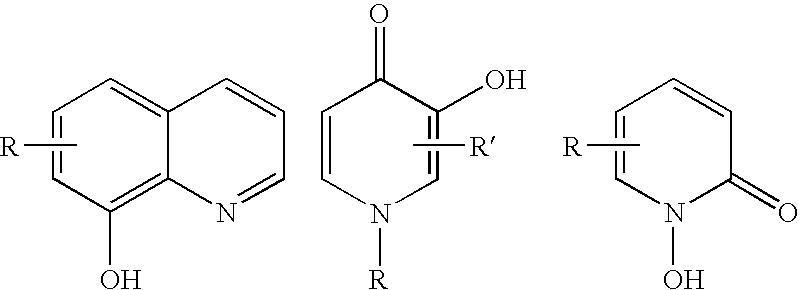
FIELD OF THE INVENTION [0001] The present invention relates to amphiphilic metal chelators that have specificity for iron and are useful for treatment of diseases, disorders and conditions by iron chelation therapy. In one aspect, the iron chelators are designed to provide desired cell membrane, particularly blood-brain-barrier (BBB), transport properties in lipophilic media. In another aspect, these chelators are part of multifunctional compounds possessing an iron chelator function and a residue that imparts a neuroprotective function and / or a residue that imparts both antiapoptotic and neuroprotective functions. The invention further relates to pharmaceutical compositions and methods for treatment and / or prevention of diseases, disorders and conditions associated withiron overload and oxidative stress, in particular neurodegenerative diseases, conditions and disorders such as Parkinson's disease, Alzheimer's disease, stroke, amyotrophic lateral sclerosis (ALS), multiple sclerosis...
Claims
the structure of the environmentally friendly knitted fabric provided by the present invention; figure 2 Flow chart of the yarn wrapping machine for environmentally friendly knitted fabrics and storage devices; image 3 Is the parameter map of the yarn covering machine
Login to View More
Application Information
Patent Timeline
Application Date:The date an application was filed.
Publication Date:The date a patent or application was officially published.
First Publication Date:The earliest publication date of a patent with the same application number.
Issue Date:Publication date of the patent grant document.
PCT Entry Date:The Entry date of PCT National Phase.
Estimated Expiry Date:The statutory expiry date of a patent right according to the Patent Law, and it is the longest term of protection that the patent right can achieve without the termination of the patent right due to other reasons(Term extension factor has been taken into account ).
Invalid Date:Actual expiry date is based on effective date or publication date of legal transaction data of invalid patent.


 Login to View More