
Preparation method of biotinylated protein and detection method using the same
- Summary
- Abstract
- Description
- Claims
- Application Information
AI Technical Summary
Benefits of technology
Problems solved by technology
Method used
Image

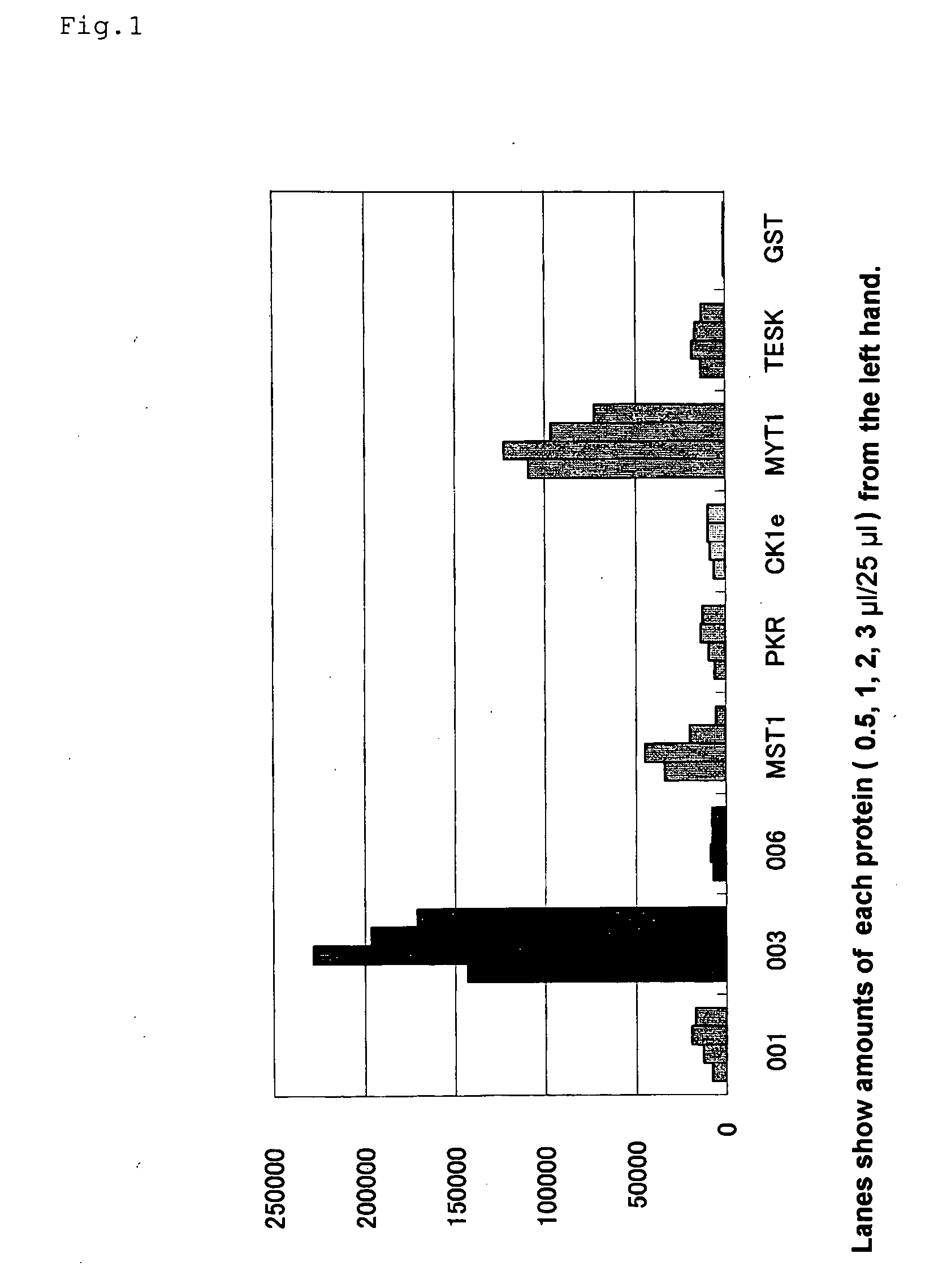
Examples
example 1
Preparation of Wheat Embryo Extract
(1) Preparation of Wheat Embryo
[0115] Chihoku wheat seeds of Hokkaido origin, or Chikugo-izumi seeds of Ehime Prefecture origin were added to a mill (supplied by Fritsch Co.: Rotor Speed Millpulverisette type 14) at a rate of 100 g per minute, and the seeds were gently pulverized at 8,000 rpm. After a fraction containing embryo with germinability was recovered with a sieve (mesh size: from 0.7 to 1.00 mm), a floating fraction containing the embryo with germinability was recovered by flotation using a mixture of carbon tetrachloride and cyclohexane (a volume ratio of carbon tetrachloride:cyclohexane=2.4:1), and the organic solvent was removed by drying at room temperature and then contaminating impurities such as seed coat were removed by air blasting at room temperature to give a crude embryo fraction.
[0116] Subsequently, using a belt-type color separator BLM-300K (manufacturer: Anzai Manufacturing Co., Ltd., selling agency: Anzai Sogyo), embr...
example 2
Preparation of Biotinylating Enzyme
[0123] pEU vector to which a base sequence coding a biotinylating enzyme from E. coli genome was inserted was prepared. Subsequently, a transcription template was prepared using the pEU vector as a template and using PCR. The transcription template was added to a transcription reaction solution [final concentrations: 80 mM of HEPES-KOH (pH 7.8), 16 mM of magnesium acetate, 10 mM of dithiothreitol, 2 mM of spermidine, 2.5 mM of 4NTPs (4 kinds of nucleotide triphosphates), 0.8 U / μl of RNase inhibitor, and 1.6 U / μl of SP6 RNA polymerase], and the transcription was conducted at 37° C. for 3 hours (Proc Natl Acad Sci USA, 2002, vol 99, pl4652-14657: Sawasaki, T et al.). All of the obtained mRNA pellets were added to the wheat embryo extract (200 O.D.) obtained in the above-mentioned Example 1, and the protein synthesis was conducted at 26° C. for 15 to 20 hours.
[0124] It was confirmed by using a radio isotope ([14C]-Leu) that the above biotinylating ...
example 3
Preparation of a Translation Template of Biotinylated Protein (001-006)
[0125] In relation to the translation template mRNA, a vector which was a biotinylated protein transcription template in which a gene represented as a gene number of 001-006 was fused with a biotin tag (pEU-biotinylated tag-001-006) was prepared. Based on the vector, a PCR product containing Ω sequence part of tobacco mosaic virus (TMV) was used as a template. The transcription template was added to a transcription reaction solution [final concentrations: 80 mM of HEPES-KOH (pH 7.8), 16 mM of magnesium acetate, 10 mM of dithiothreitol, 2 mM of spermidine, 2.5 mM of 4NTPs (4 kinds of nucleotide triphosphates), 0.8 U / μl of RNase inhibitor, 1.6 U / μl of SP6 RNA polymerase], and the reaction was conducted at 37° C. for 3 hours. The obtained RNA was extracted with phenol / chloroform, precipitated with ethanol, and purified with Nick Column (supplied by Amersham Pharmacia Biotech Inc.) to give a translation template.
[...
PUM
| Property | Measurement | Unit |
|---|---|---|
| Time | aaaaa | aaaaa |
Abstract
Description
Claims
Application Information
 Login to View More