

Stable Composite Material Comprising Supported Porous Gels
a technology of porous gels and composite materials, applied in the direction of metal/metal-oxide/metal-hydroxide catalysts, chemical/physical processes, water/sewage treatment by ion exchange, etc., can solve the problems of failure of all attempts, and achieve the effect of high flux
- Summary
- Abstract
- Description
- Claims
- Application Information
AI Technical Summary
Benefits of technology
Problems solved by technology
Method used
Image

Examples
example 1
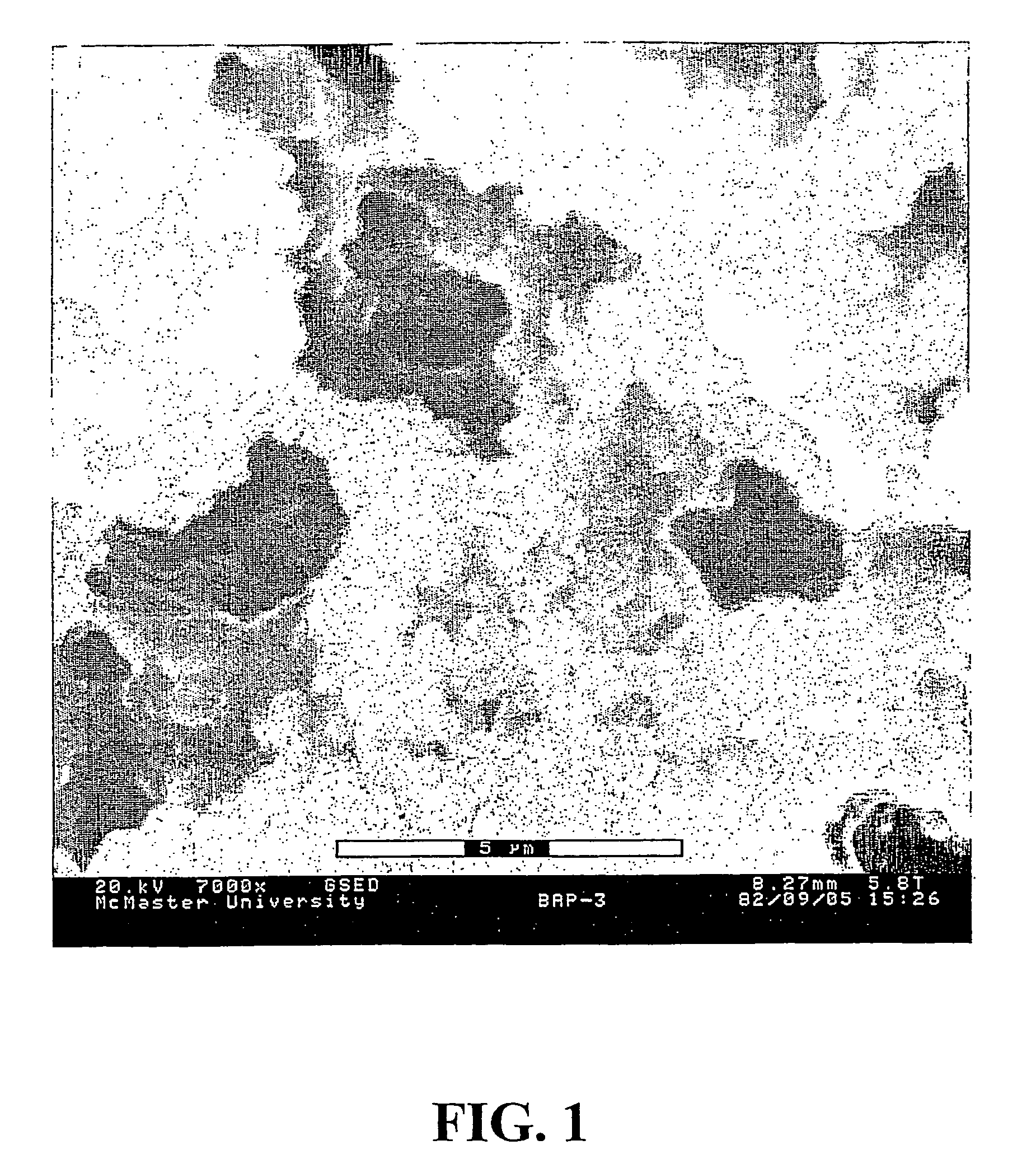
[0182]This example illustrates the formation of an unsupported porous gel, which can be used as the macroporous gel to prepare the composite material of the invention.
[0183]A solution containing 3.33 g of (3-acrylamidopropane)trimethylammonium chloride (APTAC) monomer as a 75% aqueous solution, 0.373 g of N,N′-methylenebisacrylamide (BIS) crosslinker, and 0.0325 g of Irgacure®2959 photoinitiator dissolved in 25 ml of a dioxane:dimethylformamide:water mixture, with the solvent volume ratio of 71:12:17, respectively, was prepared. In this solvent mixture, dioxane is a poor solvent while DMF and water are good solvents. A total monomer concentration (APTAC and BIS) of 0.58 mol / L was thus obtained. The crosslinking degree was 20 mol %, based on APTAC. 5 ml of this solution was placed in a glass vial and subjected to UV irradiation at 350 nm for 2 hrs. A white gel was formed which was washed thoroughly with de-ionized water to exchange the reaction solvent and remove the unreacted monome...
example 2
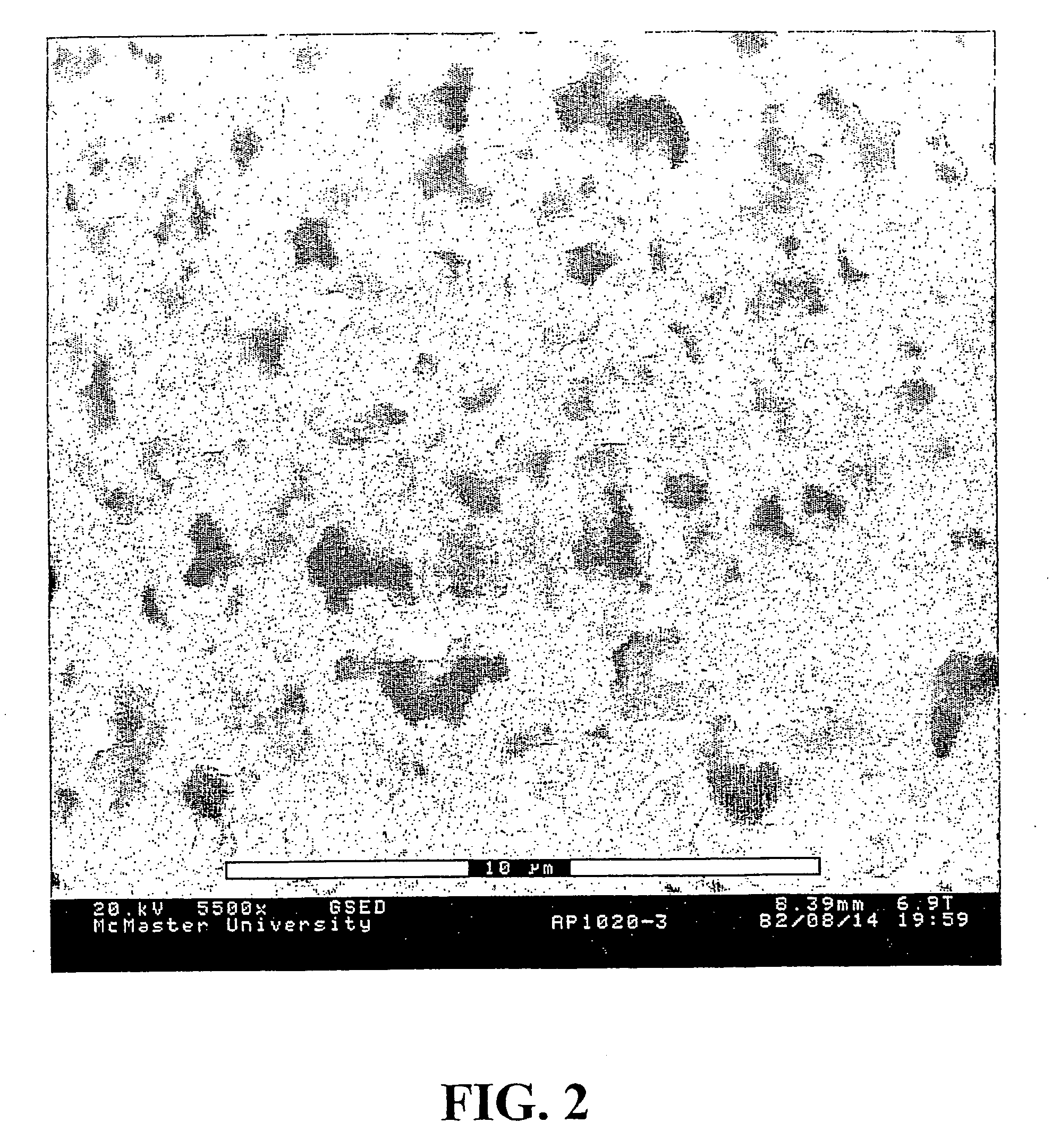
[0185]This example illustrates a method of preparing a positively charged composite material of the present invention using the monomer solution of composition described in example 1 applied to a sample of the poly(propylene) porous support PP1545-4. The composite material was prepared according to the general procedure described above using UV irradiation at 350 nm for 2 hours. After polymerization, the composite material was washed with de-ionized water for 48 hrs.
[0186]Mass gain of the resulting composite material after drying was 107 wt %, water flux was 1643±5 kg / m2 h at 50 kPa and Darcy permeability was 9.53×10⁻¹⁶ m2.
[0187]The morphology of the gel-incorporated composite material was examined using ESEM in the same manner as described in Example 1. The ESEM micrograph shown in FIG. 2 shows that the macroporous gel has been incorporated into the host membrane. The micrograph shows a similar structure to that of the unsupported macroporous gel shown in FIG. 1 and little evidence...
example 3
[0188]This example illustrates a method of preparing a negatively charged composite material of the present invention, with a weak acid functionality.
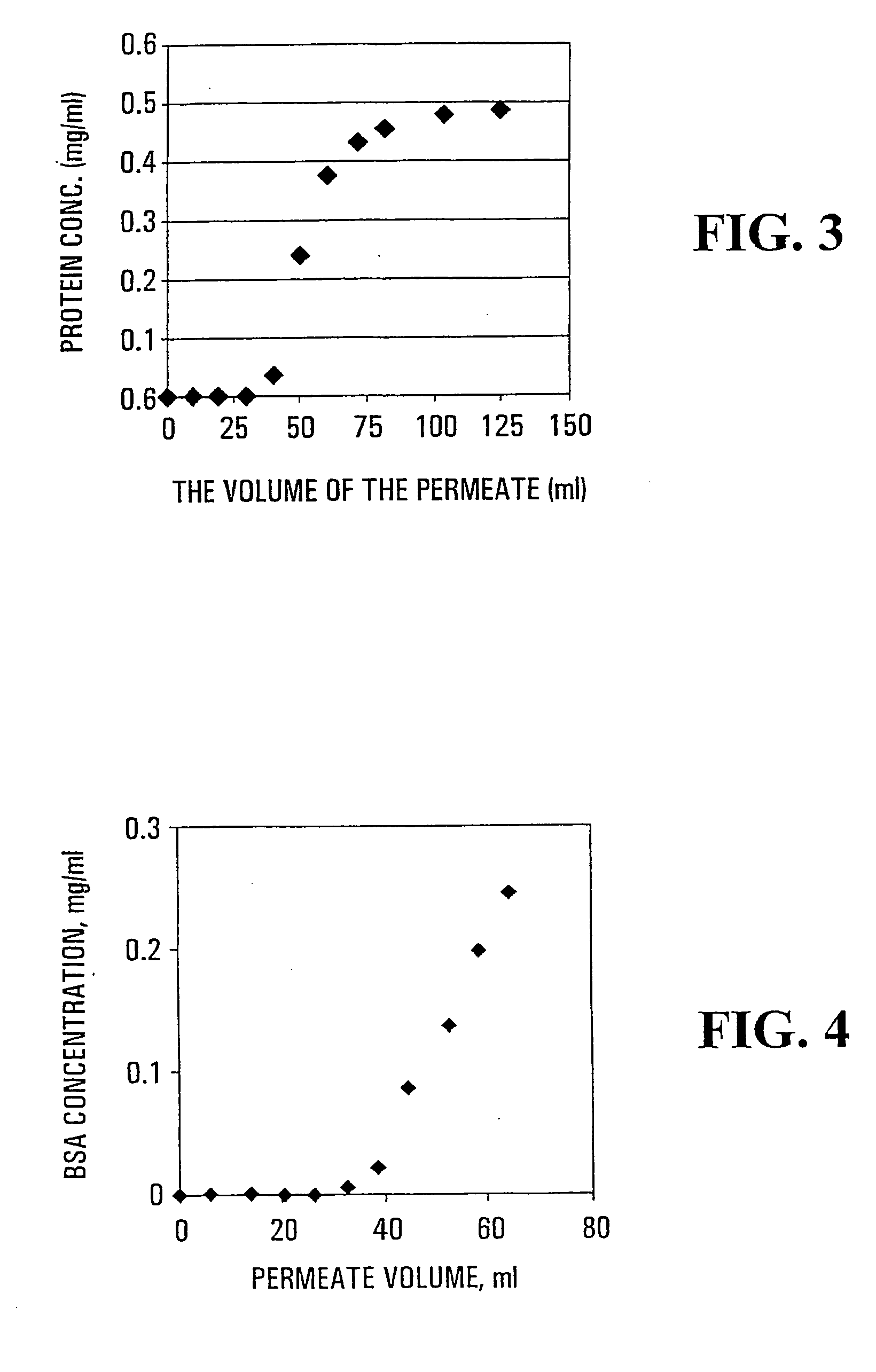
[0189]5.50 g of vacuum-distilled methacrylic acid (MAA) monomer, 0.4925 g of N,N′-methylenebisacrylamide crosslinker and 0.1503 g of Irgacure® 2959 photoinitiator were dissolved in 25 ml of a dioxane:DMF solvent mixture with a volume ratio of 9:1, respectively, to prepare the starting monomer solution. The composite material was prepared using the poly(propylene) PP1545-4 support and the general procedure for the photoinitiated polymerization described above. The irradiation time used was 2 hours and the resulting membrane was washed with DMF for 24 hrs followed by a 48 hr wash with deionized water. The mass gain of the resulting dried membrane was 231 wt %, water flux was 4276±40 kg / m2 h at 50 kPa and Darcy permeability was 2.64×10⁻¹⁵ m2.
[0190]The protein (lysozyme) absorption / desorption characteristics of the composite material were ...
PUM
| Property | Measurement | Unit |
|---|---|---|
| Fraction | aaaaa | aaaaa |
| Fraction | aaaaa | aaaaa |
| Fraction | aaaaa | aaaaa |
Abstract
Description
Claims
Application Information
 Login to View More