Check patentability & draft patents in minutes with Patsnap Eureka AI!

Binary vectors and uses of same

a technology of t-dna sequences and vectors, applied in the field ofbinary vectors, can solve the problems of low yield of dna plasmids, difficult handling of size, low copy number, etc., and achieve the effects of reducing undeired expression of t-dna sequences, reducing size, and facilitating assembly and delivery of multi-component constructs

Active Publication Date: 2020-08-13
GARCÍA ÁLVAREZ JUAN ANTONIO
View PDF1 Cites 0 Cited by
  • Summary
  • Abstract
  • Description
  • Claims
  • Application Information

AI Technical Summary

Benefits of technology

The present invention provides a new set of T-DNA binary vectors, called pLX, which are useful for plant synthetic biology and the delivery of multiple genes to plants and animals. The pLX vectors have several advantages, including reduced size, compatibility with a wide range of bacteria, and the ability to be amplified and linearized. They also include rare-cutting recognition sites and selectable markers for easy assembly and cloning. The pLX vectors can be used in combination with other plasmid systems for high-throughput assembly and delivery. Overall, the pLX vectors provide a flexible and efficient tool for plant synthetic biology research.

Problems solved by technology

Disadvantages of existing binary vectors, for example the 12-kb pBIN19 (Bevan M., Nucleic Acids Res. 1984, 12, 8711-8721), are their difficult-to-handle size, and their low-copy number, which leads to low yields of DNA plasmids and makes cloning procedures difficult.
Due to the large sizes of many binary vectors, amplification of the plasmid backbones by PCR is not practical.
Unstable replication origins can lead to variable plasmid losses during replication.
For certain applications, use of origins with a high copy number is not desirable, since it could promote deletions / alterations of large DNA inserts, of sequences with bacterial toxicity, or of repeated sequence elements.
Undesired expression of exogenous sequences can lead to production of toxic products during vector propagation in bacteria, and could increase insert and vector instability.
In the early series of binary vectors, there is also frequently a lack of a sufficient restriction enzyme sites for cloning desired sequences into the T-DNA cassettes, or the vectors only permit the use of a few selectable markers.
The presence or absence of restriction sites in the vector and insert sequences can limit possible assemblies, particularly those involving multiple inserts.
Recombinase-based technologies are limited to vectors with appropriate recombination sequences, they allow simultaneous cloning of small number of inserts, and are not always scar-benign, as they leave >20-bp scars between building blocks.
Methods 2009, 6, 343-345); nonetheless, it has not been widely adopted for building plant constructs.
The large size of many binary vectors makes backbone linearization by PCR impractical, and small-sized binary vectors are therefore desirable for efficient construct cloning by Gibson assembly and other overlap-based assembly methods.
Moreover, in most current binary vector systems, selectable markers cannot be removed from transgenic lines at a later time.
Technical constraints of known systems include limited cloning flexibility due to the large plasmid size (>15 kb), incompatibility with high-throughput methods for construct assembly, or lack of replication independence of the binary vectors used.
Another operational disadvantage of binary vectors is the use of common components in their backbone sequences, which hampers their simultaneous maintenance in a single bacterial cell.
As is well known to those skilled in the field of molecular biology, use of origins belonging to identical incompatibility groups impedes vector replication and maintenance in the same cell.
Moreover, large sequence repeats can lead to DNA deletions and other rearrangements, particularly when the repeats are part of the plasmid structure.
Such rearrangements can lead to partial or complete loss of the T-DNA region, resulting in little or no transfer of the intact, desired foreign sequences into eukaryotic cells.
Another disadvantage of binary vectors are the plasmid mobilization sequences needed to mobilize the vectors into Agrobacterium by triparental mating.
The presence of mobilization sequences in binary vectors contributes to their size increase and to reducing their biological safety.
Moreover, the origin of transfer of certain plasmids can interfere with the desired T-DNA processing and its delivery to eukaryotic cells (Buchanan-Wollaston V., et al, Nature 1987, 328, 172-175).

Method used

the structure of the environmentally friendly knitted fabric provided by the present invention; figure 2 Flow chart of the yarn wrapping machine for environmentally friendly knitted fabrics and storage devices; image 3 Is the parameter map of the yarn covering machine
View more

Image

Smart Image Click on the blue labels to locate them in the text.
Viewing Examples
Smart Image
  • Binary vectors and uses of same
  • Binary vectors and uses of same
  • Binary vectors and uses of same

Examples

Experimental program
Comparison scheme
Effect test

example 1

ion of T-DNA Binary Vectors by Assembly of Modular Parts, and Cloning Features of a pBBR1-Based pLX Vector

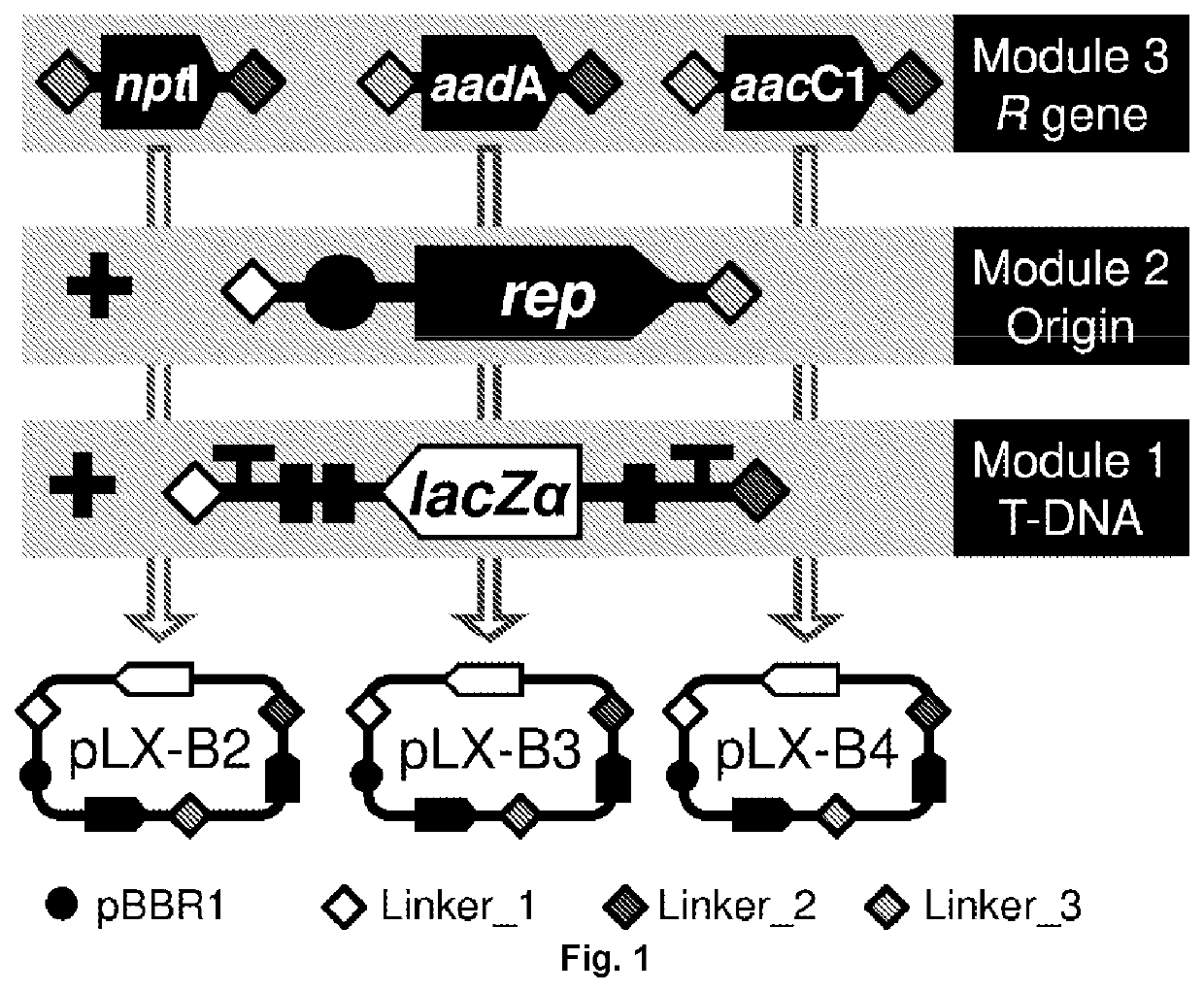
[0188]In the design of new T-DNA binary vectors, the inventors chose basic principles: (a) reduced size; (b) stability; (c) a broad-host-range replication origin for maintenance in E. coli and A. tumefaciens; (d) an origin compatible with the most commonly used T-DNA binary vectors; (e) consistency with current standards for plant synthetic biology; and (f) the possibility to adopt overlap-dependent cloning methods for construct assembly.

[0189]Therefore, to construct the pLX binary vectors of the present invention, modular parts were assembled by overlap-based cloning methods. Sequences of synthetic orthogonal overlapping junctions known as assembly linker were designed to allow combinatorial assembly of DNA modules (Table 2). Module 1, 2, and 3 refer to the T-DNA cassette, the pBBR1 origin and a selectable marker (resistance (R) genes such as nptI, aadA, and aacC1), respectivel...

example 2

Expression in Plants Using the pLX Vector Series

[0192]To demonstrate that the binary vectors of the present invention can be used to deliver DNA constructs to eukaryotic cells, specifically to plant cells by Agrobacterium tumefaciens-mediated transformation, a transcription unit (P35S:RFP:Tnos) that comprises sequences of the cauliflower mosaic virus 35S promoter, the red fluorescent protein (RFP, as a reporter; FIG. 3A), and the nopaline synthase terminator was assembled into the pLX vectors of the present invention to obtain pLX-B2-TagRFP-T (SEQ ID NO: 13), pLX-B3-TagRFP-T (SEQ ID NO: 14) and pLX-B4-TagRFP-T (SEQ ID NO: 15)(FIG. 3A). Details for the generation of the vectors are disclosed above. Transient expression of RFP in Nicotiana benthamiana leaves was evaluated by A. tumefaciens-mediated delivery. At 6 dpa, leaves infiltrated with pLX-B2-TagRFP-T (SEQ ID NO: 13), pLX-B3-TagRFP-T (SEQ ID NO: 14) and pLX-B4-TagRFP-T (SEQ ID NO: 15) showed bright RFP fluorescence, which was ab...

example 3

intenance of T-DNA Cassettes in the pLX Binary Plasmid Series of the Invention

[0196]cDNA copies of RNA virus genomes can be inserted into plasmids to generate viral infectious clones; these often show instability problems and sequence deletions that arise during the clone propagation in bacteria. To test the stability of the pLX binary vectors of the present invention in challenging conditions, the inventors transferred the entire cDNA sequence of potyvirus genomes into a pLX vector. The vectors generated were propagated in Escherichia coli, and the bacteria were subjected to several growth cycles. Vector stability was evaluated by restriction enzyme digestion assays.

[0197]The whole cDNA sequence of an RNA virus was obtained from a pBIN19-based vector, pSN-PPV (Pasin F., et al, PLoS Pathog. 2014, 10, e1003985), which contains the cauliflower mosaic virus 35S promoter, a cDNA copy of the plum pox virus (PPV) genome and the nopaline synthase terminator (P35S:PPV:Tnos) sequences. As di...

the structure of the environmentally friendly knitted fabric provided by the present invention; figure 2 Flow chart of the yarn wrapping machine for environmentally friendly knitted fabrics and storage devices; image 3 Is the parameter map of the yarn covering machine
Login to View More

PUM

PropertyMeasurementUnit
Digital informationaaaaaaaaaa
Volumeaaaaaaaaaa
Sizeaaaaaaaaaa
Login to View More

Abstract

The invention relates to binary vectors based on compatible and autonomous origins, specifically based on the pBBR1 and RK2 replication origins. These binary vectors are useful for having a wide range of hosts, for their maintenance in Agrobacterium sp. and Escherichia coli, and as a new tool for plant synthetic biology as well as a flexible framework for assembly, transfer and characterization of multiple DNA elements. The binary vectors disclosed are small, preferably less than 3.8 kb in size, stable, include an origin compatible with the most commonly used binary T-DNA vectors, comply with current standards for plant synthetic biology, and allow the administration of multiple T-DNA cassettes by means of the multiplexing of the vectors. The present invention also relates to methods for transferring and expressing nucleic acid sequences using said binary vectors, and to the uses of the same.

Description

[0001]The invention relates in general to the field of molecular biology and to agents useful for the manipulation of eukaryotic organisms. In particular, the present invention provides methods to assemble, transfer, and express DNA sequences using binary vectors, the binary vectors themselves, and uses of the same.BACKGROUND ART[0002]Plants are plastic organisms that sense and respond to environmental stimuli. These responses or specific plant features might not fit human needs, and can be manipulated by targeted use of plant-interacting microorganisms or by plant genetic transformation. Plant biotechnology uses advanced tools to generate plants with new functions, enhanced agronomic traits, or to produce new products. Synthetic biology applies engineering principles to facilitate the production of organisms with customized functions and for precise control of specific biological functions. Genetic components of complex biological systems are reduced to DNA parts with modular and d...

Claims

the structure of the environmentally friendly knitted fabric provided by the present invention; figure 2 Flow chart of the yarn wrapping machine for environmentally friendly knitted fabrics and storage devices; image 3 Is the parameter map of the yarn covering machine
Login to View More

Application Information

Patent Timeline
no application Login to View More
IPC IPC(8): C12N15/82
CPCC12N15/8205C12N15/8241
Inventor PASIN, FABIOGARCÍA ÁLVAREZ, JUAN ANTONIOBEDOYA ROJAS, LEONOR CECILIASIMÓN MATEO, MARÍA DEL CARMENORZÁEZ CALATAYUD, DIEGO VICENTEBERNABÉ ORTS, JUAN MIGUEL
Owner GARCÍA ÁLVAREZ JUAN ANTONIO
Features
  • R&D
  • Intellectual Property
  • Life Sciences
  • Materials
  • Tech Scout
Why Patsnap Eureka
  • Unparalleled Data Quality
  • Higher Quality Content
  • 60% Fewer Hallucinations
Social media
Patsnap Eureka Blog
Learn More