Fluidized bed device and method for preparing para-xylene and co-producing light olefins from methanol and/or dimethyl ether and benzene
Active Publication Date: 2021-04-29
DALIAN INST OF CHEM PHYSICS CHINESE ACAD OF SCI
View PDF0 Cites 0 Cited by
Summary
Abstract
Description
Claims
Application Information
AI Technical Summary
This helps you quickly interpret patents by identifying the three key elements:
Problems solved by technology
Method used
Benefits of technology
Benefits of technology
The present patent application describes a turbulent fluidized bed reactor that can prepare para-xylene and co-produce light olefins from methanol and / or dimethyl ether and benzene. The reactor allows for a synergistic effect between the MTO reaction and the alkylation reaction, thus improving the conversion rate of benzene, the yield of para-xylene, and the selectivity of light olefins. The during the process, controlling the mass transfer and reaction can coordinate and optimize the competition between the MTO reaction and the alkylation reaction, resulting in improved performance. Additionally, optimizing the concentrations of methanol and benzene / toluene in the reaction zone can further enhance the conversion rates and yields.
Problems solved by technology
When the content of methanol in the raw material is excessively excessive, the difference in the diffusion speed between methanol and toluene and / or toluene in the molecular sieve pores makes the adsorption amount of benzene and / or toluene per unit time low, which is also unfavorable for the alkylation reaction of methanol and / or dimethyl ether and benzene.
Method used
the structure of the environmentally friendly knitted fabric provided by the present invention; figure 2 Flow chart of the yarn wrapping machine for environmentally friendly knitted fabrics and storage devices; image 3 Is the parameter map of the yarn covering machine
View more
Image
Smart Image Click on the blue labels to locate them in the text.
Viewing Examples
Smart Image
Click on the blue label to locate the original text in one second.
Reading with bidirectional positioning of images and text.
Smart Image
Examples
Experimental program
Comparison scheme
Effect test
example 1
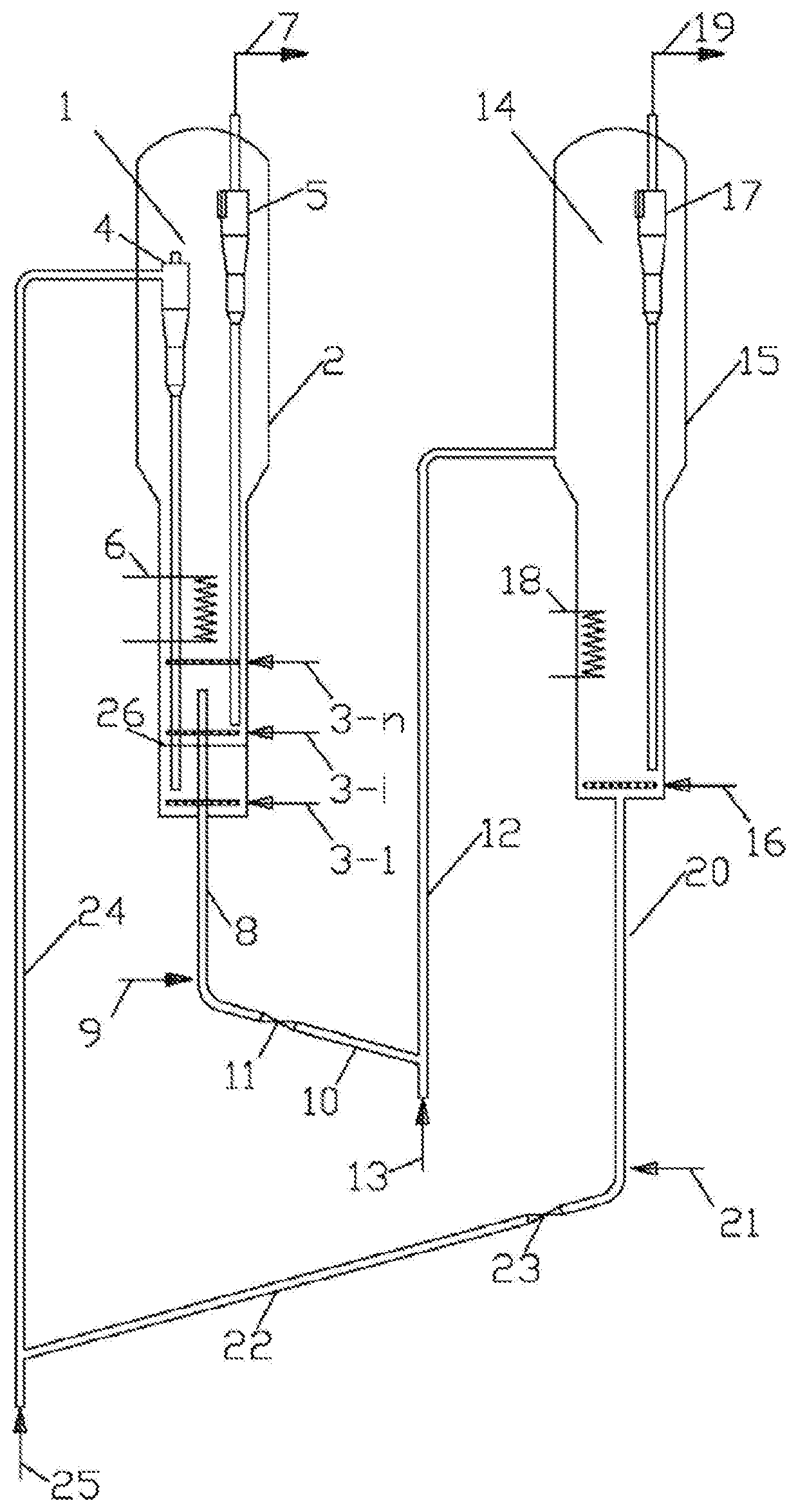
[0123]The device shown in FIG. 1 is used, but the turbulent fluidized bed reactor 1 does not contain the reactor gas-solid separator 4 and the perforated plate 26, and the regenerated catalyst lift pipe 24 is directly connected to the dilute phase zone of the turbulent fluidized bed reactor 1. The turbulent fluidized bed reactor 1 contains one reactor feed distributor 3-1.
[0124]The reaction conditions in the reaction zone of the turbulent fluidized bed reactor 1 are as follows: the apparent linear velocity of gas is about 1.0 m / s, the reaction temperature is about 500° C., the reaction pressure is about 0.15 MPa, and the bed density is about 350 kg / m3.
[0125]The reaction conditions in the regeneration zone of the fluidized bed regenerator 14 are as follows: the apparent linear velocity of the gas is about 1.0 m / s, the regeneration temperature is about 650° C., the regeneration pressure is about 0.15 MPa, and the bed density is about 350 kg / m3.
[0126]The catalyst contains a HZSM-5 mole...
example 2
[0130]The device shown in FIG. 1 is used, the turbulent fluidized bed reactor 1 contains three reactor feed distributors 3-1 to 3-3, the porosity of the perforated plate 26 is 10%, and the reactor gas-solid separator 4 is placed inside the reactor shell 2.
[0131]The reaction conditions in the reaction zone of the turbulent fluidized bed reactor 1 are as follows: the apparent linear velocity of gas is about 1.0 m / s, the reaction temperature is about 500° C., the reaction pressure is about 0.15 MPa, and the bed density is about 350 kg / m3.
[0132]The reaction conditions in the regeneration zone of the fluidized bed regenerator 14 are as follows: the apparent linear velocity of the gas is about 1.0 m / s, the regeneration temperature is about 650° C., the regeneration pressure is about 0.15 MPa, and the bed density is about 350 kg / m3. The catalyst contains a HZSM-5 molecular sieve. The carbon content of the regenerated catalyst is about 0.1 wt. %.
[0133]The regeneration medium is air; the rea...
example 3
[0142]The device shown in FIG. 1 is used, the turbulent fluidized bed reactor 1 contains six reactor feed distributors 3-1 to 3-6, the porosity of the perforated plate is 5%, and the reactor gas-solid separator 4 is placed inside the reactor shell 2.
[0143]The reaction conditions in the reaction zone of the turbulent fluidized bed reactor 1 are as follows: the apparent linear velocity of gas is about 0.8 m / s, the reaction temperature is about 560° C., the reaction pressure is about 0.6 MPa, and the bed density is about 460 kg / m3.
[0144]The reaction conditions in the regeneration zone of the fluidized bed regenerator 14 are as follows: the apparent linear velocity of the gas is about 1.7 m / s, the regeneration temperature is about 600° C., the regeneration pressure is about 0.6 MPa, and the bed density is about 220 kg / m3.
[0145]The catalyst contains a HZSM-11 molecular sieve. The carbon content of the regenerated catalyst is about 0.15 wt. %.
[0146]The regeneration medium is air; the reac...
the structure of the environmentally friendly knitted fabric provided by the present invention; figure 2 Flow chart of the yarn wrapping machine for environmentally friendly knitted fabrics and storage devices; image 3 Is the parameter map of the yarn covering machine
Login to View More
PUM
Property
Measurement
Unit
Temperature
aaaaa
aaaaa
Temperature
aaaaa
aaaaa
Temperature
aaaaa
aaaaa
Login to View More
Abstract
A turbulent fluidized bed reactor, device and method for preparing para-xylene and co-producing light olefins from methanol and / or dimethyl ether and benzene, resolving or improving the competition problem between an MTO reaction and an alkylation reaction during the process of producing para-xylene and co-producing light olefins from methanol and / or dimethyl ether and benzene, and achieving a synergistic effect between the MTO reaction and the alkylation reaction. By controlling the mass transfer and reaction, competition between the MTO reaction and the alkylation reaction is coordinated and optimized to facilitate a synergistic effect of the two reactions, so that the conversion rate of benzene, the yield of para-xylene, and the selectivity of light olefins are increased. The turbulent fluidized bed reactor includes a first reactor feed distributor and a number of second reactor feed distributors; the first reactor feed distributor and the plurality of second reactor feed distributions are sequentially arranged.
Description
TECHNICAL FIELD[0001]The present invention relates to a device and a production method for producing para-xylene (PX) and co-producing light olefins, and is particularly suitable for a fluidized bed device and a production method for preparing the para-xylene and co-producing the light olefins by the alkylation of methanol and / or dimethyl ether and benzene, which belongs to the field of chemistry and chemical industry.BACKGROUND[0002]Para-xylene (PX) is one of the basic organic raw materials in the petrochemical industry, which has a wide range of applications in chemical fiber, synthetic resins, pesticides, pharmaceuticals and polymer materials. At present, the production of para-xylene mainly uses toluene, C9 aromatics and mixed xylene as raw materials, and para-xylene is obtained by disproportionation, isomerization, adsorption separation or cryogenic separation. Since the para-xylene content in the product is controlled by thermodynamics, para-xylene only accounts for ˜24% of th...
Claims
the structure of the environmentally friendly knitted fabric provided by the present invention; figure 2 Flow chart of the yarn wrapping machine for environmentally friendly knitted fabrics and storage devices; image 3 Is the parameter map of the yarn covering machine
Login to View More
Application Information
Patent Timeline
Application Date:The date an application was filed.
Publication Date:The date a patent or application was officially published.
First Publication Date:The earliest publication date of a patent with the same application number.
Issue Date:Publication date of the patent grant document.
PCT Entry Date:The Entry date of PCT National Phase.
Estimated Expiry Date:The statutory expiry date of a patent right according to the Patent Law, and it is the longest term of protection that the patent right can achieve without the termination of the patent right due to other reasons(Term extension factor has been taken into account ).
Invalid Date:Actual expiry date is based on effective date or publication date of legal transaction data of invalid patent.


 Login to View More