However, in practice, the
transistor is not completely symmetrical.
In addition, HBTs may be used in phased-array
radar and
very high frequency terrestrial and
satellite communication systems, and the reliability of HBT devices is not sufficient to incorporate these ICs into such applications, primarily due to the limitations of present HBT process technologies.
However, Si BJTs and SiGe HBTs suffer from several performance disadvantages in comparison to
compound semiconductor HBTs, including, for example, low collector breakdown voltages and the inability to integrate passive components in ICs including resistors, capacitors, and inductors due to the glossy, conductive
Si substrate.
Although the “T-shaped” emitter HBT has resulted in ICs with world
record speeds in the research laboratory, they suffer from several different manufacturing and
processing problems that will ultimately limit their use in commercial high-speed IC applications.
Also, the emitter
undercut impedes the ability to deposit a conformal dielectric
coating of Si3N4 and / or SiO2 that is considered to be essential for proper
passivation of the emitter p-n junction.
The inability to completely fill the emitter
undercut can result in significantly reduced reliability and lifetimes of the HBT device, thereby precluding their use in many IC applications.
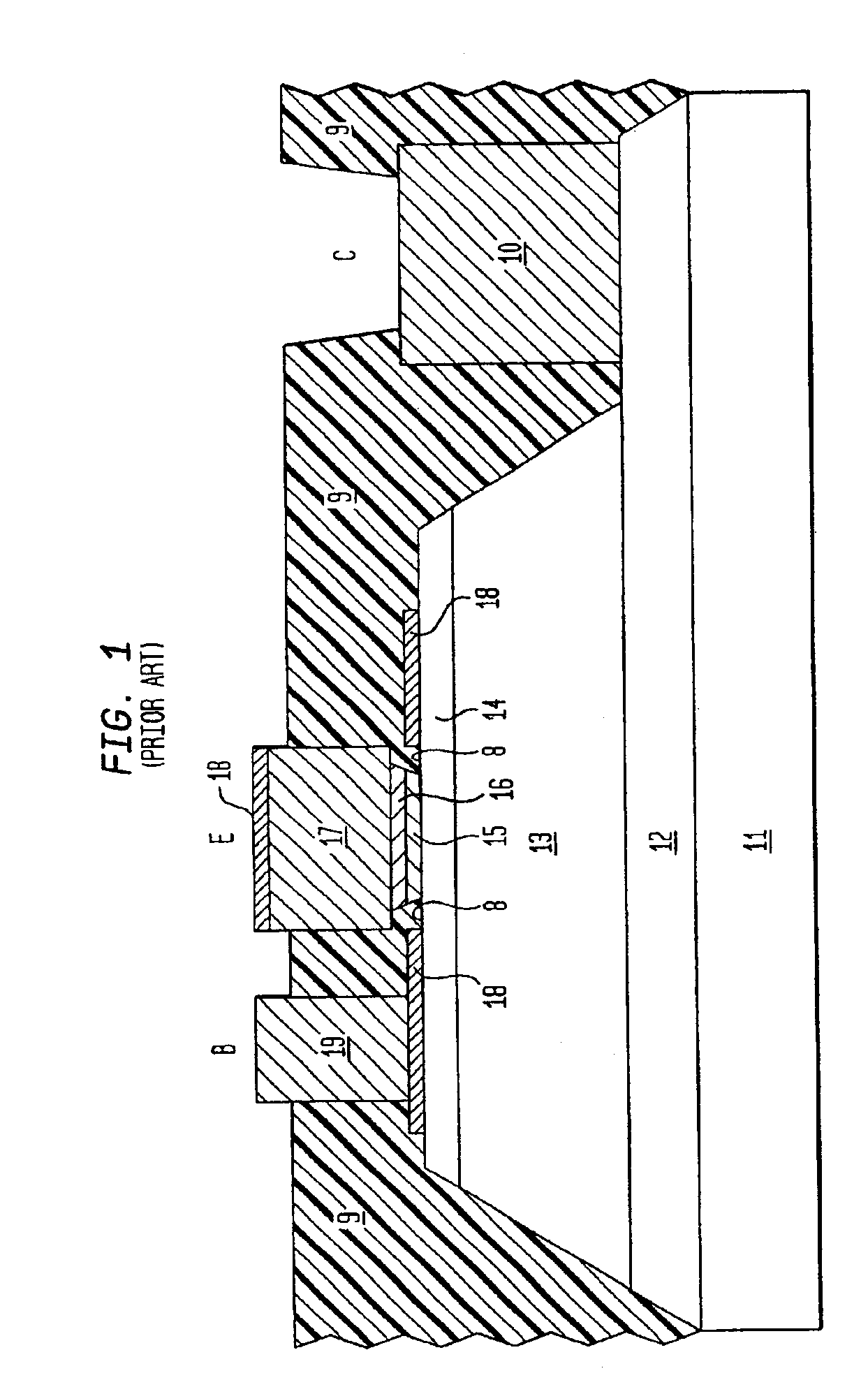
This makes it virtually impossible to accurately measure the undercut 8 in an HBT
semiconductor process line.
However, AFM cannot be used to measure the emitter undercut in the “T-shaped” HBT process because the AFM probe tip cannot penetrate below the emitter
metal in the emitter undercut region.
Also, SEM imaging of a tilted
wafer cannot be used to accurately measure the emitter undercut due to the shadowing effect of the emitter metal in the collection of
secondary electrons.
Another difficult and potentially fatal HBT reliability problem results from the use of conventional
hydrochloric acid (HCl)-based wet etch chemistries to selectively etch the emitter
layers containing AlInAs, InP, or InGaP regions while stopping at InGaAs or GaAs
layers that form the p-type base layer.
Selective etches are often used in the emitter etch process to prevent over-
etching into the base region that would lead to variations in the base resistance and thus greatly reduce IC yields.
The lack of complete dielectric
passivation of the emitter p-n junction will severely degrade the reliability of the HBT leading to short device lifetimes that will preclude their use in many high-speed IC applications.
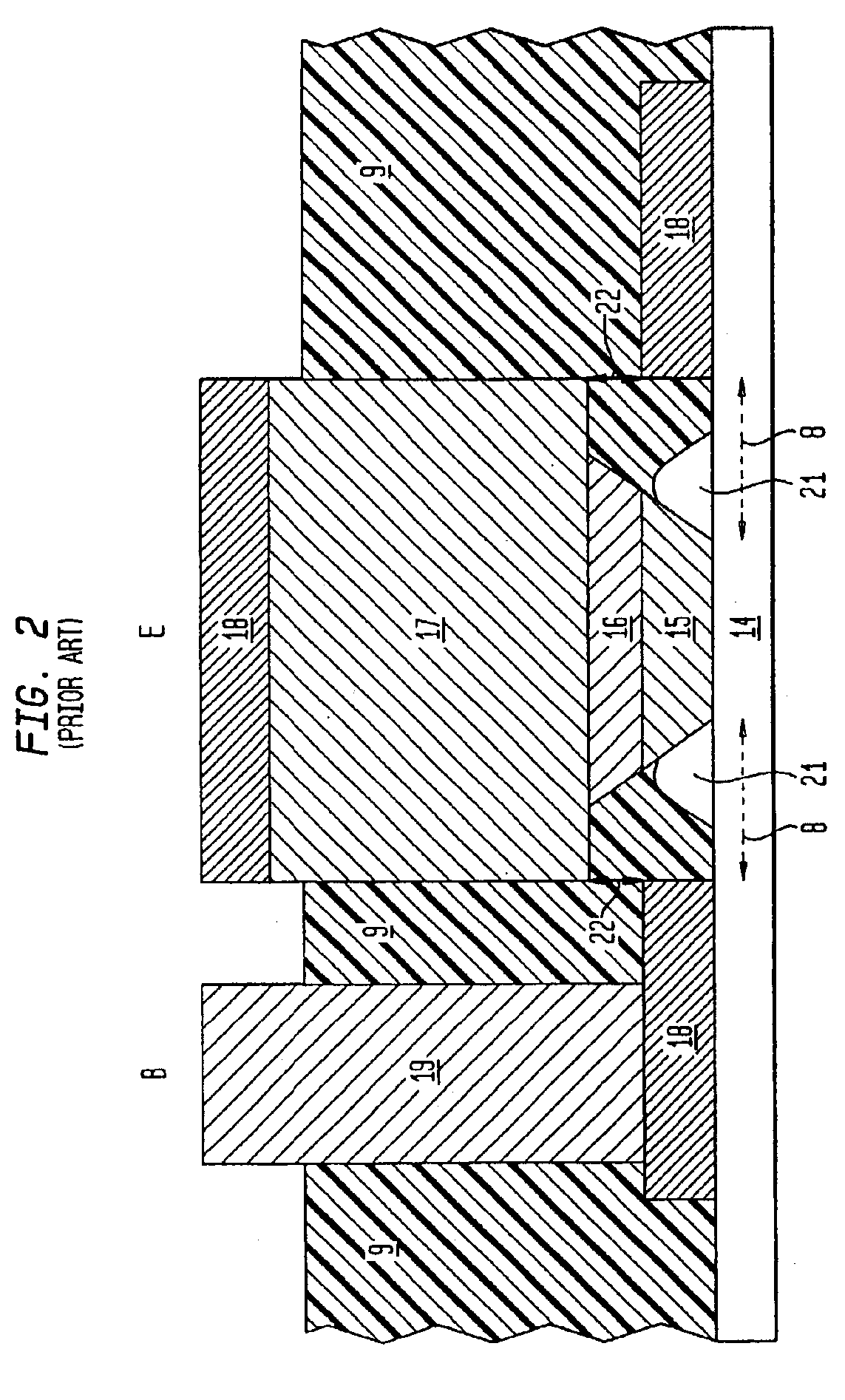
However, it is still often observed that these
polymer films 9 cannot always penetrate into the undercut 8 region through the narrow opening H 22 due to the
surface tension of the
polymer films.
This, too, directly results in the formation of voids 21 at the critical emitter p-n junction that greatly decreases the HBT device reliability.
Thus,
water vapor can diffuse to the emitter p-n junction and further oxidize the semiconductor surface leading to increasing base surface recombination currents that will result in eventual HBT
device failure.
Another
disadvantage to these
polymer films is that they are not true passivation films since they do not form strong chemical bonds with the semiconductor surface.
In the case of spun-on polymer films, these layers only serve to overcoat the semiconductor native oxides and do not stabilize the semiconductor surface from further
decomposition through oxidation in the presence of
water vapor.
These
refractory dielectric films also form a
hermetic seal preventing
water vapor from reaching the semiconductor surface—water that can lead to deterioration of the emitter p-n junction and degrade the HBT's reliability.
The emitter perimeter surface area to active p-n
junction area ratio is also much larger in small-area, high
cutoff frequency HBTs leaving them particularly susceptible to enhanced base surface recombination currents resulting in lower current gains.
HBTs fabricated without this depleted ledge have been found to have seriously degraded operating lifetimes due to surface recombination.
This is because conventional wet chemical and
plasma etches for gold (Au) and related metals will also aggressively etch compound semiconductors such as GaAs and InP and are thus not compatible in this process technology.
This is especially problematic when depositing thick metal layers or when defining narrow metal stripes with widths less than or equal to 1 micron.
The high metal edges have a tendency to break off during subsequent process steps that can result in short circuits in the transistor structure that can greatly decrease discrete device and IC yields.
Finally, the conducting path is disrupted after the etching process.
Further, complete isolation between the semiconductor devices is carried out by disrupting the conducting path after the etching process.
However, it does suffer from significant disadvantages, as described herein, which greatly hinder the applicability of resulting HBTs to many IC applications.


 Login to View More
  Login to View More