Electrochemical enzyme sensor device for detecting blood sugar and preparation method thereof
An enzyme sensor, electrochemical technology, applied in the field of preparation of electrochemical enzyme sensor devices, can solve the problems of glucose diffusion, complicated electrode preparation, etc., and achieve the effects of eliminating interference, high chemical stability, and good electrolytic performance
- Summary
- Abstract
- Description
- Claims
- Application Information
AI Technical Summary
Problems solved by technology
Method used
Image

Examples
Embodiment 1
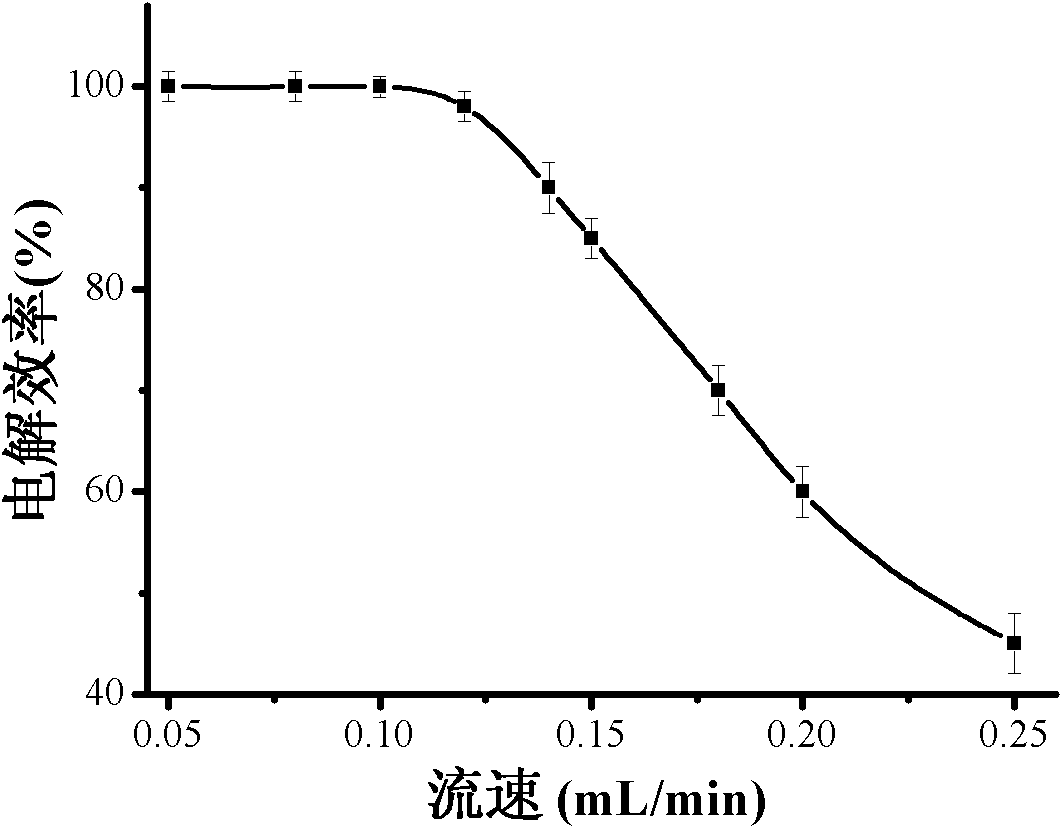
[0029] Embodiment 1, the electrolysis efficiency of electrochemical enzyme sensor device
[0030] Accurately weigh 0.23mg of ferrocenecarboxylic acid dissolved in 10mL of 0.1mol L -1 In PBS buffer solution (pH=7.4). The applied potential of the RVC electrode was set to 0.5V, the potential of the gold electrode was set to 0.3V, and 20 μL of ferrocene formic acid solution was injected, and the electrolysis efficiency of the RVC electrode was studied by adjusting the flow rate. Such as figure 2 As shown, when the flow rate is lower than 0.1mL·min -1 When , there is no obvious oxidation current on the gold electrode, that is, there is no electroactive substance in the solution. It shows that under this condition, the electrolysis efficiency of the device is 100%.
Embodiment 2
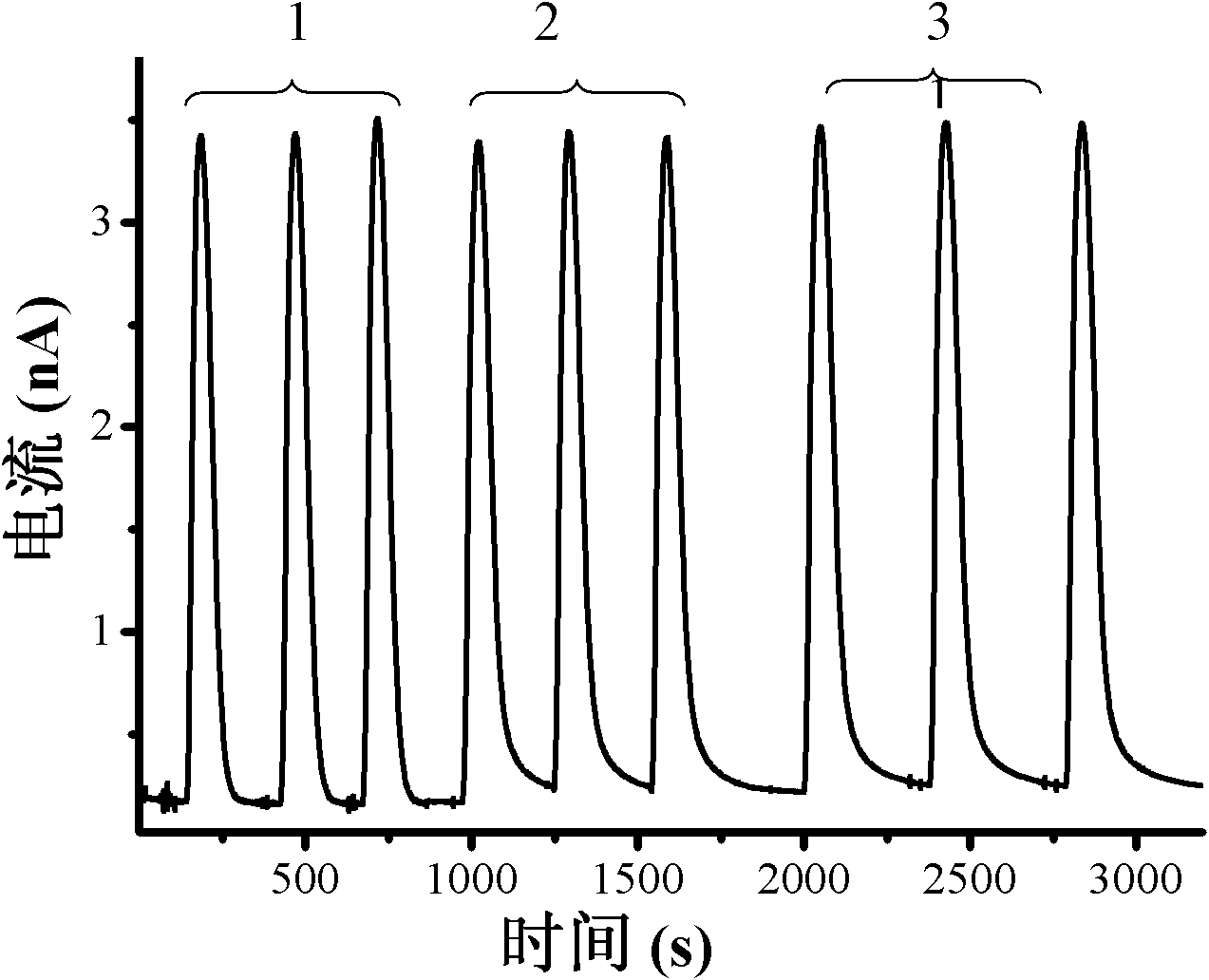
[0031] Embodiment 2, the mixed solution of glucose and different interferents in FcC 11 Electrochemical response of SH / GOD enzyme electrode
[0032] The following three solutions were injected into the device to measure FcC 11 The SH / GOD enzyme electrode responds to current.
[0033] Solution (1) contains 5.0mmol·L -1 0.1mol·L of glucose -1 PBS buffer solution,
[0034] Solution (2) contains 5.0mmol·L -1 Glucose, 0.1mmol·L -1 0.1mol L of acetaminophen -1 PBS buffer solution,
[0035] Solution (3) contains 5.0mmol·L -1 Glucose, 0.1mmol·L -1 Ascorbic acid, 0.5mmol·L -1 Uric acid and 0.1mmol·L -1 0.1mol L of acetaminophen -1 PBS buffer solution.
[0036] image 3 FcC 11 Response signal of SH / GOD enzyme electrode. Enzyme electrode surface assembled with FcC 11 Mixed double monolayers of SH and GOD. The potential of the RVC electrode is 0.8V, FcC 11 SH / GOD enzyme electrode potential is 0.5V, flow rate is 0.1mL min -1 . 1 for three consecutive injections of gluc...
Embodiment 3
[0037] Example 3, Different Glucose Concentrations and FcC 11 Correlation of SH / GOD Enzyme Electrode Current Response
[0038] First, accurately weigh 0.198g glucose and dissolve it in 10mL PBS solution (containing 0.1mol·L -1 KClO 4 ), the concentration is 100mmol·L -1 , diluted with PBS solution, prepared 0.05, 0.1, 0.3, 0.5, 0.8, 1.0, 3.0, 5.0, 8.0, 10.0, 15.0, 20.0, 30.0 and 40.0mmol·L -1 of glucose solution. Three consecutive injections of different concentrations of glucose solution, FcC 11 The relationship between the current and the glucose concentration of the mixed double monomolecular membrane electrode of SH and GOD is as follows Figure 4 shown. Enzyme electrode at glucose concentration of 0.05-40mmol·L -1 Within the range of FcC 11 The current response of the SH / GOD enzyme electrode is linear with the glucose concentration.
PUM
| Property | Measurement | Unit |
|---|---|---|
| Diameter | aaaaa | aaaaa |
| Porosity | aaaaa | aaaaa |
Abstract
Description
Claims
Application Information
 Login to View More
 - R&D
- Intellectual Property
- Life Sciences
- Materials
- Tech Scout
- Unparalleled Data Quality
- Higher Quality Content
- 60% Fewer Hallucinations
Browse by: Latest US Patents, China's latest patents, Technical Efficacy Thesaurus, Application Domain, Technology Topic, Popular Technical Reports.
© 2025 PatSnap. All rights reserved.Legal|Privacy policy|Modern Slavery Act Transparency Statement|Sitemap|About US| Contact US: help@patsnap.com