Unlock instant, AI-driven research and patent intelligence for your innovation.

Preparation method of titanium dioxide based composite nanofiber photocatalytic material

A technology of composite nanofibers and photocatalytic materials, applied in chemical instruments and methods, physical/chemical process catalysts, chemical/physical processes, etc., can solve problems such as hindering industrial application process, low sunlight utilization rate, and poor photon quantum efficiency , to achieve the effect of controllable structure, broad market prospect and no secondary pollution

Inactive Publication Date: 2014-12-24
曹铁平
View PDF2 Cites 0 Cited by
  • Summary
  • Abstract
  • Description
  • Claims
  • Application Information

AI Technical Summary

Problems solved by technology

[0003] However, in practical applications TiO 2 There are also two inherent defects. One is that the band gap is wide (anatase Eg=3.2eV), and it can only be excited by ultraviolet light with a wavelength less than λ<387.5nm, and ultraviolet light only accounts for about 5% of the solar spectrum. The utilization rate of sunlight is low; the second is that photogenerated electrons and holes are very easy to recombine, resulting in poor photon quantum efficiency, which hinders its industrial application process

Method used

the structure of the environmentally friendly knitted fabric provided by the present invention; figure 2 Flow chart of the yarn wrapping machine for environmentally friendly knitted fabrics and storage devices; image 3 Is the parameter map of the yarn covering machine
View more

Image

Smart Image Click on the blue labels to locate them in the text.
Viewing Examples
Smart Image
  • Preparation method of titanium dioxide based composite nanofiber photocatalytic material
  • Preparation method of titanium dioxide based composite nanofiber photocatalytic material
  • Preparation method of titanium dioxide based composite nanofiber photocatalytic material

Examples

Experimental program
Comparison scheme
Effect test

preparation example Construction

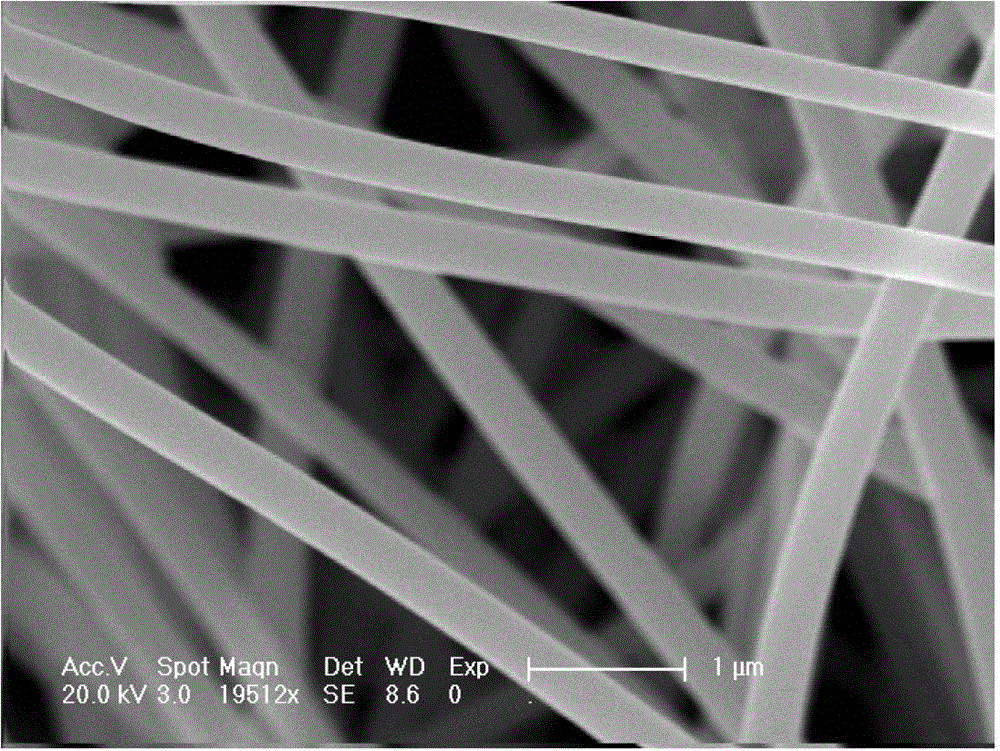
[0024] TiO 2 Preparation of nanofibers

[0025] Dissolve 1.0g of PVP in 10mL of absolute ethanol, and magnetically stir for 4h to obtain solution A; 1.5mL of n-butyl titanate (Ti(OBu) 4 ) was slowly added dropwise to the mixed solution of 3mL absolute ethanol and 3mL glacial acetic acid under stirring, and continued to stir for 30min to obtain solution B; at room temperature, slowly added solution B dropwise to solution A, and vigorously stirred for 2h to obtain PVP / Ti(OBu) 4 Sol.

[0026] Preparation of TiO using a commercially available electrospinning device 2 For nanofibers, the electrospinning device mainly consists of three parts: electrostatic high-voltage power supply, liquid supply device, and fiber collection device. Put an appropriate amount of PVP / Ti(OBu) 4 The sol is injected into the liquid supply device (syringe), and the metal electrode is inserted into the front capillary. Adjust the syringe tilt angle to approximately 45° from the horizontal. The dist...

Embodiment 1

[0029] CaTiO 3 / TiO 2 Preparation of composite nanofibers: weigh 0.023g Ca(NO 3 )2.4H 2 O dissolved in 20mL ethylene glycol and water (V 乙二醇 :V 水 =1:4) in the mixed solution, after it was completely dissolved, KOH solution was added dropwise to adjust the pH of the reaction solution to pH 11. Transfer to a 25mL polytetrafluoroethylene reactor, and then add 0.01gTiO 2 The fibers are sealed and placed in an oven for 24 hours at 180°C. Naturally cooled to room temperature, washed several times with distilled water and absolute ethanol, and dried in an oven at 60 °C for 10 h to obtain CaTiO 3 / TiO 2 Composite nanofiber photocatalytic materials.

[0030] Such as figure 2 Shown is the CaTiO that this embodiment makes 3 / TiO 2 The scanning electron microscope image of the composite nanofiber photocatalytic material, it can be clearly seen from the image that the sample still maintains the original fiber shape, but the surface is no longer smooth, and there are many CaTiO3...

Embodiment 2

[0032] BaTiO 3 / TiO 2 Preparation of composite nanofibers: weigh 0.026g Ba(NO 3 ) 2 Dissolve in 20mL ethylene glycol and water (V 乙二醇 :V 水 =1:5) in the mixed solution, after it was completely dissolved, sodium hydroxide solution was added dropwise to adjust the pH of the reaction solution to pH 11. Transfer to a 25mL polytetrafluoroethylene reactor, and then add 0.01gTiO 2 The fibers are sealed and then heated in an oven at 180°C for 12 hours. Naturally cooled to room temperature, washed several times with absolute ethanol and distilled water, and dried in an oven at 60 °C for 10 h to obtain BaTiO 3 / TiO 2 Composite nanofiber photocatalytic materials.

[0033] Such as image 3 Shown is the BaTiO that this embodiment makes 3 / TiO 2 The scanning electron microscope image of the composite nanofiber photocatalytic material, it can be clearly seen from the image that the sample still maintains the original fiber shape, but the surface is no longer smooth, and there are m...

the structure of the environmentally friendly knitted fabric provided by the present invention; figure 2 Flow chart of the yarn wrapping machine for environmentally friendly knitted fabrics and storage devices; image 3 Is the parameter map of the yarn covering machine
Login to View More

PUM

PropertyMeasurementUnit
diameteraaaaaaaaaa
decolorization rateaaaaaaaaaa
Login to View More

Abstract

The invention provides a preparation method of a titanium dioxide based composite nanofiber photocatalytic material. The preparation method comprises the following steps of: (1) dissolving a corresponding nitrate in a mixed solution of ethylene glycol and water, adjusting the pH of an obtained mixed solution to 10-12 after the nitrate is completely dissolved, then transferring the obtained mixed solution to a polytetrafluoroethylene reaction kettle, adding TiO2 nanofibers prepared by an electrostatic spinning method to the mixed solution, placing the reaction kettle in a drying oven, adjusting a reaction temperature to 120-180 DEG C, and controlling the heating time to 12-24h; and (2) naturally cooling a reaction system to room temperature, washing an obtained sample for several times by respectively using absolute ethyl alcohol and distilled water, and drying for 10-12h in the drying oven at the temperature of 60 DEG C to obtain the titanium dioxide based composite nanofiber photocatalytic material. The preparation method is simple in a synthesis technology and can be used for preparing the titanium dioxide based composite nanofiber photocatalytic material with the controlled shape, excellent performance and heterostructure; and the catalytic material has the advantages of high photocatalytic activity, easiness in separation, recovery and recycling and very wide market prospect.

Description

technical field [0001] The invention relates to a preparation method of a titanium dioxide-based composite nanofiber photocatalytic material. Background technique [0002] The research on photocatalytic oxidation originated from a paper published by Japan's Fujishima and Honda in the journal Nature in 1972, which marked the beginning of a new era in photocatalytic research. Under UV light irradiation, Carey et al. used TiO 2 Successfully degraded highly toxic polychlorinated biphenyls, thus opening up the application of semiconductor photocatalysis in environmental pollution treatment. Among many semiconductor photocatalytic materials, TiO 2 Because of its high photocatalytic activity, strong ultraviolet shielding, good thermal conductivity, good dispersion and low price, non-toxic, no secondary pollution and other advantages, it has become one of the most important photocatalytic semiconductor materials. Using electrospinning technology, organic polymer nanofibers are fi...

Claims

the structure of the environmentally friendly knitted fabric provided by the present invention; figure 2 Flow chart of the yarn wrapping machine for environmentally friendly knitted fabrics and storage devices; image 3 Is the parameter map of the yarn covering machine
Login to View More

Application Information

Patent Timeline
no application Login to View More
Patent Type & Authority Patents(China)
IPC IPC(8): B01J23/02B01J23/14B01J35/06
Inventor 曹铁平李跃军
Owner 曹铁平