
Fluorescent test paper capable of rapidly detecting formaldehyde and application of fluorescent test paper
A test strip and fluorescence technology, applied in the field of analytical chemistry, can solve the problems of large volume, limited scope, short working life, etc., and achieve the effects of good fluorescence emission spectrum characteristics, simple and easy synthesis process, and easy preparation.
- Summary
- Abstract
- Description
- Claims
- Application Information
AI Technical Summary
Problems solved by technology
Method used
Image

Examples
Embodiment 1
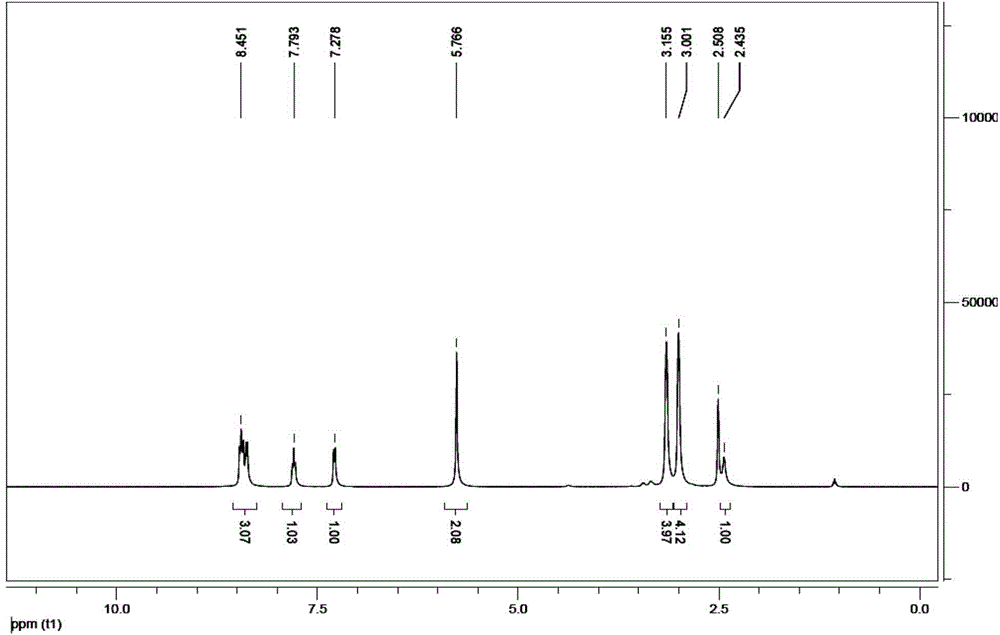
[0033] Example 1: Preparation of N-amino-4-(1-piperazinyl)-1,8-naphthalimide
[0034] Add hydrazine hydrate (80%, 62.5mg, 1mmol), 4-bromo-1,8-naphthalic anhydride (276mg, 1mmol) and ethanol (10mL) into a 50mL single-necked flask, reflux for 4 hours, and cool to room temperature Filter and dry to obtain 240mg of light gray solid. Add this solid, anhydrous piperazine (258mg, 3mmol) and ethylene glycol monomethyl ether (10mL) into a 50mL one-necked flask, reflux for 6 hours under nitrogen protection, cool to room temperature and distill under reduced pressure to obtain a dark brown viscous solid .
[0035] The sticky solid was purified by column chromatography (eluant: methanol containing 5% triethylamine) to give a yellow solid. The obtained yellow solid, 10 mL of distilled water, and 5 mL of methanol were added into a 50 mL single-necked flask, stirred at room temperature for 24 hours, filtered, and dried to obtain a light yellow product with a yield of 67%. The probe's 1 H...
Embodiment 2
[0037] Embodiment 2: the preparation of the fluorescent test paper of rapid detection formaldehyde of the present invention
[0038] (1) Using methanol as a solvent to prepare a solution of N-amino-4-(1-piperazinyl)-1,8-naphthalimide with a concentration of 1 mM;
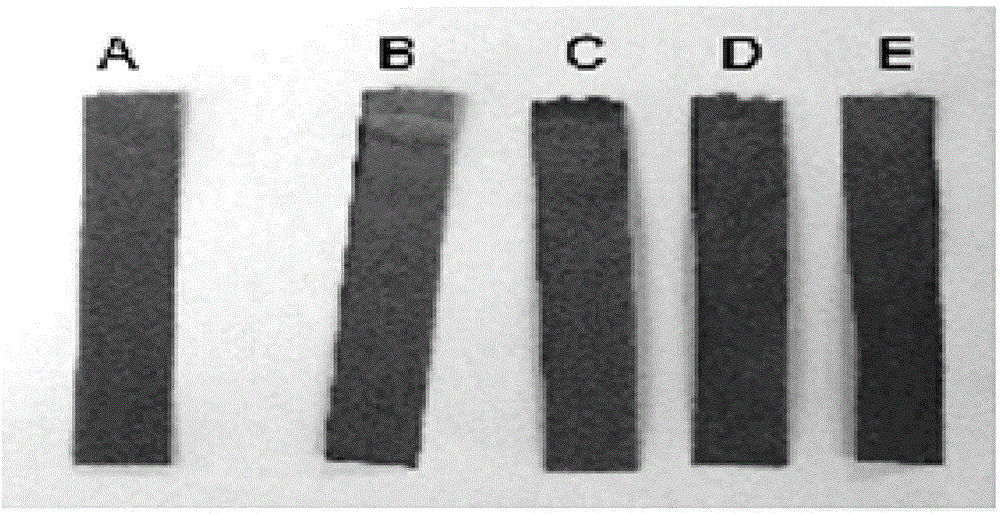
[0039] (2) Soak dark green precision pH test paper (length × width × thickness is 75mm × 10mm × 0.7mm) in the solution prepared in step (1), take it out after 10 minutes, and dry it at room temperature to obtain dark green color. Fluorescent test paper that can quickly detect formaldehyde without fluorescence under ultraviolet light (see figure 2 ).
Embodiment 3
[0040] Embodiment 3: the selectivity of N-amino-4-(1-piperazinyl)-1,8-naphthalimide to different substances
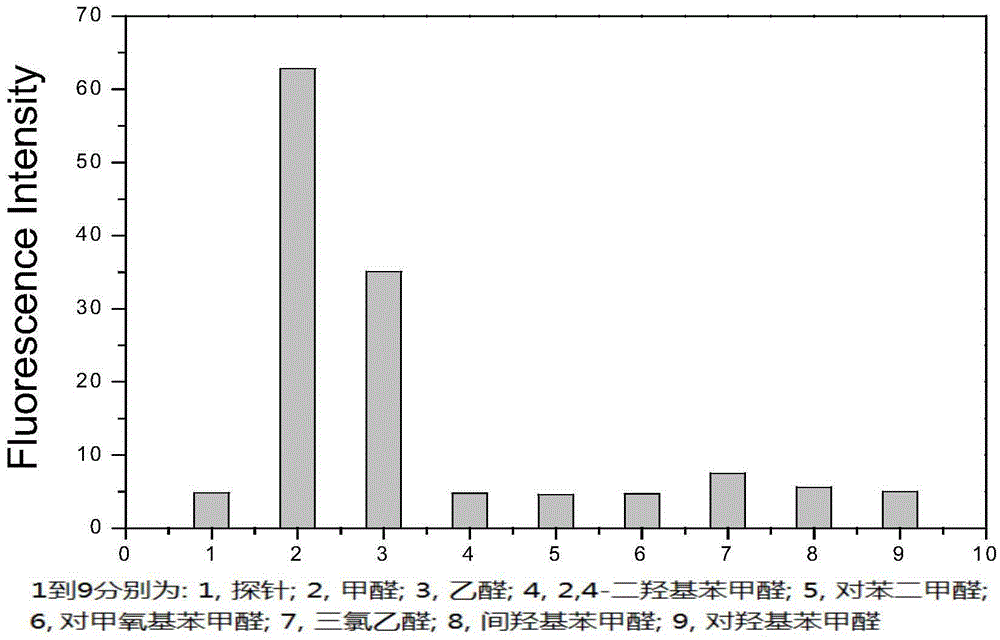
[0041] Prepare 8 parts of 5 mL of 10 μM N-amino-4-(1-piperazinyl)-1,8-naphthoimide probe acetonitrile solution (containing 5% acetic acid), and then add to the 8 parts of the system in sequence 50 µL of formaldehyde, acetaldehyde, 2,4-dihydroxybenzaldehyde, terephthalaldehyde, p-methoxybenzaldehyde, chloral, m-hydroxybenzaldehyde, and p-hydroxybenzaldehyde in acetonitrile at a concentration of 10 mM. Fluorescence detection was then performed (λ Ex =380nm,λ Em =513nm); Calculate the fluorescence intensity in each system, see the results image 3 .
PUM
 Login to View More
 Abstract
Description
Claims
Application Information
 Login to View More