
A kind of monolithic material of phospholipid organic polymer and its preparation method and application
A technology of monolithic materials and polymers, applied in the field of protein purification, can solve the problems of incompatibility between specificity and recovery, lack of specificity, reproducibility, and purity to be further verified
- Summary
- Abstract
- Description
- Claims
- Application Information
AI Technical Summary
Problems solved by technology
Method used
Image

Examples
Embodiment 1
[0037] Phospholipid monomer compound 2-methacryloyloxyethylphosphorylcholine (2-methacryloyloxyethylphosphorylcholine, MPC), cross-linking agent MBA, porogen (mixed system of IPA and THF) and initiator AIBN, according to the optimal ratio Prepare a polymerization reaction mixed solution, ultrasonically dissolve, degas, and pour into a 200 μL pipette tip, then seal both ends of the pipette tip, and put it in a 60°C water bath for 12 hours; after the reaction, put the pipette tip with The syringe was connected, and the porogen, unreacted monomer, cross-linking agent and oligomer were washed away with methanol on the peristaltic pump to obtain a phospholipid organic polymer monolithic column (poly(MPC-co-MBA)). Wherein the mass ratio of monomer MPC and porogen is 25:75, the mass ratio of monomer MPC and crosslinking agent MBA is 70:30, the mass ratio of porogen IPA and THF is 60:40, and the mass ratio of initiator AIBN The mass is 1% of the monomeric MPC.
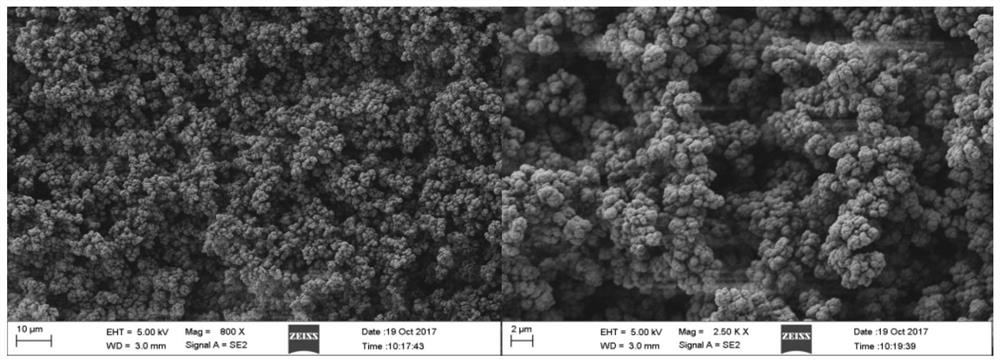
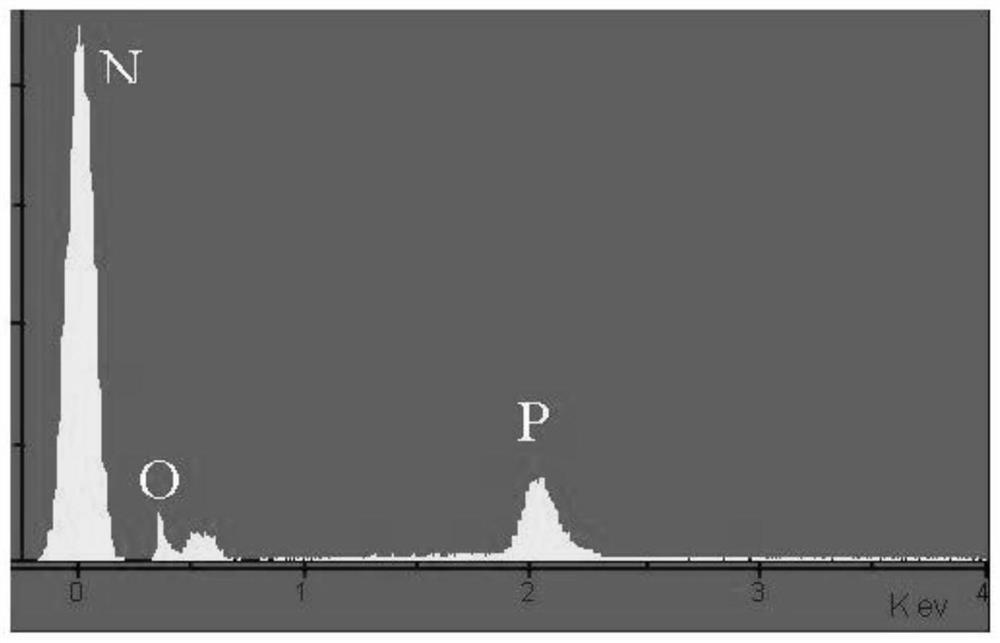
[0038] The scanning e...
Embodiment 2
[0040] The phospholipid monomer compound MPC, the cross-linking agent PDA, the porogen (a mixed system of DMSO and THF) and the initiator AIBN were formulated into a polymerization reaction mixed solution according to the optimal ratio, ultrasonically dissolved, degassed, and poured into a 200 μL pipette Then seal both ends of the pipette tip and put it in a 60°C water bath to react for 12 hours; after the reaction is completed, connect the pipette tip to the syringe, and rinse off the porogen and unreacted porogen with methanol on the peristaltic pump. Monomers, cross-linking agents and oligomers were used to obtain poly(MPC-co-PDA) organic polymer monoliths. Wherein the mass ratio of monomer MPC and porogen is 15:85, the mass ratio of monomer MPC and crosslinking agent PDA is 80:20, the mass ratio of DMSO and THF is 40:60 in the porogen, and the mass ratio of initiator The mass is 1% of the total amount of monomeric MPC.
Embodiment 3
[0042] The phospholipid monomer compound MPC, the cross-linking agent EDMA, the porogen (a mixed system of IPA and BDO) and the initiator AIBN were formulated into a polymerization reaction mixed solution according to the optimal ratio, dissolved by ultrasonic, degassed, and poured into a 200 μL pipette Then seal both ends of the pipette tip and put it in a 60°C water bath for 12 hours of reaction; porogens and oligomers to obtain poly(MPC-co-EDMA) organic polymer monoliths. Wherein the mass ratio of monomer MPC and porogen is 15:85, the mass ratio of monomer MPC and crosslinking agent EDMA is 53:47, the mass ratio of IPA and BDO is 25:75 in the porogen, and the mass ratio of initiator The mass is 1% of the mass of monomeric MPC.
PUM
 Login to View More
 Abstract
Description
Claims
Application Information
 Login to View More