Check patentability & draft patents in minutes with Patsnap Eureka AI!

Method for preparing 2,3-dichloropyridine through Sandmeyer reaction catalyst

A technology of dichloropyridine and catalyst, applied in the field of preparation of pyridine derivatives, can solve problems such as difficult separation, complex composition, difficulty in separating target products, etc., and achieve the effect of saving funds

Inactive Publication Date: 2018-10-02
JIANGSU VOCATIONAL COLLEGE OF MEDICINE
View PDF3 Cites 0 Cited by
  • Summary
  • Abstract
  • Description
  • Claims
  • Application Information

AI Technical Summary

Problems solved by technology

The advantage of the pyridine direct chlorination method is that the supply of raw material pyridine is abundant, but due to the final mixture with complex composition, it is not easy to separate, resulting in more impurities and low conversion rate
The advantage of the 2-chloropyridine method is that the starting material pyridine is rich in sources, but the disadvantage is that it is difficult to separate the target product and the yield is low
The starting material 3-chloropyridine in the 3-chloropyridine method has a relatively high price, and there is a problem that the product yield is not high
The 2,3,6-trichloropyridine reduction method has high requirements on operating conditions and reaction equipment, which brings great difficulty in safe operation
However, the current production of 1 ton of 2,3-dichloropyridine will produce 50 tons of wastewater containing heavy metal ions, which does not meet the requirements of green environmental protection.

Method used

the structure of the environmentally friendly knitted fabric provided by the present invention; figure 2 Flow chart of the yarn wrapping machine for environmentally friendly knitted fabrics and storage devices; image 3 Is the parameter map of the yarn covering machine
View more

Image

Smart Image Click on the blue labels to locate them in the text.
Viewing Examples
Smart Image
  • Method for preparing 2,3-dichloropyridine through Sandmeyer reaction catalyst
  • Method for preparing 2,3-dichloropyridine through Sandmeyer reaction catalyst
  • Method for preparing 2,3-dichloropyridine through Sandmeyer reaction catalyst

Examples

Experimental program
Comparison scheme
Effect test

Embodiment 1

[0029] Embodiment 1: the synthesis of 2,3-dichloropyridine

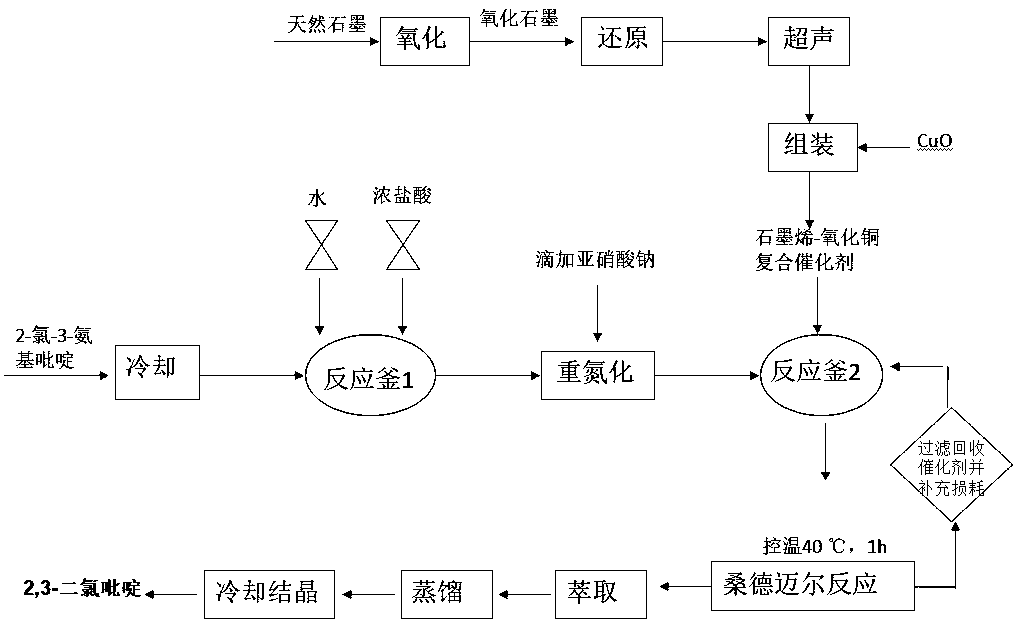
[0030] The natural graphite was treated with concentrated sulfuric acid-potassium permanganate system to obtain graphite oxide, then ultrasonicated for 1 hour in the presence of hydrazine hydrate, and copper oxide was added to continue ultrasonic oscillation for 30 minutes to prepare a graphene-copper oxide composite catalyst. The mass fraction of copper in the composite catalyst is about 50-55%.

[0031] Put 400ml of industrial hydrochloric acid (3.5mol) in a 1000ml three-necked flask, cool down to -5°C with an ice-salt bath, turn on electromagnetic stirring, slowly add 129g (1mol) of 2-chloro-3-aminopyridine, and continue stirring to make 2-chloro -3-aminopyridine fully dissolved; then 70g NaNO 2 (1mol) dissolved in 150ml of water and slowly added dropwise to the above-mentioned three-neck flask, the temperature was controlled at 0~-5°C, after the dropwise addition was completed, keep warm at -5°C for use.

[003...

Embodiment 2

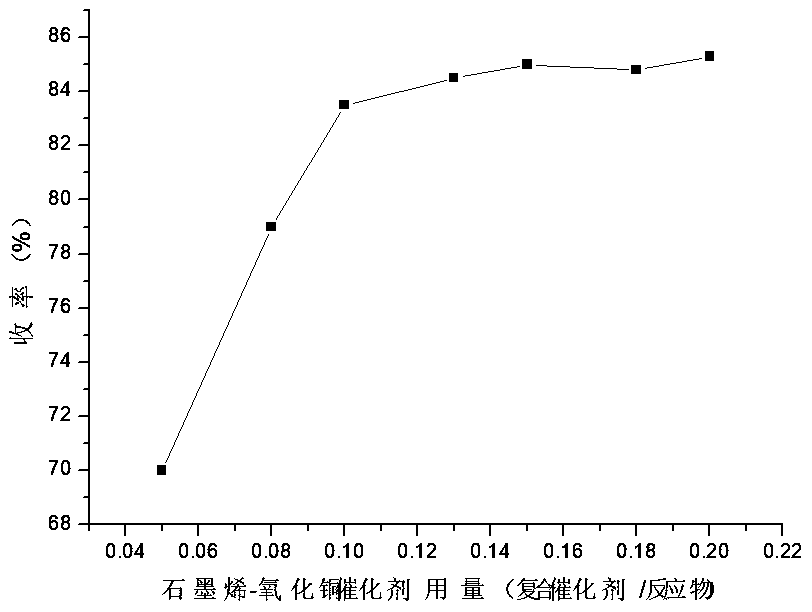
[0033] Embodiment 2: the impact of self-made catalyst consumption on reaction yield

[0034] In this example, the other reaction conditions were kept constant, and the influence of the amount of catalyst on the reaction yield was investigated.

[0035] The experimental results are attached figure 2 It can be seen that the yield of the reaction increases with the increase of the amount of catalyst. When the molar ratio of 2-chloro-3-aminopyridine to the catalyst reached 1:0.1, and then continued to increase the amount of the catalyst, the yield of the reaction remained basically unchanged. From the perspective of cost saving, we determined that the amount of catalyst used was 0.1 times that of 2-chloro-3-aminopyridine. Simultaneously, the results of parallel experiments show that the yield (80-85%) that can be achieved under this condition is slightly higher than that of the traditional process (using 0.2 times the equivalent of cuprous chloride catalyst, the yield is 78%). ...

Embodiment 3

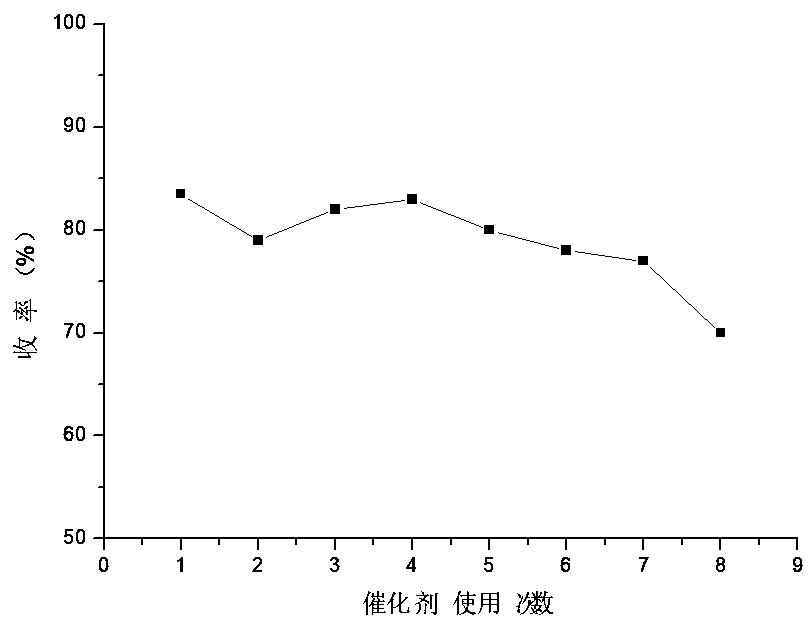
[0036] Embodiment 3: recovery and reuse of self-made catalyst

[0037] In the traditional production process, after the Sandmeyer reaction is completed, the target product is obtained by steam distillation or extraction separation, and the remaining residual liquid is discharged as three wastes, and a large amount of copper-containing wastewater is released in vain, which not only brings economic losses, but also It will cause environmental pollution, so the present invention explores the recovery and reuse of self-made composite catalysts. After the Sandmeyer reaction is completed, the pH value of the strongly acidic raffinate is adjusted to weakly acidic by using the alkaline waste liquid of the first step reaction , filter out the catalyst, and add part of the new catalyst according to the actual consumption for the next reaction. The fixed catalyst consumption is 0.1 times equivalent of the reactant, and the reaction is repeated 8 times, and the experimental results are as...

the structure of the environmentally friendly knitted fabric provided by the present invention; figure 2 Flow chart of the yarn wrapping machine for environmentally friendly knitted fabrics and storage devices; image 3 Is the parameter map of the yarn covering machine
Login to View More

PUM

PropertyMeasurementUnit
melting pointaaaaaaaaaa
Login to View More

Abstract

The invention relates to a method for preparing 2,3-dichloropyridine through a Sandmeyer reaction catalyst. The method comprises the following steps: i, obtaining graphite oxide from natural graphiteand performing ultrasonic stripping, and performing molecular assembly on the graphite oxide and copper oxide so as to obtain a graphene-copper oxide composite catalyst; ii, adding 2-chloro-3-pyridinamine and concentrated hydrochloric acid into a first reactor, cooling to 5 DEG C below zero, slowly dropping an aqueous solution of sodium nitrite, and controlling the temperature to 5 DEG C below zero for later use; iii, adding hydrochloric acid and the composite catalyst into a second reactor, dropping the mixed solution in the first reactor under nitrogen protection, gradually raising the temperature to 40 DEG C after dropping, reacting for an hour, extracting with dichloromethane, and performing organic phase rotary evaporation, thereby obtaining the crude 2,3-dichloropyridine. According to the 2,3-dichloropyridine prepared by the method disclosed by the invention, the production cost can be reduced, the used graphene-copper oxide composite catalyst can be repeatedly utilized, and heavy metal pollution brought by copper in liquid waste can be reduced.

Description

technical field [0001] The invention relates to the technical field of preparation of pyridine derivatives, in particular to a method for preparing 2,3-dichloropyridine through a Sandmeyer reaction catalyst. Background technique [0002] 2,3-Dichloropyridine is a very important fine chemical intermediate, which is widely used in the synthesis of pesticides. For example, in the synthesis process of the new insecticide chlorantraniliprole, 2,3-dichloropyridine is the key intermediate. In 2007, DuPont's chlorantraniliprole insecticide went on the market and was widely recognized by the market. In 2008, the sales volume was 55 million US dollars, in 2011 it exceeded 600 million US dollars, and in 2014 it further increased to 1.2 billion US dollars. In addition, 2,3-dichloropyridine is widely used in the preparation of various medicines and pesticides, and can be used to synthesize antibiotics, drugs for treating cardiovascular and other diseases, agricultural insecticides, herb...

Claims

the structure of the environmentally friendly knitted fabric provided by the present invention; figure 2 Flow chart of the yarn wrapping machine for environmentally friendly knitted fabrics and storage devices; image 3 Is the parameter map of the yarn covering machine
Login to View More

Application Information

Patent Timeline
no application Login to View More
Patent Type & Authority Applications(China)
IPC IPC(8): C07D213/61B01J23/72
CPCB01J23/72C07D213/61
Inventor 张玲司乃元张馨月周瑶施丽张家伟
Owner JIANGSU VOCATIONAL COLLEGE OF MEDICINE
Features
  • R&D
  • Intellectual Property
  • Life Sciences
  • Materials
  • Tech Scout
Why Patsnap Eureka
  • Unparalleled Data Quality
  • Higher Quality Content
  • 60% Fewer Hallucinations
Social media
Patsnap Eureka Blog
Learn More