Zirconia ceramic bone implant and preparation method thereof
What is AI technical title?
AI technical title is built by Patsnap AI team. It summarizes the technical point description of the patent document.
A technology of zirconia ceramics and bone implantation
Active Publication Date: 2019-02-15
北京安颂科技有限公司
View PDF3 Cites 7 Cited by
Summary
Abstract
Description
Claims
Application Information
AI Technical Summary
This helps you quickly interpret patents by identifying the three key elements:
Problems solved by technology
Method used
Benefits of technology
Problems solved by technology
However, for large-sized and complex-shaped ceramic materials, the probability of uneven distribution of the microwave field during microwave sintering is greatly increased. In addition, due to the reasons of the ceramic itself, such as large thermal expansion coefficient and low thermal conductivity, uneven heating is prone to occur. In severe cases, it will cause the material to crack
[0007] Conventional sintering methods are mostly used in the existing technology to prepare zirconia-mullite composite ceramics. The mullite content is generally greater than 20% and the grain size is large, so it is difficult to ensure the density of ceramics.
Method used
the structure of the environmentally friendly knitted fabric provided by the present invention; figure 2 Flow chart of the yarn wrapping machine for environmentally friendly knitted fabrics and storage devices; image 3 Is the parameter map of the yarn covering machine
View more
Image
Smart Image Click on the blue labels to locate them in the text.
Viewing Examples
Smart Image
Click on the blue label to locate the original text in one second.
Reading with bidirectional positioning of images and text.
Smart Image
Examples
Experimental program
Comparison scheme
Effect test
Embodiment 1
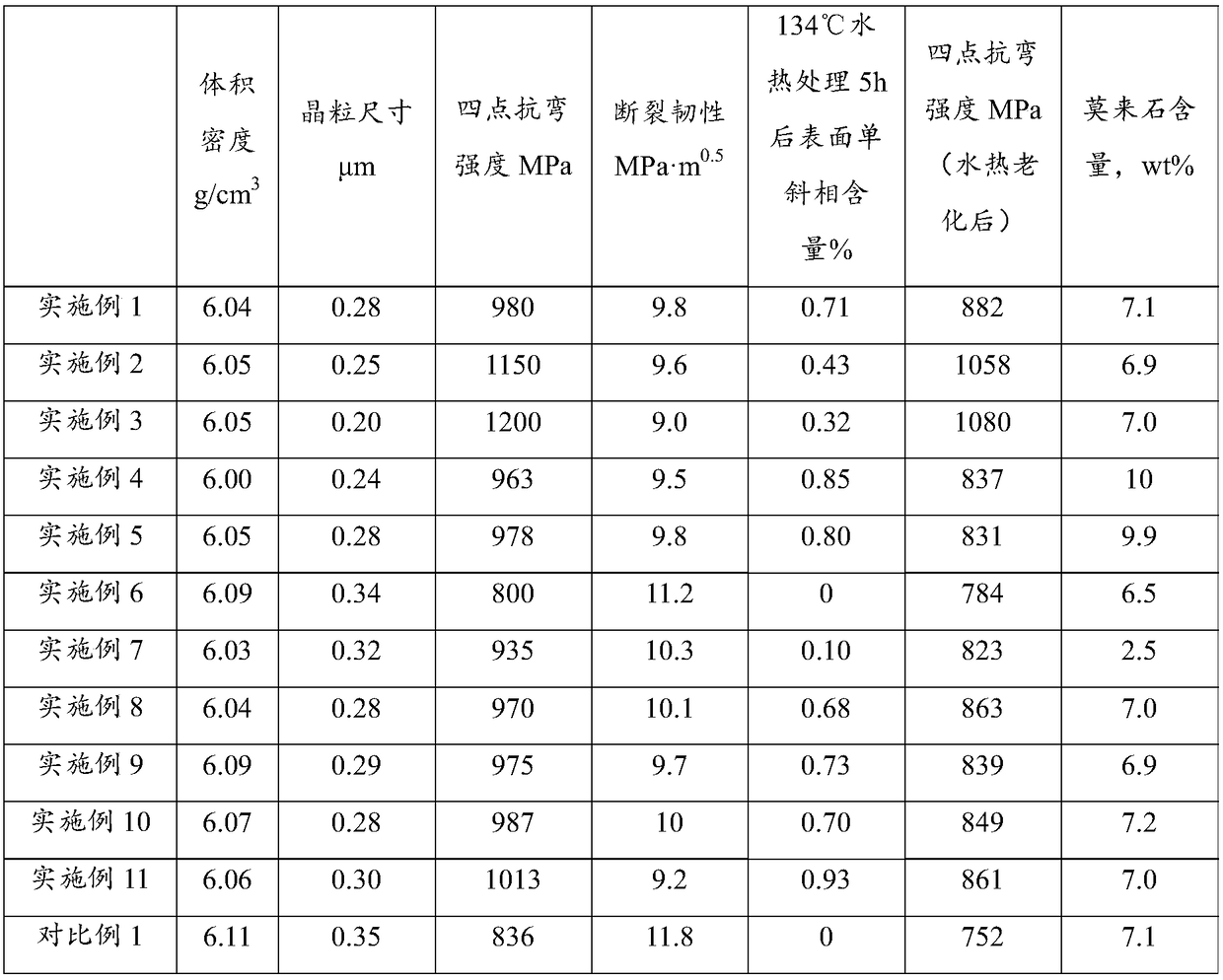
[0058] The first step, mixing zirconia powder, stabilizer A, acidic silica sol (concentration: 10wt%) and aluminum sol (concentration: 10wt%), wet grinding for 30h to obtain slurry; based on the weight of zirconia powder , the addition of stabilizer A, acidic silica sol (calculated as silica), and aluminum sol (calculated as alumina) are respectively 5%, 3%, and 7.5%; stabilizer A is yttriumoxide, and the particle size is ≤5 μm; The purity of zirconia fine powder is: ZrO 2 +HfO 2 ≥99.9wt%, particle size ≤74μm;
[0059] In the second step, water is added to the slurry, mixed evenly, and spray-dried to obtain particles;
[0060] The third step is to cool the particles in the mold at 250MPa to obtain a green body;
[0061] Step 4: After drying the green body, heat it at 1000°C for 5 hours to complete the pre-calcination to obtain the green body;
[0062] The fifth step is to sinter the biscuit in a microwave sintering furnace at 1200° C. for 1 hour to obtain zirconia ceramic...
Embodiment 2
[0064] The difference from Example 1 is that the amount of stabilizer A added is different, specifically as follows.
[0065] The first step, mixing zirconia powder, stabilizer A, acidic silica sol (concentration: 10wt%) and aluminum sol (concentration: 10wt%), wet grinding for 30h to obtain slurry; based on the weight of zirconia powder , the addition of stabilizer A, acidic silica sol (calculated as silica), and aluminum sol (calculated as alumina) are respectively 8%, 3%, and 7.5%; stabilizer A is yttriumoxide, and the particle size is ≤5 μm; The purity of zirconia fine powder is: ZrO 2 +HfO 2 ≥99.9wt%, particle size ≤74μm;
[0066] In the second step, water is added to the slurry, mixed evenly, and spray-dried to obtain particles;
[0067] The third step is to cool the particles in the mold at 250MPa to obtain a green body;
[0068] Step 4: After drying the green body, heat it at 1000°C for 5 hours to complete the pre-calcination to obtain the green body;
[0069] Th...
Embodiment 3
[0071] The difference from Example 1 is that the amount of stabilizer A added is different, specifically as follows.
[0072] The first step, mix zirconia powder, stabilizer A, acidic silica sol (calculated as silicon dioxide), and aluminum sol (calculated as alumina), and wet grind for 30 hours to obtain slurry; the weight of zirconia powder is Benchmark, the addition amount of stabilizer A and acidic silica sol (calculated as silica) is 10%, 3%, 7.5% respectively; stabilizer A is yttriumoxide, particle size ≤ 5 μm; zirconia fine powder purity: ZrO 2 +HfO 2 ≥99.9wt%, particle size ≤74μm;
[0073] In the second step, water is added to the slurry, mixed evenly, and spray-dried to obtain particles;
[0074] The third step is to cool the particles in the mold at 250MPa to obtain a green body;
[0075] Step 4: After drying the green body, heat it at 1000°C for 5 hours to complete the pre-calcination to obtain the green body;
[0076] The fifth step is to sinter the biscuit in...
the structure of the environmentally friendly knitted fabric provided by the present invention; figure 2 Flow chart of the yarn wrapping machine for environmentally friendly knitted fabrics and storage devices; image 3 Is the parameter map of the yarn covering machine
Login to View More
PUM
Property
Measurement
Unit
particle diameter
aaaaa
aaaaa
particle diameter
aaaaa
aaaaa
density
aaaaa
aaaaa
Login to View More
Abstract
The invention provides a zirconia ceramicbone implant and a preparation method thereof. The preparation method comprises the following steps of: mixing and grinding zirconia powder, a stabilizer A, acidic silica sol and aluminum sol to obtain slurry; adding a solvent to the slurry, and carrying out mixing and spray drying to obtain microparticles; placing the microparticles in a mold, carrying out cold forming under 150 to 500 MPa so as to obtain a green body; pre-firing the green body at 700 to 1200 DEG C so as to obtain a biscuit; putting the biscuit in a microwavesintering furnace at 900to 1500 DEG C for 0.2 to 2h so as to obtain zirconia ceramic; and processing the zirconia ceramic to obtain the zirconia ceramicbone implant. According to the preparation method, ways of combining Y / Yb doping, pre-firing and microwavesintering, and in-situ generating mullite by silica sol and aluminum sol are adopted, and a few mullite crystalline grains are prepared to be dispersed on a bone implant of a zirconia matrix, so that the crystalline grain size, density, mechanical properties and hydrothermal ageing resistance of the zirconia ceramic bone implant are improved.
Description
technical field [0001] The invention relates to the field of ceramic materials, in particular to a zirconia ceramic bone implantprosthesis and a preparation method thereof. Background technique [0002] Zirconia (ZrO 2 ) is chemically inactive, has the characteristics of high melting point, high refractive index, low thermal expansion coefficient and excellent biocompatibility, and is widely used in the fields of refractory materials, structural ceramics, bioceramics and electronic functional ceramics. Zirconia has three crystal forms: monoclinic phase with a density of 5.65g / cm 3 , the stable temperature is lower than 1100℃; tetragonal phase, the density is 6.10g / cm 3 , the stable temperature range is 1100-2300 ° C; cubic phase, the density is 6.27g / cm 3 , and the stable temperature is higher than 2300°C. Therefore, at room temperature, zirconia exists in the form of monoclinic phase. [0003] During the sintering process of zirconia, a monoclinic phase will occur T...
Claims
the structure of the environmentally friendly knitted fabric provided by the present invention; figure 2 Flow chart of the yarn wrapping machine for environmentally friendly knitted fabrics and storage devices; image 3 Is the parameter map of the yarn covering machine
Login to View More
Application Information
Patent Timeline
Application Date:The date an application was filed.
Publication Date:The date a patent or application was officially published.
First Publication Date:The earliest publication date of a patent with the same application number.
Issue Date:Publication date of the patent grant document.
PCT Entry Date:The Entry date of PCT National Phase.
Estimated Expiry Date:The statutory expiry date of a patent right according to the Patent Law, and it is the longest term of protection that the patent right can achieve without the termination of the patent right due to other reasons(Term extension factor has been taken into account ).
Invalid Date:Actual expiry date is based on effective date or publication date of legal transaction data of invalid patent.


 Login to View More