A Strain of Streptomyces oryzae and Its Application in Controlling Wheat Root Rot and Stem Rot
A technology of Streptomyces oryzae and biocontrol agents, applied in application, microorganism-based methods, bacteria, etc., can solve problems such as enhanced drug resistance of pathogenic bacteria, ineffective chemical control methods, and environmental pollution.
- Summary
- Abstract
- Description
- Claims
- Application Information
AI Technical Summary
Problems solved by technology
Method used
Image

Examples
Embodiment 1
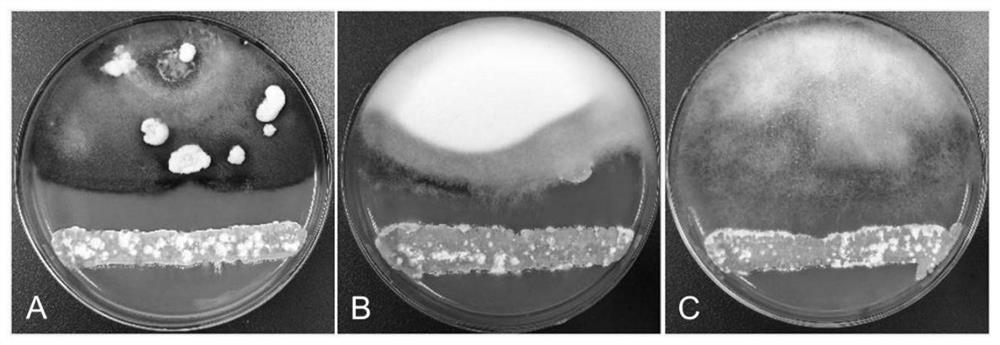
[0016] Embodiment 1, the screening of antagonizing Umbilaria graminis, Fusarium graminearum and Pseudofusarium graminearum
[0017] 1. Isolation and storage of actinomycetes
[0018] Collect a 5-10cm sample of the sediment surface layer of the Qilihai Lagoon in Beidaihe, weigh 10g of the sediment, put it into a triangular flask filled with 90ml of sterile water, shake it for 30min at 30°C and 150rpm, and obtain a dilution of 10 -1 bacterial suspension. Take 1ml of the above-mentioned sediment bacterial suspension, add it to a test tube filled with 9ml sterile water, vortex and mix well, and obtain a dilution of 10 -2 Bacterial suspension; do 10-fold gradient dilution to 10 by the above method -4 . Take 10 respectively -1 to 10 -4 20 μl of the bacterial suspension was evenly spread on Gaoshi No. 1 medium plate (soluble starch 20g / L, KNO 3 1g / L, NaCl 0.5g / L, K 2 HPO 4 ·3H 2 O 0.5g / L, MgSO 4 ·7H 2 O0.5g / L, FeSO 4 ·7H 2 O 0.5g / L, agar 15g / L, pH 7.2~7.4; add K with ...
Embodiment 2
[0021] Physiological and biochemical characteristics and species identification of embodiment 2, Q1C-5 bacterial strain
[0022] 1. Physiological and biochemical characteristics of the strain
[0023] Colony color and shape observation method. Take the preserved Q1C-5 strain, and use the plate streaking method to streak continuously on the Gaoshi No. 1 plate and the PSA plate respectively, and culture the streaked plate upside down in a 30°C incubator until a single colony appears.
[0024] Strain enzyme production detection method. Lipase detection medium: beef extract 3g / L, peptone 10g / L, tributyrin 6ml / L, NaCl 10g / L, agar 20g / L. Cellulose detection medium; carboxymethylcellulose 5g / L, NaNO 3 1g / L, K 2 HPO 4 2g / L, KCl 1g / L, MgSO 4 .7H 2 O 0.5g / L, yeast powder 2g / L, glucose 1g / L, NaCl 10g / L, agar 20g / L. Protease detection medium: skimmed milk powder 15g / L, yeast powder 2g / L, NaCl 10g / L, agar 20g / L. Amylase detection medium: starch 5g / L, yeast powder 2g / L, (NH 4 ) ...
Embodiment 3
[0034] Embodiment 3, Streptomycesmisionensis Q1C-5CGMCC NO.18008 on wheat root rot Inhibitory Physiological Characteristics of Helminthroides, Fusarium graminearum and Pseudomonas graminearum
[0035] 1. Physiological characteristics of Q1C-5 inhibiting wheat pathogenic fungi in confrontation culture
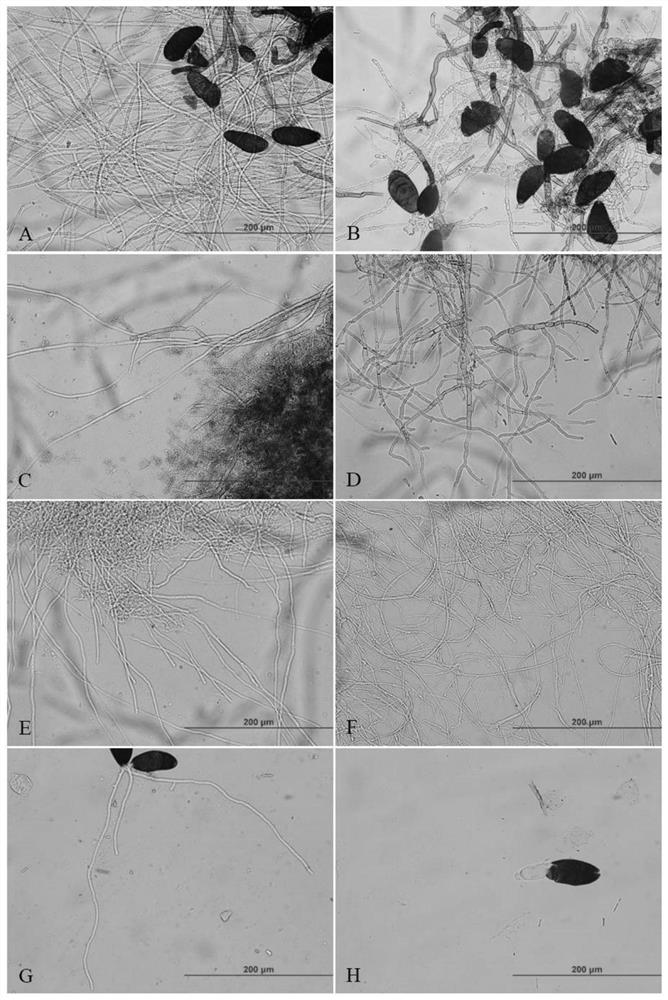
[0036] According to the method described in the second step in Example 1, Streptomyces misionensis Q1C-5 was cultured in confrontation with Umbilium solani, Fusarium graminearum and Fusarium graminearum respectively, and then cultivated at 30°C until When the leading edge mycelium of pathogenic fungi grows to 3cm on the side not connected with actinomycetes, measure the colony radius of the pathogenic fungi connected with actinomycetes at this moment, and according to the formula: inhibition rate=[(3cm-pathogenic fungi colony growth radius) / 3cm]×100%, calculate the inhibitory rate of actinomycetes Q1C-5 to above three strains of pathogenic fungi; , and then observed under a...
PUM
 Login to View More
 Abstract
Description
Claims
Application Information
 Login to View More
 - R&D
- Intellectual Property
- Life Sciences
- Materials
- Tech Scout
- Unparalleled Data Quality
- Higher Quality Content
- 60% Fewer Hallucinations
Browse by: Latest US Patents, China's latest patents, Technical Efficacy Thesaurus, Application Domain, Technology Topic, Popular Technical Reports.
© 2025 PatSnap. All rights reserved.Legal|Privacy policy|Modern Slavery Act Transparency Statement|Sitemap|About US| Contact US: help@patsnap.com