Check patentability & draft patents in minutes with Patsnap Eureka AI!

Application of carbon material coated nickel nanoparticle catalyst in synthesis of p-aminophenylacetic acid by hydrogenation of p-nitrophenylacetic acid

A technology of p-nitrophenylacetic acid and p-aminophenylacetic acid is applied in the preparation of organic compounds, physical/chemical process catalysts, metal/metal oxide/metal hydroxide catalysts, etc. "Three wastes" treatment of large investment, catalyst can not be reused and other problems, to achieve the effect of green and efficient preparation method, low production cost, easy to operate

Pending Publication Date: 2021-12-03
ZHEJIANG UNIV OF TECH
View PDF2 Cites 0 Cited by
  • Summary
  • Abstract
  • Description
  • Claims
  • Application Information

AI Technical Summary

Problems solved by technology

However, there are many disadvantages in the above methods: method ① Pd / C catalyst is mostly used now, and the production cost of precious metal catalyst is high and it is not easy to recycle; method ② discharges a large amount of sulfur-containing wastewater, which causes serious harm to the ecological environment, and the investment in "three wastes" treatment is relatively large. Does not conform to the concept of green chemistry; method ③ produces a large amount of iron sludge, the purity of the product cannot be guaranteed, the reduced product cannot be directly used for drug synthesis, and the catalyst cannot be reused
④ Hydrazine hydrate is highly toxic, and the recovery and treatment of waste liquid in the later stage is cumbersome

Method used

the structure of the environmentally friendly knitted fabric provided by the present invention; figure 2 Flow chart of the yarn wrapping machine for environmentally friendly knitted fabrics and storage devices; image 3 Is the parameter map of the yarn covering machine
View more

Image

Smart Image Click on the blue labels to locate them in the text.
Viewing Examples
Smart Image
  • Application of carbon material coated nickel nanoparticle catalyst in synthesis of p-aminophenylacetic acid by hydrogenation of p-nitrophenylacetic acid
  • Application of carbon material coated nickel nanoparticle catalyst in synthesis of p-aminophenylacetic acid by hydrogenation of p-nitrophenylacetic acid
  • Application of carbon material coated nickel nanoparticle catalyst in synthesis of p-aminophenylacetic acid by hydrogenation of p-nitrophenylacetic acid

Examples

Experimental program
Comparison scheme
Effect test

Embodiment 1

[0076] Weigh a certain amount of nickel nitrate hexahydrate and 4-pyridinecarboxylic acid and dissolve in a certain amount of absolute ethanol, the molar ratio of nickel to organic ligand is 1:2; the mass ratio of nickel to alcohol solution is 1:100. Heat at 25°C After stirring for 6 hours, add 1.0 mol / L sodium hydroxide aqueous solution dropwise to the mixed solution, adjust the pH of the solution to 4.0, and keep for 1 hour; add dropwise 98% triethanolamine solution, adjust the pH to 6.5, and keep for 2 hours; Add 25-28% ammonia water dropwise, adjust the pH to 8.5, and keep it for 2 hours. The resulting slurry is sealed and placed on a vibration table. The vibration program is set as follows: 1) Vibration frequency 10Hz, banner vibration for 2 minutes; 2) Vibration frequency 30Hz, banner vibration for 5 minutes; 3) Vibration frequency 40Hz, banner vibration for 1 minute; 4) The operation procedure 1)-3) is a vibration cycle; the entire crystallization, precipitation and agi...

Embodiment 16

[0118] Example 16 investigated the performance of different nickel nanoparticle catalysts prepared in Examples 1-15 and Comparative Examples 1-16 in catalytic hydrogenation synthesis of haloanilines.

[0119] In a 50ml stainless steel reaction kettle, add 25ml methanol, 1.0g p-chloronitrobenzene, 0.05g carbon material coated nickel nanoparticle catalyst prepared by different embodiments or comparative examples, close the reaction kettle, and replace the air in the reaction kettle with hydrogen for 10 The second time, the temperature was raised to 100°C, the hydrogen pressure was 1.0 MPa, stirring was started, and the stirring rate was 1800 r / min, and the reaction was carried out for 40 minutes. Stop the reaction, and after the temperature drops to room temperature, take the supernatant of the reaction solution, filter the catalyst, and analyze the filtrate by gas chromatography. The experimental results are shown in Table 3:

[0120] Table 3 Performance of different carbon ma...

Embodiment 17

[0124] Example 17 investigated the reaction performance of the carbon material-coated nickel nanoparticle catalyst prepared in Example 2 for the hydrogenation of different halogenated nitrobenzenes to prepare halogenated anilines.

[0125] In a 50ml stainless steel reactor, add 25ml of methanol, 1.0g of different halogenated nitrobenzenes, 0.05g of the carbon material coated nickel nanoparticle catalyst prepared in Example 2, close the reactor, and replace the air in the reactor with hydrogen for 10 times , the temperature was raised to 100° C., the hydrogen pressure was 1.0 MPa, stirring was started at a stirring rate of 1800 r / min, and the reaction was carried out for 1 h. Stop the reaction, and after the temperature drops to room temperature, take the supernatant of the reaction solution, filter the catalyst, and analyze the filtrate by gas chromatography. The experimental results are shown in Table 4:

[0126] Table 4 Reaction performance of nickel nanoparticle catalysts ...

the structure of the environmentally friendly knitted fabric provided by the present invention; figure 2 Flow chart of the yarn wrapping machine for environmentally friendly knitted fabrics and storage devices; image 3 Is the parameter map of the yarn covering machine
Login to View More

PUM

PropertyMeasurementUnit
Sizeaaaaaaaaaa
Login to View More

Abstract

The invention discloses application of a carbon material coated nickel nanoparticle catalyst in synthesis of p-aminophenylacetic acid by hydrogenation of p-nitrophenylacetic acid. The carbon material coated nickel nanoparticle catalyst has a conversion rate of 100%, high selectivity, good stability and long service life in the application of p-nitrophenylacetic acid hydrogenation synthesis of p-aminophenylacetic acid.

Description

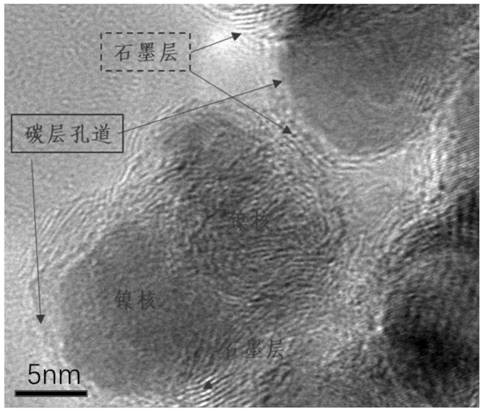
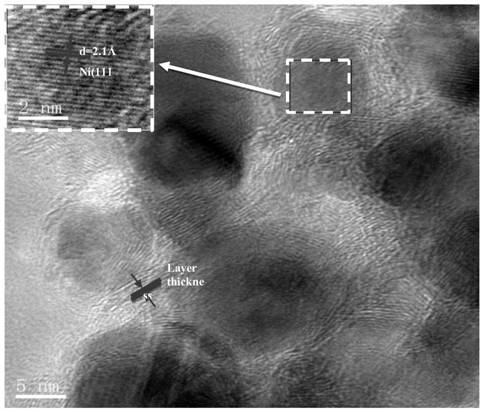
technical field [0001] The invention belongs to the field of catalyst preparation technology and application, and relates to the application of a carbon material-coated nickel nanoparticle catalyst in the hydrogenation of p-nitrophenylacetic acid to synthesize p-aminophenylacetic acid. Background technique [0002] Nickel nanoparticles have great application value in catalysis, lithium batteries, sensors and other fields. As a catalyst, nanoscale nickel particles have better catalytic activity than bulk or flake, but due to the high surface energy, nanoscale nickel particles are easy to agglomerate and limit its advantages. When exposed to the air, the metal nanoparticles are easily oxidized into metal oxides, and a layer of carbon material wrapped around the metal nanoparticles can prevent the metal nanoparticles from being oxidized. In addition to the characteristics of non-toxicity, high thermal stability and low price, the carbon layer-coated metal structure also has th...

Claims

the structure of the environmentally friendly knitted fabric provided by the present invention; figure 2 Flow chart of the yarn wrapping machine for environmentally friendly knitted fabrics and storage devices; image 3 Is the parameter map of the yarn covering machine
Login to View More

Application Information

Patent Timeline
no application Login to View More
IPC IPC(8): B01J23/755C07C221/00C07C225/34
CPCB01J23/755C07C221/00C07C225/34
Inventor 卢春山杨园园李小年张群峰丰枫
Owner ZHEJIANG UNIV OF TECH
Features
  • R&D
  • Intellectual Property
  • Life Sciences
  • Materials
  • Tech Scout
Why Patsnap Eureka
  • Unparalleled Data Quality
  • Higher Quality Content
  • 60% Fewer Hallucinations
Social media
Patsnap Eureka Blog
Learn More