
Stable and bioavailable iron fortified beverages
a bioavailable, beverage technology, applied in the field of beverages, can solve the problems of no significant free iron generated in solution to be available to react, form off-flavors or colors, etc., and achieve the effects of superior iron bioavailability, excellent storage stability, and high palatable tas
- Summary
- Abstract
- Description
- Claims
- Application Information
AI Technical Summary
Benefits of technology
Problems solved by technology
Method used
Image

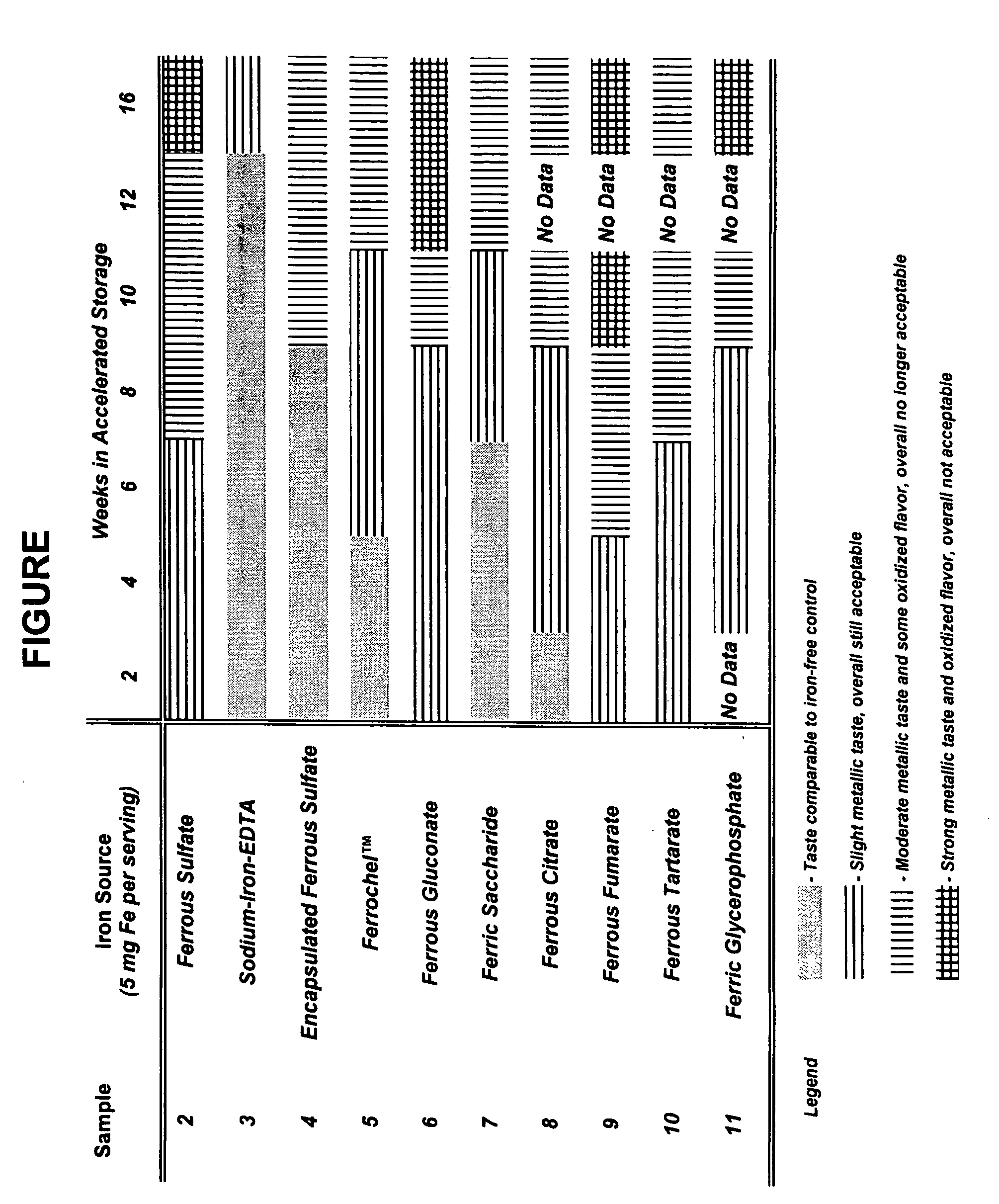
Examples
example 1
[0034] Basic powdered beverage formulations, as detailed in Table 1, were prepared using different forms of iron. The stability of the various products were evaluated over their shelf life by a trained panel for sensorial attributes.
TABLE 1Basic Powdered Beverage Formulation.IngredientAmount (%)iron fortification agent10.2citric acid58.5orange flavoring214.9orange coloring5.1carboxymethyl cellulose10.1vitamins & mineral blend310.2titanium oxide1.0
1Amount based on iron (Fe) content only; provides about 5 mg Fe per 22 g serving (dry mix).
2Commercially available orange concentrate containing terpenes
3Vitamin C, vitamin E, zinc, iodine, and calcium
[0035] The various iron fortification agents used are shown in Table 2.
TABLE 2Iron Fortification Agents.SampleIron Fortification Agent1none (negative control)2ferrous sulfate (positive control)3sodium iron EDTA (inventive)4encapsulated ferrous sulfate5Ferrochel ™6ferrous gluconate7ferric saccharide8ferrous citrate9ferrous fumarate10ferr...
example 2
[0041] This example compares the bioavailability of an inventive beverage sample fortified with ferric EDTA with a control sample fortified with ferrous sulfate. The beverage samples were prepared in the same manner and using the same formulations as Samples 2 and 3 as described in Example 1. The iron bioavailability of each these prepared beverage samples was determined using the ferritin technique as essentially described in U.S. Pat. No. 6,017,713, which is hereby incorporated by reference. Briefly a 0.9 mL of a beverage sample was introduced, along with a standard meal, into a simulated digestion, peptic, and intestinal system (Glahn et al., J. Nutrition, 128, 1555 (1998)). The resulting digestion solution was placed in wells on top of dialysis membrane inserts over a monolayer of human intestinal cancer cells (i.e., Caco-2 cells). Available iron from the sample was absorbed by the Caco-2 cells and stored in the form of ferritin (a storage protein). Ferritin levels were then mea...
example 3
[0042] This example compares the stability of inventive ferric EDTA beverage to both negative (i.e., no iron) and positive (i.e., ferrous sulfate) controls ready-to-drink products. Twenty five pound batches of the ready-to-drink (RTD) beverages were made in a pilot plant using the basic formulations described in Table 3 below: Batch 1—negative control; batch 2—inventive product; and batch 3—positive control. Batch 2 and 3 beverages provided about 3.6 mg Fe per 200 ml serving. The formulated RTD beverages were pasteurized at 205° F. for 30 seconds, hot filled in pouches, and sealed.
TABLE 3Basic RTD Composition before Iron Fortification.IngredientAmount (%)water81.8corn syrup15.9citric acid0.4fruit juice concentrate1.8vitamin & mineral blend0.08coloring agent0.0043preservative10.043orange flavoring0.03
1Sodium benzoate, potassium sorbate, calcium disodium EDTA.
[0043] The beverages were subjected to accelerated shelf life tests as essentially described in Example 1 except that 200 ml...
PUM
 Login to View More
 Abstract
Description
Claims
Application Information
 Login to View More