
Laser annealing apparatus and annealing method of semiconductor thin film
a technology of semiconductor thin film and laser annealing apparatus, which is applied in the direction of manufacturing tools, crystal growth process, polycrystalline material growth, etc., can solve the problems of large energy loss, reduced short wavelength of laser beam to about 20 microns, and prone to energy change damage to silicon film, etc., to achieve good annealing, small energy loss, and high mobility
- Summary
- Abstract
- Description
- Claims
- Application Information
AI Technical Summary
Benefits of technology
Problems solved by technology
Method used
Image

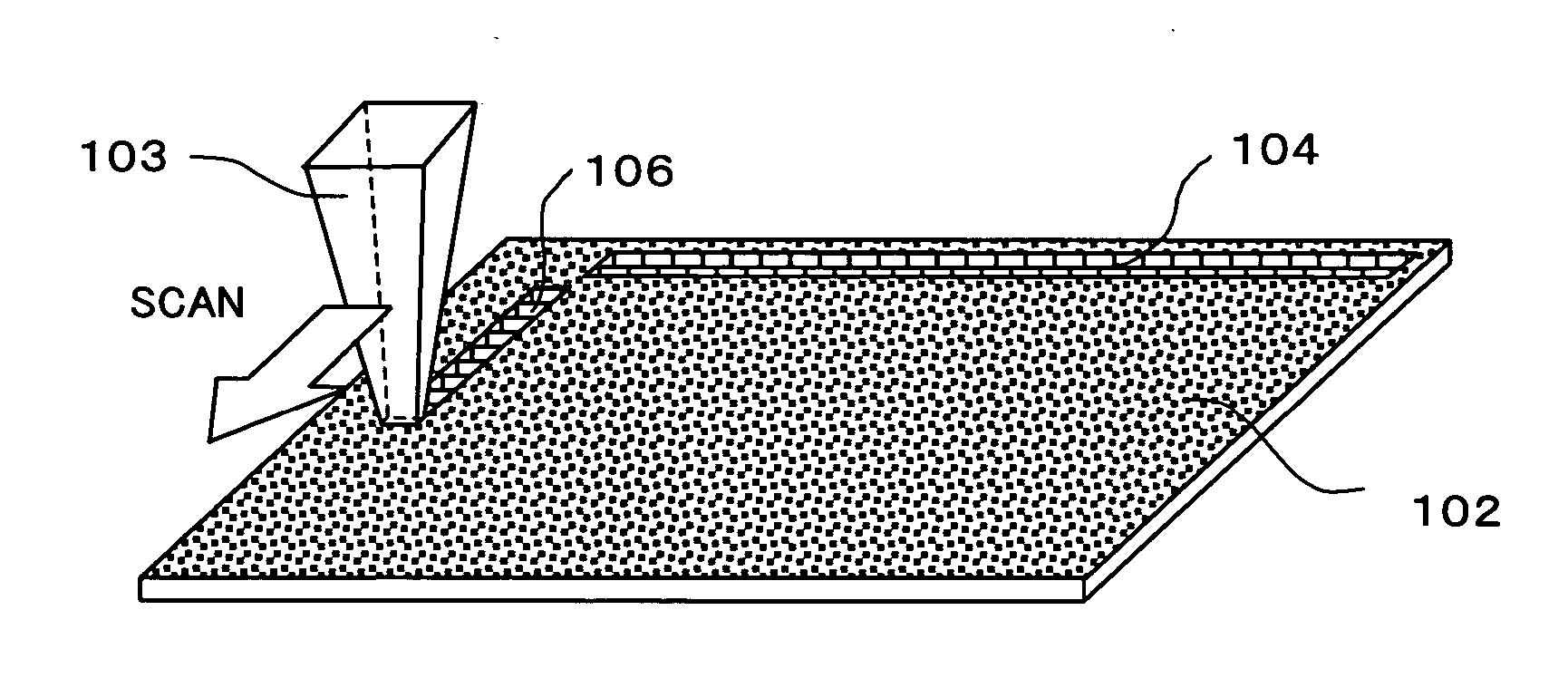
Examples
Embodiment Construction
[0027] The present invention will be described below in detail with reference to the drawings showing respective embodiments thereof.
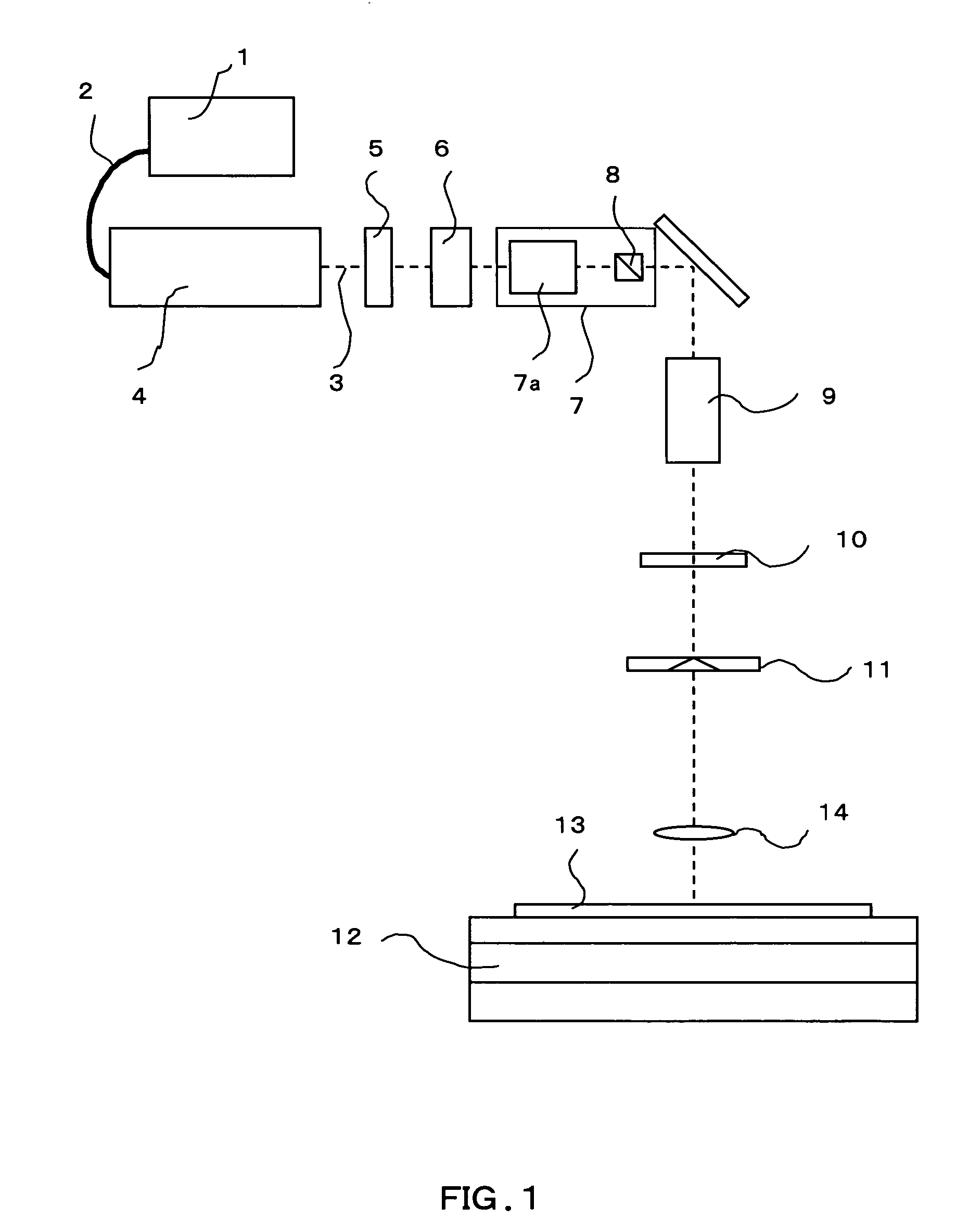
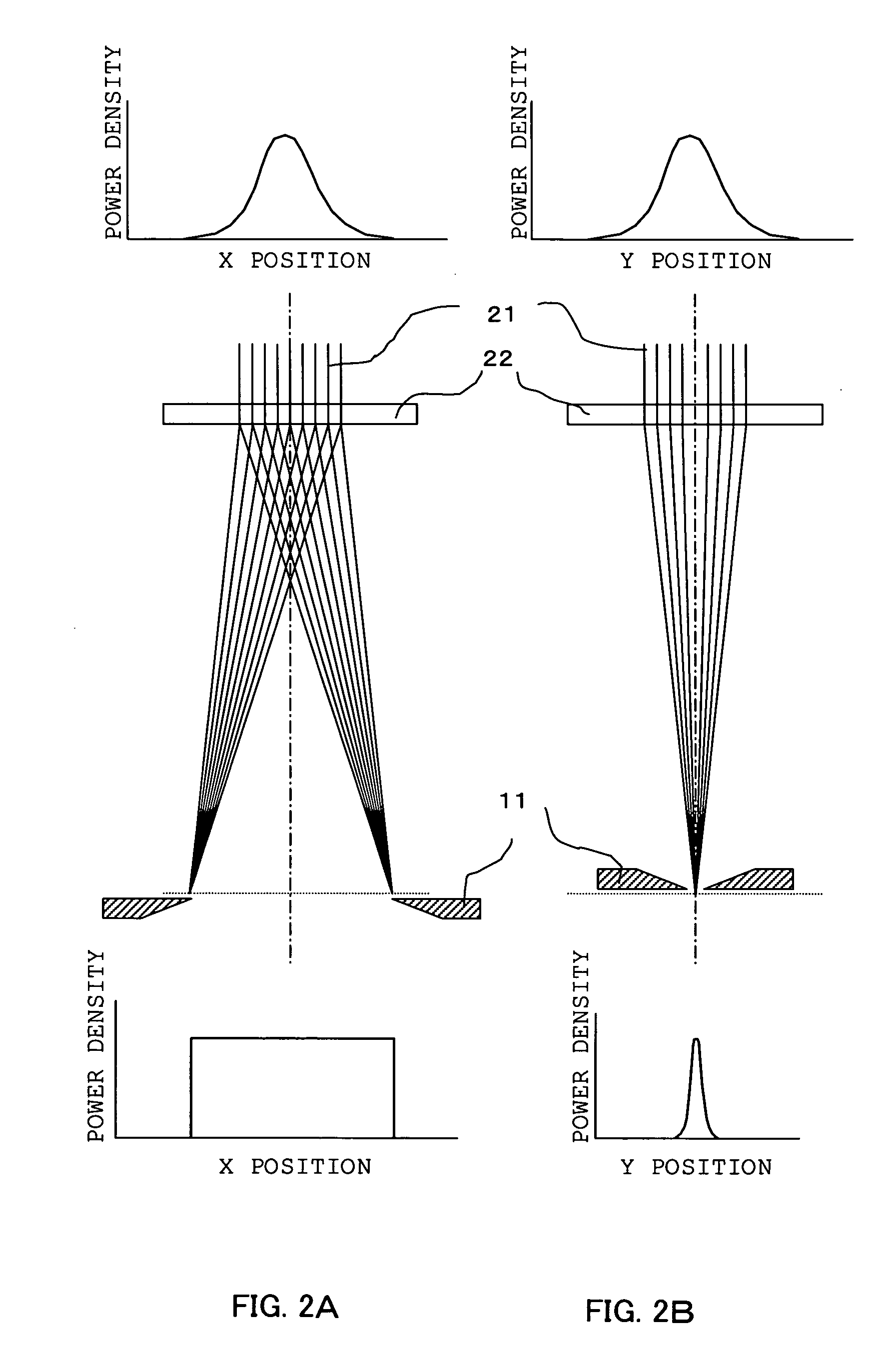
[0028]FIG. 1 is a diagram showing the optical configuration of a laser annealing apparatus according to an embodiment of the invention. The annealing apparatus comprises a laser oscillator 4, a shutter 5, a continuously variable transmittance neutral-density (ND) filter 6, a modulator 7, a beam expander (beam reducer) 9, a beam shaper 10, a rectangular opening slit 11, and an imaging lens 14. The laser oscillator 4 is connected to an excitation laser diode (LD) 1 by a fiber 2 and generates a continuous-wave (CW) laser beam 3. The shutter 5 switches the laser beam 3 on and off. The continuously variable transmittance ND filter 6 controls the energy of the laser beam 3. The modulator 7 temporally modulates in amplitude the laser beam 3 output from the laser oscillator 4 to achieve temporal amplitude modulation of pulsation or energy. The beam expander (...
PUM
| Property | Measurement | Unit |
|---|---|---|
| size | aaaaa | aaaaa |
| size | aaaaa | aaaaa |
| speed | aaaaa | aaaaa |
Abstract
Description
Claims
Application Information
 Login to View More