

Method forming transparent conductive film, transparent conductive film, glass substrate including the same and photoelectric conversion device using that glass substrate
a technology of transparent conductive film and transparent conductive film, which is applied in the direction of coatings, layered products, chemistry apparatuses and processes, etc., can solve the problems of short circuit in the photoelectric conversion device, deformation of defects in the transparent conductive film, and slowing down the line speed of the glass ribbon, so as to achieve high photoelectric conversion efficiency, low absorption coefficient at 400 to 550 nm wavelength, and high carbon concentration
- Summary
- Abstract
- Description
- Claims
- Application Information
AI Technical Summary
Benefits of technology
Problems solved by technology
Method used
Image


Examples
working examples
[0039] The following is a more detailed description of the present invention with reference to working examples.
[0040] First, the following is an explanation of a method for measuring / calculating the absorption coefficient of the transparent conductive film, the component concentrations of carbon and fluorine etc. in the transparent conductive film, and the ratio between the number of tin atoms and the number of carbon atoms in the transparent conductive film.
Absorption Coefficient of the Transparent Conductive Film
[0041] Methylene iodide with a refractive index of 1.79 was applied onto the transparent conductive film formed on an undercoating thin film, and a cover glass (#7059 by Corning Inc.) of 1 mm thickness was placed directly thereon, thus fabricating a sample in which the scattering loss due to the surface roughness of the conductive film is eliminated. The transmittance and reflectance of these samples at 400 to 550 nm were measured with a spectrophotometer, and the abs...
working example 1
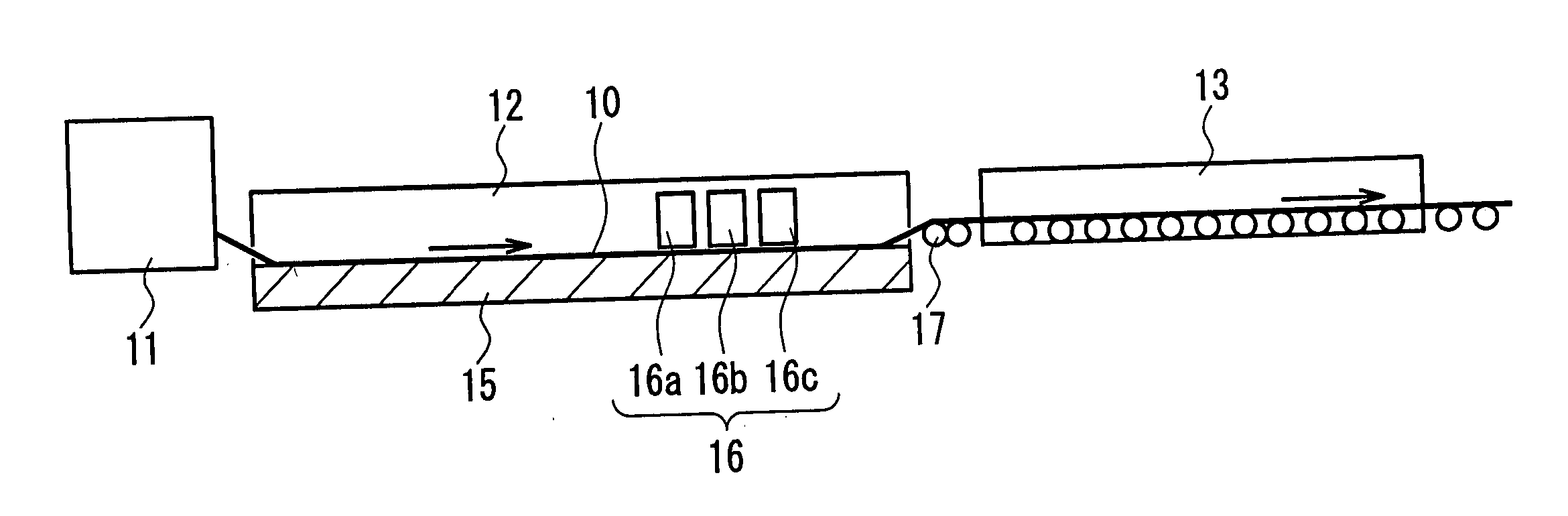
[0045] A gas mixture made of monosilane, ethylene, oxygen and nitrogen was supplied from the coater positioned furthest to the upstream side, and an undercoating film with about 30 nm film thickness whose principal component is silica was deposited on the glass ribbon. Subsequently, a gas mixture obtained by mixing a nitrogen carrier gas such that it contains 1.9 mol % dimethyltin dichloride (vapor), 36 mol % oxygen, 33 mol % water vapor, 5 mol % helium and 0.5 mol % hydrogen fluoride was supplied from a coater further downstream and a transparent conductive film of about 700 nm thickness whose principal component is tin oxide doped with fluorine was deposited at a film deposition speed of 5000 nm / min. The surface temperature of the glass ribbon just before depositing the transparent conductive film was about 650° C.
[0046] The film deposition conditions and the properties of this transparent conductive film are listed in Table 1 and Table 2.
working example 2
[0047] The concentration of the dimethyltin dichloride, the film deposition speed and the surface temperature of the glass ribbon just before depositing the transparent conductive film in Working Example 1 were changed as shown in Table 1, but otherwise the undercoating film and the transparent conductive film were deposited in the same manner as in Working Example 1.
[0048] The film deposition conditions and the properties of this transparent conductive film are listed in Table 1 and Table 2.
PUM
| Property | Measurement | Unit |
|---|---|---|
| absorption coefficient | aaaaa | aaaaa |
| glass transition temperature | aaaaa | aaaaa |
| thickness | aaaaa | aaaaa |
Abstract
Description
Claims
Application Information
 Login to View More