[0021] The relatively low reactivity of
deuterium compounds in comparison with compounds that contain
light hydrogen becomes noticeable primarily when the
hydrogen content in the immersion liquid is relatively high overall. This applies to water, for example, since two
hydrogen atoms occur on each
oxygen atom. Water which is deuterated to a high degree is generally referred to as
heavy water (D2O ) and is produced on an
industrial scale. If virtually all of an immersion liquid consists of
heavy water (that is to say more than 99
molar per cent) then it will have a significantly reduced reactivity in comparison with normal water, that is to say water with a natural
isotope distribution. The lifetime of sensitive
optical materials, for example
calcium fluoride crystals, can thereby be extended by a factor of about 5 or more. This presents significant cost advantages, since such
optical materials are very expensive. Furthermore, replacement of the optical elements in question leads to prolonged down-times of the projection exposure apparatuses and therefore to production losses.
[0026] The reduced temperature dependency of the
refractive index of heavy water makes it possible to significantly increase the thickness of the immersion layer, but without the stronger heating leading to a significant impairment of the imaging properties. The
minimum distance between the last
optical surface on the image side and a photo-sensitive layer to be exposed, which hitherto has usually been 2 mm, may now be more than 2.5 mm, for example, or even more than 5 mm.
[0027] Owing to the reduced temperature dependency of the
refractive index, furthermore, the
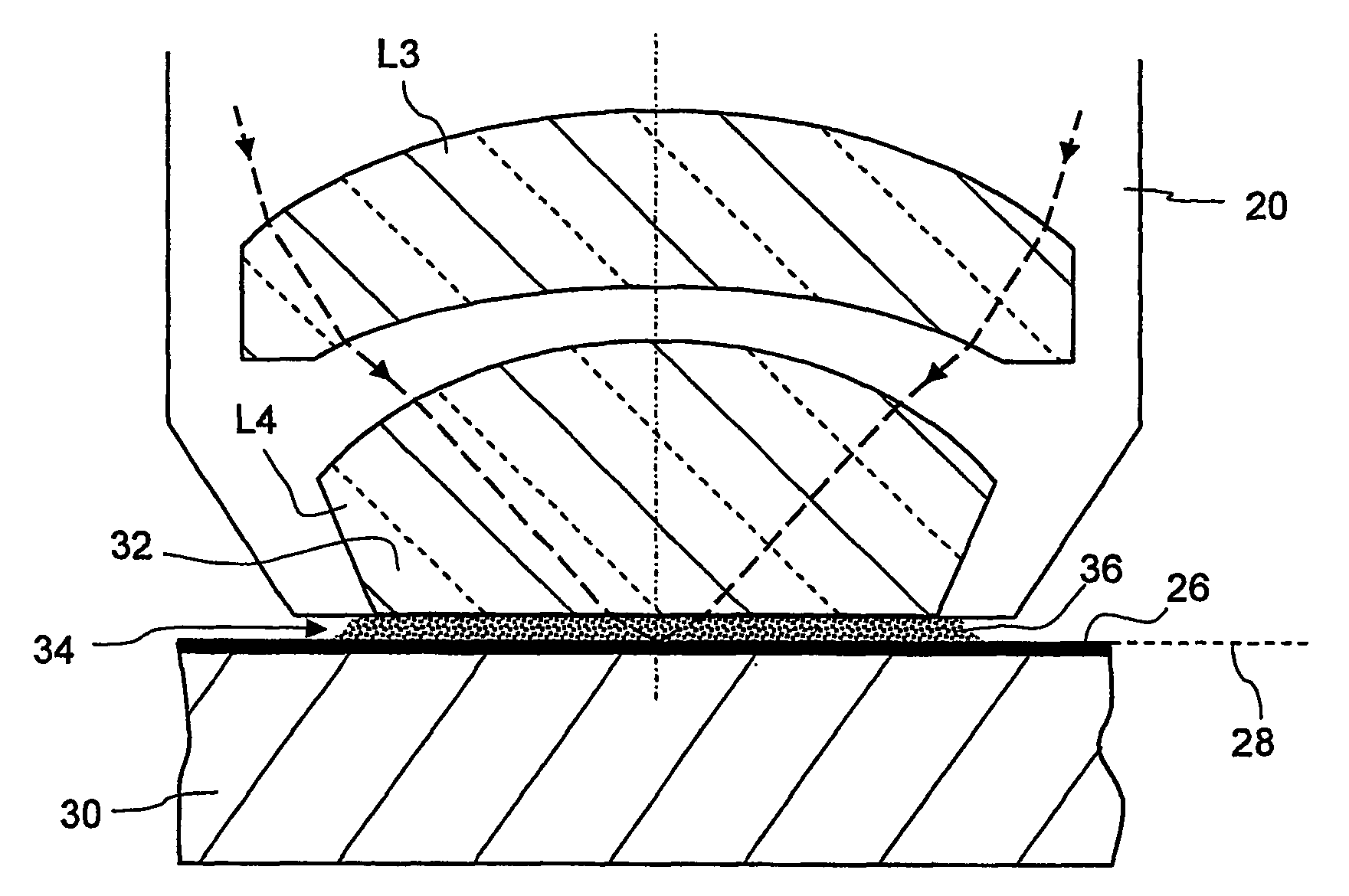
projection lens can be designed so that the immersion liquid is convexly curved towards an object plane of the projection lens during immersed operation. This can be achieved, for example, if the immersion liquid is directly adjacent to a concavely curved surface on the image side of the last optical element on the image side during immersed operation. This provides a kind of “
liquid lens”, the
advantage of which is primarily that it is very cost-effective. A
calcium fluoride crystal, which is very expensive, has hitherto mainly been used as a material for the last imaging optical element on the image side in projection exposure apparatuses which are designed for wavelengths of 193 nm.
[0037] An additional or alternative way of resolving the problem of chemically corrosive immersion liquids is to provide a projection lens in which the
refractive index of the last surface on the image side is at least approximately the same as the refractive index of the immersion liquid. Although this measure does not prevent the immersion liquid from chemically attacking a last surface on the image side of the projection lens, it does reduce the detrimental consequences for the
imaging quality. This is because of the closer the ratio of the refractive indices of this surface and of the immersion liquid lies to 1, the less is the
refraction at the interface. If the refractive indices were exactly the same, then light would not be refracted at the interface and therefore the shape of the interface would actually have no effect on the beam path. Local deformations on the surface, due to the immersion liquid, could not then affect the
imaging quality.
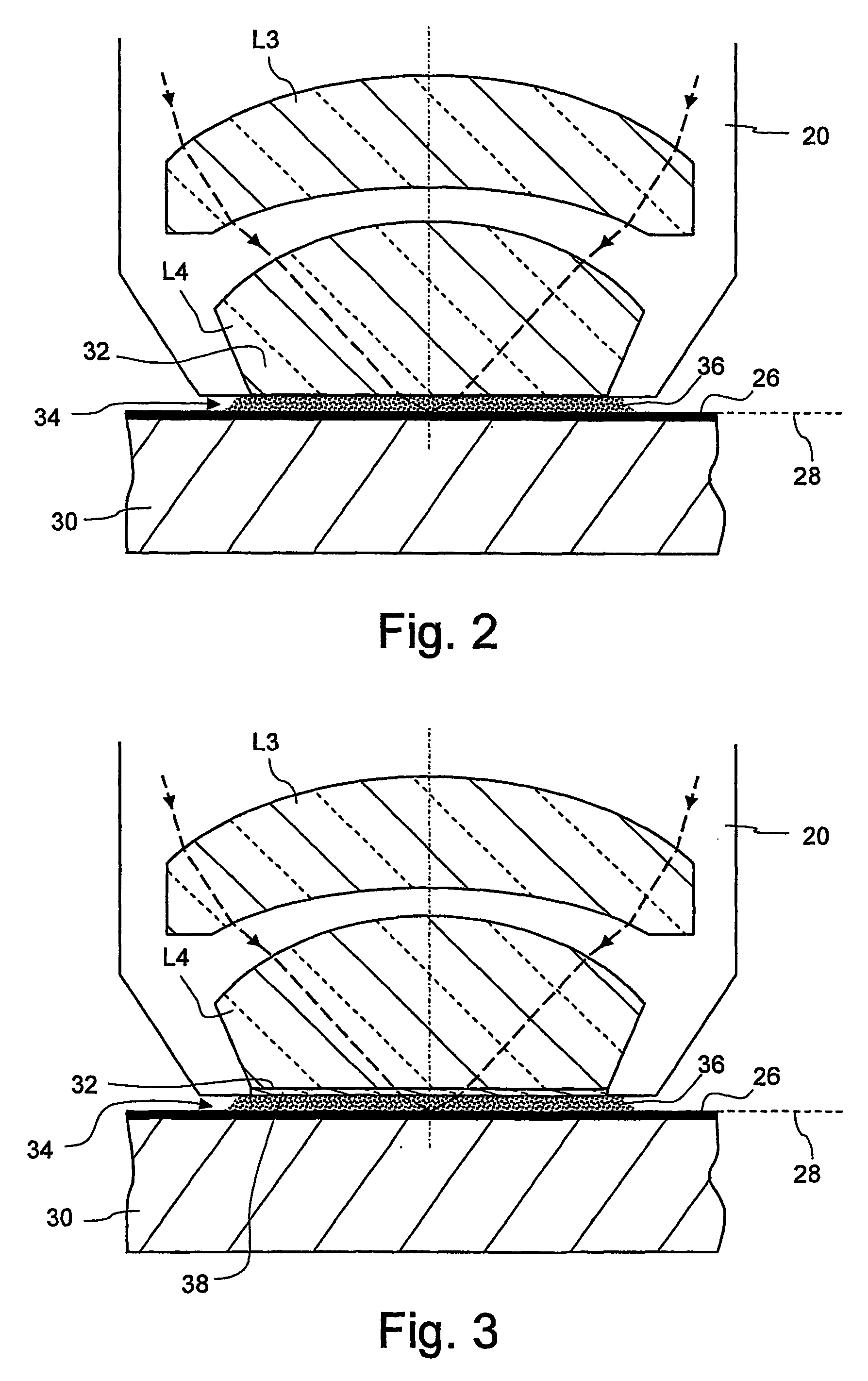
[0039] For example, if a
thin layer of MgF2 is vapour-deposited on a last surface on the image side and light water, heavy water or a mixture of the two liquids is used as the immersion liquid, then with particularly compact MgF2 the said value may readily be less than 1%. Applying a layer by
vapour deposition on the last surface on the image side has, inter alia, the
advantage that arbitrarily curved layers can be produced very easily in this way.
[0042] Experiments have shown that even relatively low
ion concentrations in the water are sufficient to significantly reduce its chemical reactivity. In particular, it has been found that the at least one additive should dissociate in the immersion liquid so that the electrical
conductivity of the immersion liquid is between about 4×10⁻⁸ S / m and about 4×10⁻⁶ S / m, and particularly preferable between about 3.5×10⁻⁸ S / m and about 6×10⁻⁷ S / m, after adding the additive.


 Login to View More
  Login to View More