

Methods and compositions for desulfurization of hydrocarbon fuels
a technology of hydrocarbon fuels and compositions, applied in the direction of catalyst activation/preparation, metal/metal-oxide/metal-hydroxide catalysts, chemical/physical processes, etc., can solve the problem of reducing the amount of fuel that the absorbent can process before its activity is reduced to an impractical level, and achieve the effect of effectively removing the more-refractory organosulfur compounds
- Summary
- Abstract
- Description
- Claims
- Application Information
AI Technical Summary
Benefits of technology
Problems solved by technology
Method used
Image

Examples
example 1
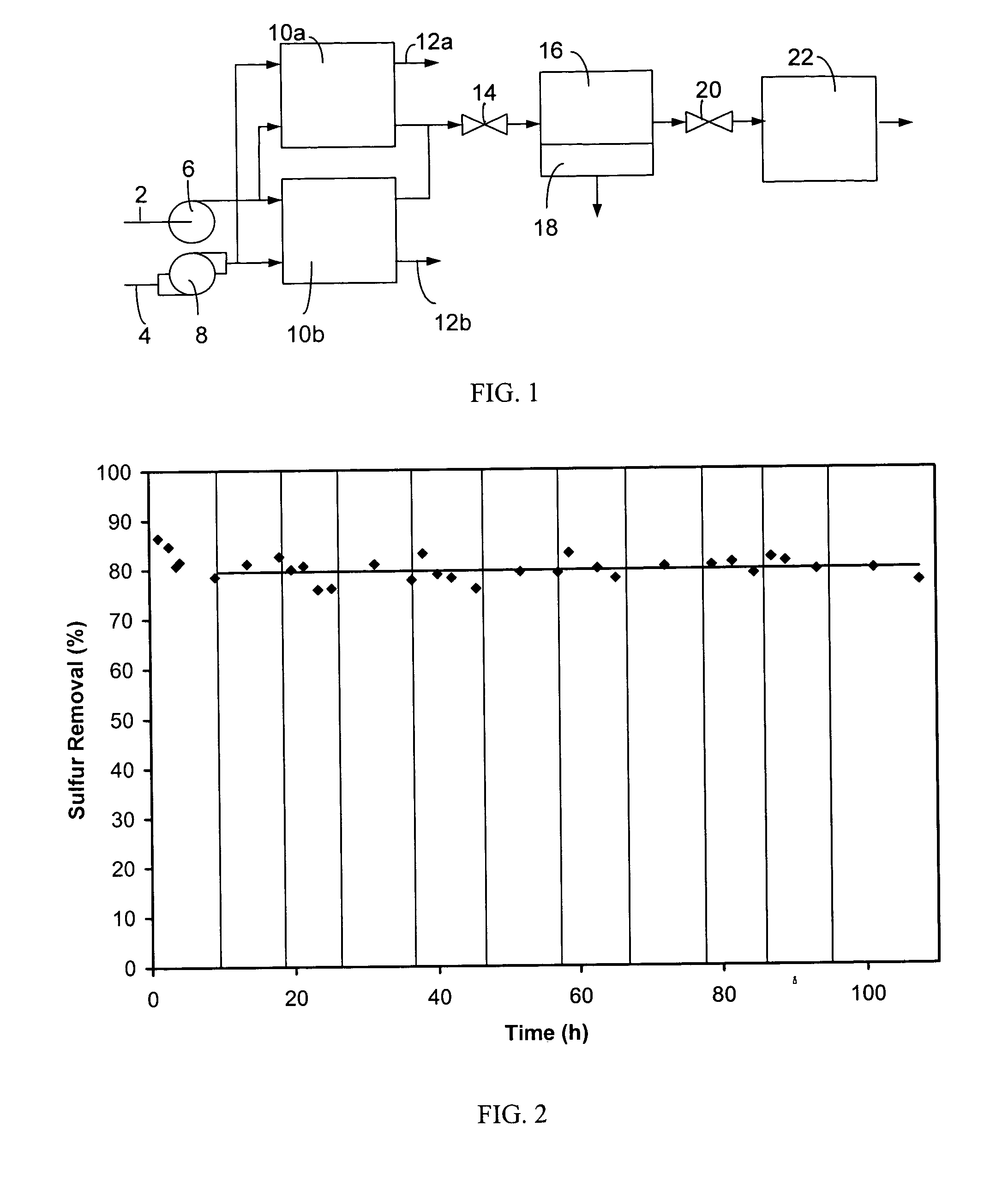
[0041] Operation of a regenerable desulfurization reactor in the absence of the separator and the secondary desulfurization agent bed has been demonstrated to produce a significant reduction in the sulfur content of hydrocarbon fuels. A regenerable desulfurization reactor containing an 18 weight-% MoO3 / Al2O3 absorbent (wherein the MoO3 is 18 weight % and the Al2O3 is 82 %) prepared by impregnating the MoO3 into a porous Al2O3 substrate was used in this example. A commercial diesel fuel containing 300 ppm sulfur was passed through the regenerable desulfurization reactor at 200 psig (about 1.5 MPa), 400° C. and a liquid hourly space velocity of 1.1 h−1. The resulting liquid product contained 60 ppm sulfur, which is an 80% reduction in sulfur content relative to the diesel fuel before this treatment. Following 10 hours of sulfur absorption, diesel flow to the reactor was terminated and air flow was initiated and continued for 2 hours at 400° C. Significant evolution of SO02 was observe...
example 2
[0044] One example of the preparation of a regenerable desulfurization agent is found in the synthesis of a 20 wt % MoO3 / Al2O3 absorbent. An aqueous solution of ammonium paramolybdate was impregnated into a high surface area (200 m2 / g) Al2O3 substrate (SAB, available from UOP of Des Plaines, Ill., USA). In this case, a solution of 30.7 g ammonium paramolybdate in 100 g water was impregnated into a 75 g Al2O3 substrate. The substrate was impregnated by adding enough ammonium paramolybdate solution to fully wet the absorbent substrate and then drying under vacuum. This procedure was repeated until the entire impregnating solution had been loaded onto the substrate. The material was then calcined in air at 550° C. to decompose the precursor to MoO3. This desulfurization agent possessed a surface area of greater than 150 m2 / g and a total pore volume greater than 0.45 cm3 / g.
[0045] Table 1 presents data characterizing the performance of the regenerable desulfurization reactor when commer...
example 3
[0046] The composition of the desulfurization agent contained in the regenerable desulfurization reactor plays a significant role in the amount of sulfur that can be removed from a fuel. The amounts of dibenzothiophene, 4-methyldibenzothiophene and 4,6-dimethyldibenzothiophene removed from a synthetic fuel containing 350 ppm sulfur at 425° C., 200 psig (about 1.5 MPa) and a liquid hourly space velocity of 1.1 h−1 are shown in Table 2 for a variety of Al2O3-impregnated metal oxide absorbents.
TABLE 2Sulfur Removal Activity of Impregnated AbsorbentsAbsorbentSulfur Removal (%)19 wt % MoO3 / Al2O36529 wt % Ta2O5 / Al2O33522 wt % WO3 / Al2O33116 wt % ZnTiO3 / Al2O32821 wt % ZnO / Al2O31111 wt % MnO2 / Al2O38
PUM
| Property | Measurement | Unit |
|---|---|---|
| pressure | aaaaa | aaaaa |
| temperature | aaaaa | aaaaa |
| temperature | aaaaa | aaaaa |
Abstract
Description
Claims
Application Information
 Login to View More