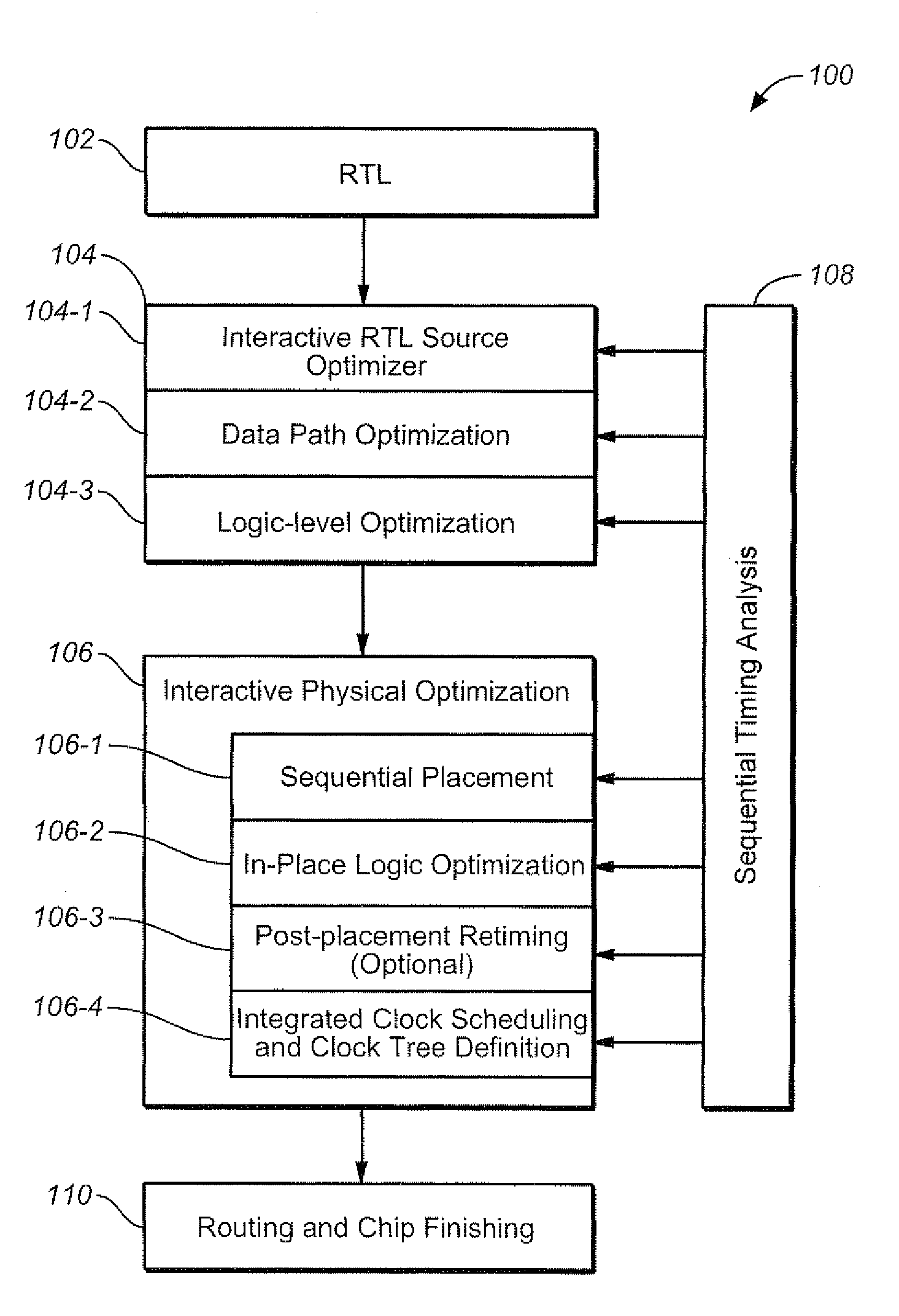
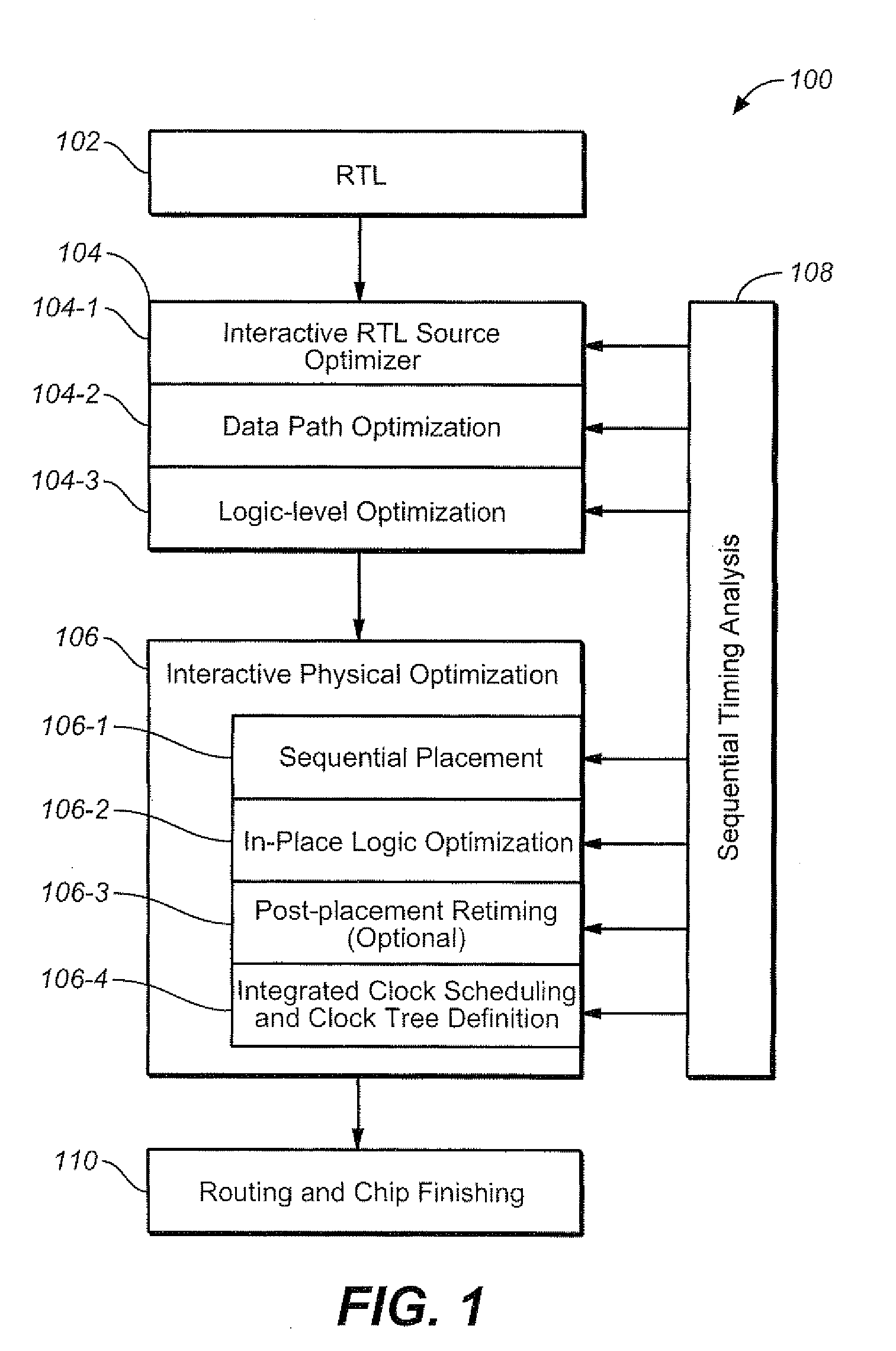
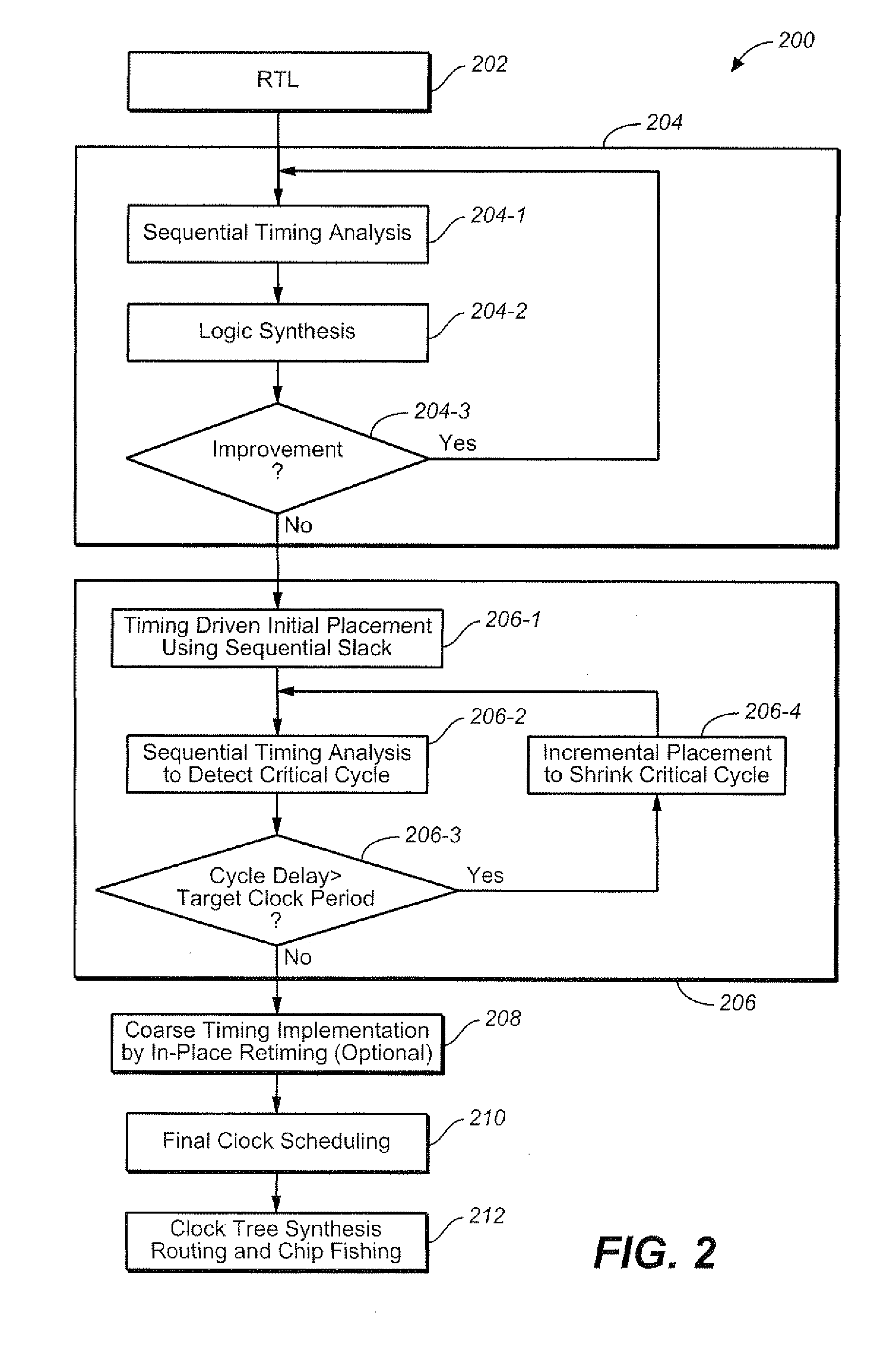
[0015]Yet another aspect of the invention involves determining sequential slack associated with a respective register in a
circuit design. The determined sequential slack is used to evaluate a first
design choice involving a structural cycle in the circuit design in which the register is a constituent. In some embodiments, the first
design choice may involve one or more of RTL source optimization,
data path optimization or
logic optimization, for example. A maximum critical cycle
delay within the circuit design is determined. The maximum critical cycle delay is used to select a second
design choice in the circuit design that decreases the maximum critical cycle delay. In some embodiments, the second design choice may involve one or more of placement choices or post placement retiming choices. Hence, sequential slack is used to add to flexibility of design choices, and a critical cycle can be used as a guide to reduction in maximum
cycle time.
[0017]In a still further aspect of the invention, a limit upon clock cycle duration is obtained. A determination is made for a register in the circuit design, from structural cycles in which the circuit element is a constituent, of a limit upon addition of structural cycle delay to such structural cycles, assuming a clock cycle duration that is not greater than the obtained limit upon clock cycle duration. Combinational slack is determined for a combinational path in the circuit design. The determined limit upon addition cycle delay and the determined combinational slack are used to identify a change in a
data path in the circuit design involving both a
combinational logic change and register retiming. The identified change is made to the design. By using together, both a measure of sequential flexibility and a measure of combinational slack, design changes involving both retiming and
combinational logic changes can be identified and implemented more readily.
[0018]A further aspect of the invention involves obtaining a limit upon clock cycle duration applicable to the circuit design. A determination is made for each of multiple respective circuit elements in the circuit design, of a respective limit upon addition of structural cycle delay that is not greater than each individual maximal limit of structural cycle delay for each individual structural cycle in which such respective circuit element is a constituent, based upon a clock cycle duration that is not greater than the obtained limit upon clock cycle duration. A determination is made of combinational slack of multiple paths in the circuit design. Both the determined limits upon addition of cycle delay and the determined combinational slack are used to evaluate multiple possible
combinational logic changes to the circuit design. At least one of the changes is made. By using together, both a measure of sequential flexibility and a measure of combinational slack, design changes involving
logic optimization can be identified and implemented more readily.
[0019]An additional aspect of the invention involves determining at least first and second register placement alternatives. A determination is made for the first register placement alternative, of a first value indicative of a proportionality of delay to number of registers for a structural cycle of the first placement alternative having a largest proportionality of delay to number of registers. A determination is made for the second register placement alternative, of a second value indicative of a proportionality of delay to number of registers for a structural cycle of the second placement alternative having a largest proportionality of delay to number of registers. The determined first and second values are used to evaluate the first and second register placement alternatives. One of the first and second register placement alternatives is selected. Therefore, a retiming alternative having a lesser minimum
cycle time can be selected. Moreover, if one of the register placement alternatives involves a critical cycle within the circuit design and the other does not, then selection of the register placement alternative with the lesser minimum
cycle time can have the effect of reducing the minimum cycle delay of the overall circuit.
[0020]A further aspect of the invention involves a method used in defining a
clock tree network in a circuit design. First and second non-common
clock tree paths are identified in the design that are used to impart a
clock signal to trigger first and second registers that are constituents of a structural cycle.
Path delay from the first register to the second register is determined.
Path delay from the second register to the first register is determined. Based upon a target clock period, a determination is made of a change in delay in one or both of the first and second non-common
clock tree paths that increases permissible variation of clock accuracy, consistent with the target clock period.
Delay of one or both of the first and second non-common clock tree paths is changed according to the determination so as to achieve increased permissible variation of clock accuracy. Thus, sequential slack can be used advantageously to relax the accuracy required in creating a clock
tree network.


 Login to View More
  Login to View More