
Process for the preparation of droxidopa
a technology of droxidopa and droxidopa, which is applied in the field of improved enzymatic process for the preparation of lthreodihydroxyphenyl serine, can solve the problems of low yield and achieve high chemical and chiral purity, high yield and good yield
Patent Information
- Authority / Receiving Office
- US · United States
- Patent Type
- Applications(United States)
- Current Assignee / Owner
- Publication Date
- 2017-11-23
Smart Images
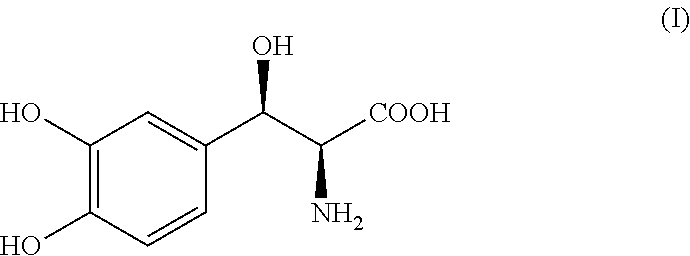
Figure 1 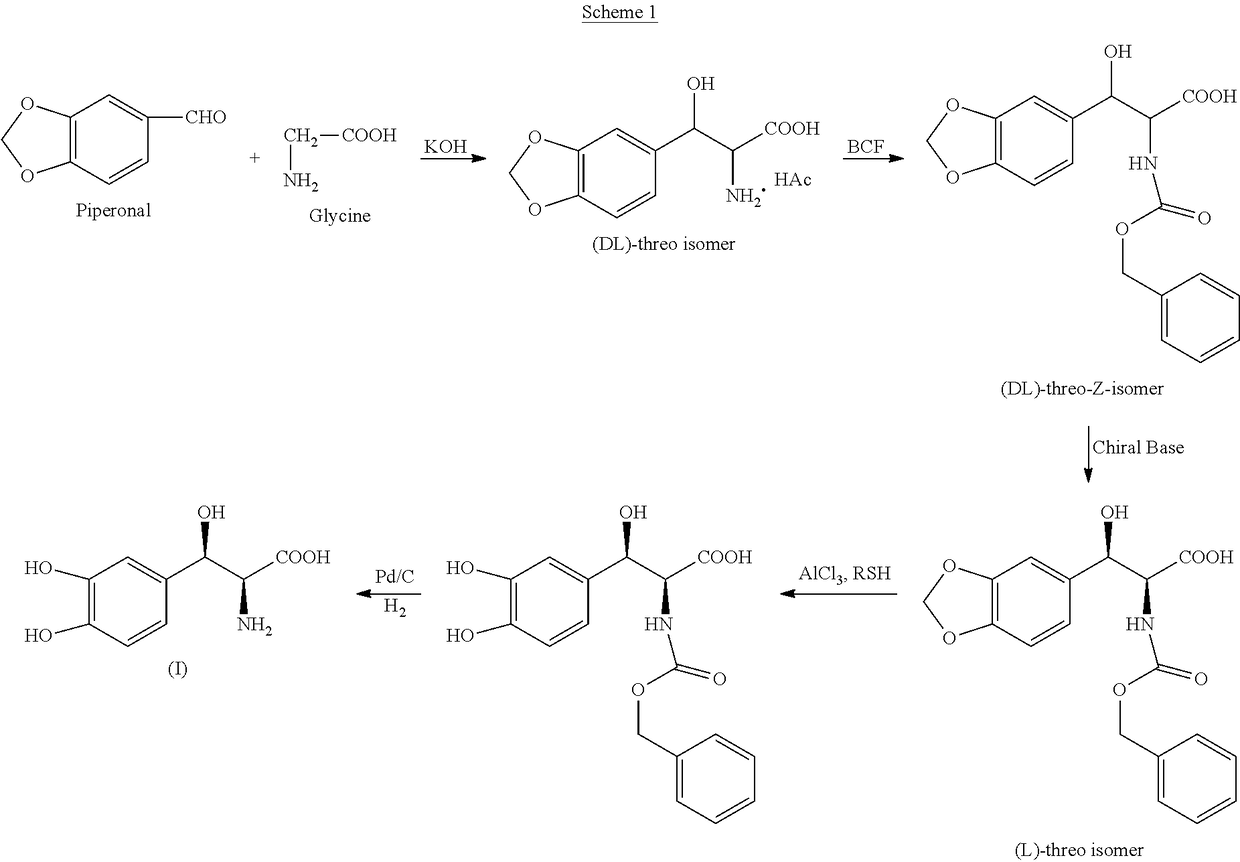
Figure 2 
Figure 3
Abstract
Description
FIELD OF INVENTION
[0001] The present invention relates to an improved enzymatic process for the preparation of L-threo-dihydroxyphenyl serine, known as Droxidopa.BACKGROUND OF THE INVENTION
[0002] Droxidopa is a prodrug of norepinephrine which by the action of dopa decarboxylase enzyme, is converted to norepinephrine in the body. It is used in the treatment of orthostatic hypotension. It is also useful in treating certain symptoms associated with Parkinson's disease. It is chemically (L)-threo-3-(3,4-methylenedioxyphenyl) serine (formula I) having the following structure:
[0003] The U.S. Pat. No. 4,480,109 assigned to Sumitomo Chemical Company, Japan, describes a process for the preparation of Droxidopa (Scheme 1).
[0004] The scheme involves condensation of piperonal with glycine in the presence of a base to obtain (DL)-threo-3-(3,4-methylenedioxyphenyl)serine followed by N-protection by Schotten-Baumann reaction with benzyl chloroformate to give (DL)-threo-N-carbobenzyloxy-3-(3,4-methylen...
Examples
examples
[0030]Chemical purity was determined using HPLC under the following conditions:[0031]Column: X Terra RP18, 150×4.6 mm, 3.5 μm[0032]Mobile phase: Buffer:Acetonitrile (93:7)[0033]Buffer Preparation: Sodium 1-heptane sulfonate (1.0)g and potassium phosphate (1.36 g) are dissolved in 1000 ml of H2O and pH of the buffer is maintained at 2.0 using phosphoric acid[0034]Diluent: 0.1M Hydrochloric acid solution[0035]Injection Volume: 20 μl[0036]flow rate: 1.0 ml / min[0037]Detection: 220 nm[0038]Temperature: 27° C.[0039]Run Time: 35 min[0040]Enantiomeric purity was determined using HPLC under the following conditions:[0041]Column: Crownpack CR+, 150×4 0 mm, 5 μm[0042]Mobile phase: Taken 16.3 g of 70% perchloric acid in 1000 ml of water (maintained pH at 1.0)[0043]Diluent: Water[0044]flow rate: 0.4 ml / min[0045]Temperature: 15° C.[0046]Detection: 200 nm
[0047]Enzyme: L-aminoacylase from Aspergillus sp. (EC 3.5.1.14.; CAS No. 9012-37-7) having the activity of >30,000 u / g was purchased from Amano E...
example-1
on of DL-threo-3-(3,4-methylenedioxyphenyl)serine (II)
[0049]Potassium hydroxide (8.5 g) was added to methanol (41.5 mL) and stirred for 30 min at 25-30° C. to obtain a clear solution. To this was added glycine (5.2 g, 0.069 mole) and toluene (31.0 mL) while stiffing. Piperonal (22.9 g, 0.15 mole) was dissolved in toluene (31.0 mL) and was added to the above reaction mixture and stirred for 18 hrs at RT. The reaction temperature was increased to 40° C. and the solvents (toluene and methanol) were distilled off under vacuum until mixture becomes thick. Additional toluene (21.0 mL) was added to the reaction mass three times and distilled out for complete removal of methanol and toluene. The reaction mixture was kept under vacuum at 40° C. After 3 hrs, the reaction mixture was cooled to 18-22° C., dilute hydrochloric acid (23.0 mL) and 114.5 mL water added and stirred for 30 min.
[0050]The mixture was allowed to settle for 30 min to separate into organic and aqueous layers. The aqueous l...
example-2
on of DL-threo-N-acetyl-3-(3,4-methylenedioxyphenyl)serine (III)
[0051]Threo-3-(3,4-methylenedioxyphenyl)serine (II), (50.0.g, 0.22 mole) was added, lot wise, to a solution of sodium hydroxide (26.0 g, 0.66 mole) in 500.0 mL water to get a clear solution at room temperature. To the above reaction mass, acetic anhydride (29.49 g, 0.289 mole) was added slowly and stirred overnight at R.T. After cooling to 0-5° C., the pH was adjusted to about 1.5 with HCl, and stirred for one hour. The white solid obtained was collected by filtration, and dried under vacuum to give (III) (Yield: 50.4 g, 85%; Melting point: 199-200° C.; HPLC, 99.6%); IR (KBr): 3298.66, 3075, 2949.42, 2912.58, 2837.15, 1863.19, 1744.96, 1724.00, 1642.50, 1558.92, 1504.83, 1446.43, 1285.63, 1220.46, 1140.97, 1039.91, 880.24 Cm−1; 1HNMR (300 MHz DMSO): δ 1.77 (s, 3H), δ 4.38 (m, 1H), δ 5.05 (d, 1H), δ5.97 (t, 2H) δ 6.7-6.9 (m, 3H) δ8.00 (d, 1H); 13C NMR (300 MHz, DMSO): 174.7, 170.7, 149.7, 147.2, 134.6, 120.0, 109.2, 108....