Check patentability & draft patents in minutes with Patsnap Eureka AI!

Process for the Preparation of Hydroxyl-Functionalized Polysiloxanes

a technology of hydroxylfunctionalized polysiloxane and polysiloxane, which is applied in the field of process for the preparation of hydroxylfunctionalized polysiloxane, can solve the problems of unstable derivative materials, by-products, and high content of heavy metal impurities, and achieve the effect of preventing backbiting and reducing the reactivity of secondary or tertiary alcohol groups

Active Publication Date: 2019-10-24
HENKEL KGAA
View PDF2 Cites 1 Cited by
  • Summary
  • Abstract
  • Description
  • Claims
  • Application Information

AI Technical Summary

Benefits of technology

The patent describes a method of making hydroxyl-functionalized polysiloxanes in high yields. The method reduces the likelihood of unwanted side products, such as backbiting and O-alkylation, by using a modified KPnOx process. The reaction takes place between 1-30 hours, depending on the desired outcome. The use of acid catalysts can be reduced or eliminated to stabilize the reaction product.

Problems solved by technology

However, such reactions are often associated with low conversions—depending on the molecular weight and viscosity of the Si—H terminated polymer used—and result in products having high contents of heavy metal impurities derived from the catalysts used for the hydrosilylation.
The purification of the products has also proved very difficult: a corollary to the presence of impurities is that any subsequent reaction of the hydroxyl terminated polysiloxanes can result in by-products and in unstable derivative materials.
The prior art processes conforming to this mode have, to date, been unsatisfactory.

Method used

the structure of the environmentally friendly knitted fabric provided by the present invention; figure 2 Flow chart of the yarn wrapping machine for environmentally friendly knitted fabrics and storage devices; image 3 Is the parameter map of the yarn covering machine
View more

Image

Smart Image Click on the blue labels to locate them in the text.
Viewing Examples
Smart Image
  • Process for the Preparation of Hydroxyl-Functionalized Polysiloxanes
  • Process for the Preparation of Hydroxyl-Functionalized Polysiloxanes
  • Process for the Preparation of Hydroxyl-Functionalized Polysiloxanes

Examples

Experimental program
Comparison scheme
Effect test

synthesis example 1

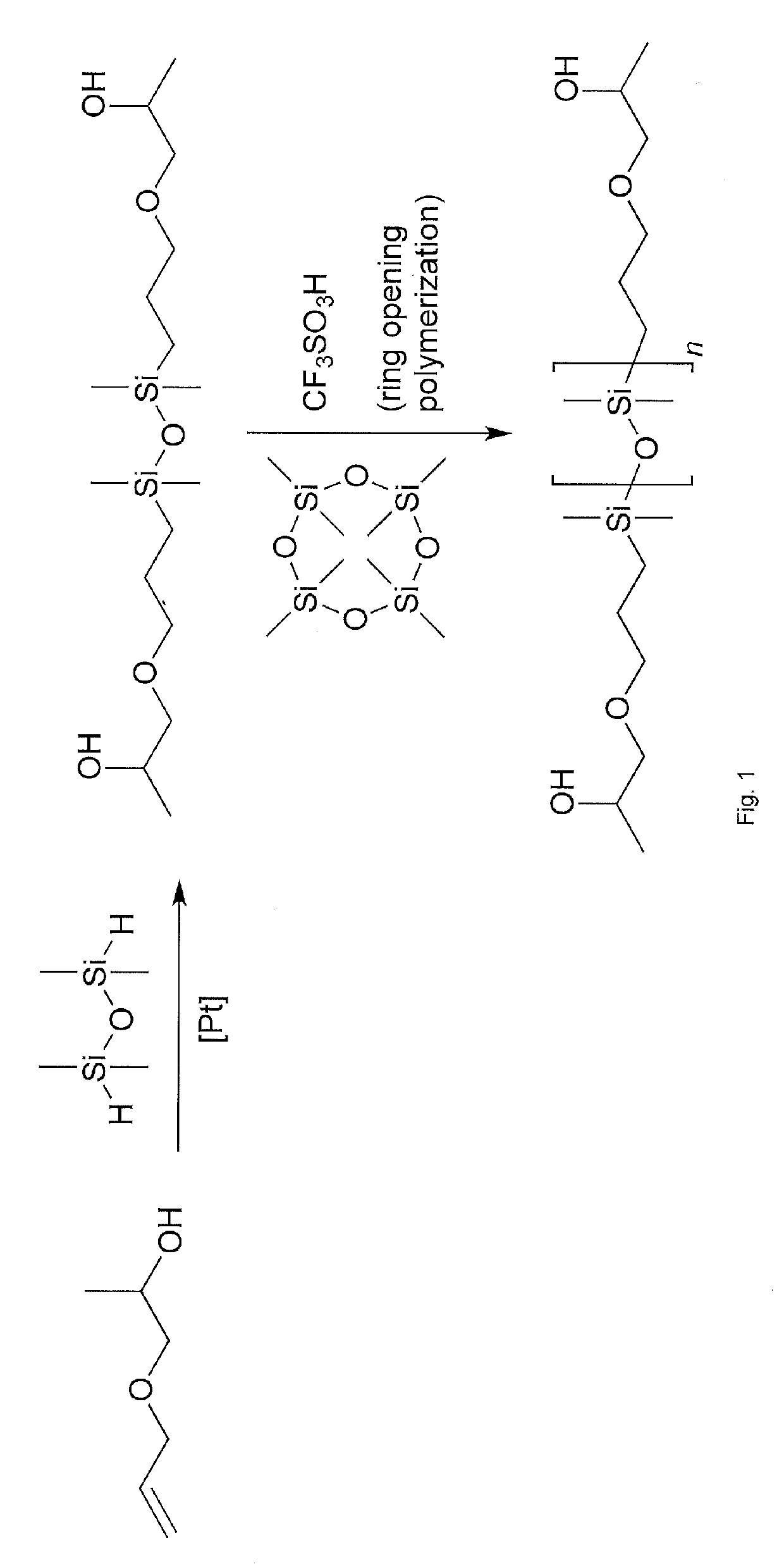
oxy-Propylallylether

[0131]Allylic alcohol and propylene oxide were reacted in a ratio of 1.5 to 1. To this end, 1.463 g of sodium were dissolved in 184 g of the alcohol while externally cooling the stirred mixture with ice. The obtained solution was placed in an autoclave, heated to 110° C. and propylene oxide was added at a rate of 1.25 g / min. After complete addition the mixture was allowed to cool to room temperature and stirred overnight. 37% hydrochloric acid was added (6.25 g) to the resultant mixture and stirred for 10 minutes. The raw product was then filtered through Silica / Diatomite. The filtrate was collected and dried over Na2SO4 and then filtered again. To obtain the desired product, the mixture was distilled over a packed body column and the product collected at a temperature between 82 and 92° C. and a pressure of from 96 to 105 mbar. The average yield of 2-hydroxy-propylallylether was 60%. The compound contains trace amounts of 2-(allyloxy)propan-1-ol.

synthesis example 2

′-Hydroxypropoxypropyl)-1,1,3,3-tetramethyldisiloxane

[0132]80.6 g of 1,1,3,3-tetramethyldisiloxane were dissolved in 600 mL of dry toluene, externally cooled with crushed ice to 10° C. and 400 mg of 5 wt % platinum on carbon was added. 2-Hydroxy-propylallylether (139.4 g)—as obtained from Synthesis Example 1—was added dropwise over a period of 30 minutes. The temperature of the reaction mixture was raised to 100° C. over a period of 5 hours and held at this temperature for a further 12 hours. The resultant mixture was finally refluxed for two hours. Then 250 mL of heptane and active charcoal were added and the mixture again warmed to reflux for 1.5 hours. After cooling the solution was filtered through Silica / Diatomite and the solvent was stripped off under reduced pressure; the product was finally held at 50 mbar pressure and 90° C. for 12 hours to obtain 181.6 g of the desired product.

example 1

of Polymer 1

[0133]800 g of octamethycylcotetrasiloxane (D4), 1.51 g of 1,1,3,3-tetramethyl-disiloxane and 400 μl of triflic acid were placed in a 2 litre reactor (SYSTAG FlexyPAT) equipped with an anchor agitator and heated at 90° C. for 2 hours under stirring. The mixture was quenched with 12.8 g of NaHCO3 and stirred for 30 minutes at 90° C. At 3 bar pressure, the crude product was filtered through a PALL Filter EDF 14-2 with a filter insert Begerow BECO KD5. The residual D4 was removed in a thin film evaporator at 120° C. and 2 mbar (200 rpm / 200 g / h). The polymer obtained was analyzed by GPC analysis and found to have: a number average molecular weight (Mn) of 82413 g / mol; a weight average molecular weight (Mw) of 125264 gmol-1; a peak molecular weight (Mp) of 121511 gmol-1; and, a Polydispersity Index of 1.52.

the structure of the environmentally friendly knitted fabric provided by the present invention; figure 2 Flow chart of the yarn wrapping machine for environmentally friendly knitted fabrics and storage devices; image 3 Is the parameter map of the yarn covering machine
Login to View More

PUM

PropertyMeasurementUnit
polydispersity indexaaaaaaaaaa
temperatureaaaaaaaaaa
Login to View More

Abstract

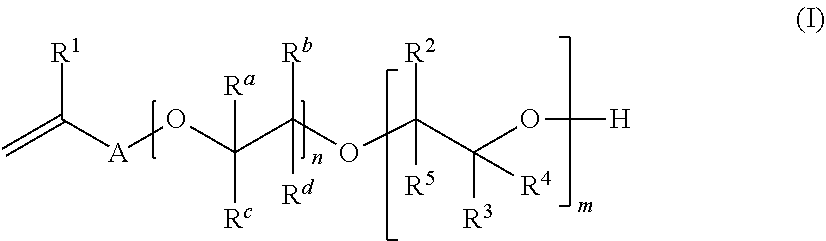
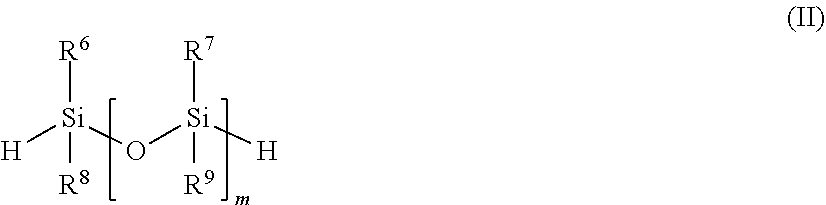
A method for producing a hydroxyl-functionalized polysiloxane having secondary or tertiary hydroxyl groups, said method comprising the steps of:i) reacting a hydroxyalkyl allyl ether having a secondary or tertiary alcohol group with a siloxane under anhydrous conditions and under transition metal catalysis,said hydroxylalkyl allyl ether conforming to Formula (I)wherein n is 0, 1, 2, 3, 4 or 5, preferably 0; m is 1, 2, 3, 4 or 5, preferably 1; spacer group A is constituted by a covalent bond or a C1-C20 alkylene group; R1 is hydrogen, a C1-C8 alkyl group, a C3-C10 cycloalkyl group, a C6-C18 aryl group or an aralkyl group; Ra, Rb, Rc, Rd, R2, R3, R4 and R5 may be the same or different and each is independently selected from hydrogen, a C1-C8 alkyl group, a C6-C18 aryl group or a C6-C18 aralkyl group, with the proviso that at least one of R3 and R4 is not hydrogen; andsaid siloxane conforming to Formula (II)wherein m is 1, 2, 3, 4 or 5, preferably 1; R6, R7, R8 and R9 may be the same or different and each represent a C1-C8 alkyl group, a C3-C10 cycloalkyl group, a C6-C18 aryl group or a C6-C18 aralkyl group; andii) in the presence of the reaction product of step i), performing a ring opening polymerization of at least one cyclic siloxane monomer.

Description

FIELD OF THE INVENTION[0001]The present invention is directed to a process for the preparation of a hydroxyl-functionalized polysiloxane. More particularly, the present invention is directed to a two-stage process for the preparation of a polysiloxane bearing hydroxyl groups bonded to a secondary carbon atom. In addition, the present invention is directed to a hydroxyl-functionalized polysiloxane obtained thereby, its use, and a silylated polymer based on the hydroxyl-functionalized polysiloxane.BACKGROUND OF THE INVENTION[0002]Carbinol (hydroxyl) terminated polysiloxanes are recognized as a useful class of materials, the reaction of which allows for the physicochemical properties of polysiloxanes to be incorporated either into cross-linked polymeric networks or into block copolymers further comprising, for instance, polyurethane, polyester, polycarbonate or polysulfone blocks.[0003]The most common method for preparing carbinol (hydroxyl) terminated polysiloxanes is through hydrosil...

Claims

the structure of the environmentally friendly knitted fabric provided by the present invention; figure 2 Flow chart of the yarn wrapping machine for environmentally friendly knitted fabrics and storage devices; image 3 Is the parameter map of the yarn covering machine
Login to View More

Application Information

Patent Timeline
no application Login to View More
Patent Type & Authority Applications(United States)
IPC IPC(8): C08G77/16C08G77/08C07F7/08
CPCC08G77/16C07F7/0879C08G77/08C08G65/14C08G65/2609C08G65/336C09D183/06C09D183/08C08G77/12C08G77/14C08G77/388C09J183/06C09J183/08C08L83/04C08K5/053C08K5/56C08G77/46
Inventor WINTERBERG, MARLEENWOZNICKA, MARTADIETRICH, ANNIKAMEJIA, ESTEBANKRAGL, UDODESPOTOPOULOU, CHRISTINADUNEKAKE, RALFBRIERS, DAVIDKLEIN, JOHANNLUND, HENRIK
Owner HENKEL KGAA
Features
  • R&D
  • Intellectual Property
  • Life Sciences
  • Materials
  • Tech Scout
Why Patsnap Eureka
  • Unparalleled Data Quality
  • Higher Quality Content
  • 60% Fewer Hallucinations
Social media
Patsnap Eureka Blog
Learn More