Unlock instant, AI-driven research and patent intelligence for your innovation.

Process for Manufacturing Nutritional Compositions for Plants and Soils

a technology of nutritional compositions and plants, applied in the field of fertilizer and compositions, can solve the problems of affecting the agricultural industry, affecting the economic benefits of agriculture, and affecting the physical qualities of soil, so as to improve the sustainability and health of soil, reduce the use of chemical fertilizers, and improve the effect of soil fertility

Pending Publication Date: 2021-10-28
ENVIROKURE
View PDF5 Cites 0 Cited by
  • Summary
  • Abstract
  • Description
  • Claims
  • Application Information

AI Technical Summary

Benefits of technology

The patent describes a process for making fertilizers and nutritional compositions from animal waste, such as poultry manure. The process involves adjusting the pH of the animal waste, adding a stabilizing agent, and separating the waste into solid and liquid components. The liquid component is then subjected to an autothermal aerobic bioreaction, which involves heating the liquid and maintaining it at a suitable pH for the growth of thermophilic bacteria. The resulting composition can be used as a fertilizer or nutritional supplement for plants. The process is efficient and produces high-quality products.

Problems solved by technology

It is now well recognized that the use of synthetic fertilizers adversely impacts the physical qualities of soil diminishing its ability to support plant productivity.
Moreover, numerous studies have shown that as soil carbon declines, significant increases in chemical fertilizers are needed to maintain yields, while leaving an estimated 67% of seed potential unrealized (see, e.g., Mulvaney R. L., et al., 2009, J. Environ. Qual. 38(6):2295-2314; Tollenaar, M., 1985, Proceedings of the Conference on Physiology, Biochemistry and Chemistry Associated with Maximum Yield Corn, Foundation for Agronomic Research and Potash and Phosphate Institute. St. Louis, Mo., 11-12; NASS Crop Production 2017 Summary (U.S.D.A.
However, while biofertilizers may increase the availability of plant nutrients and contribute to soil maintenance as compared to conventional chemical fertilizers, finding cost-effective ways to produce biofertilizers enriched with a suitable population of beneficial microorganisms that are free from microbial contamination and other contaminants and that can be used with existing application methods and technology remains a relatively unmet need in the industry.
Another issue negatively impacting the agricultural industry is field contamination by weed seeds.
Further, manure-based application, especially raw manure application, may actually contribute to weed seed contamination as undigested weed seeds may be present in the animal waste (see Katovich J. et al., “Weed Seed Survival in Livestock Systems,” U. Minn. Extension Servs.
Weed seed contamination often leads to reduced crop yields prompting the need for increased application of chemical herbicides, which may have a negative impact on both plant and human health.
Weed seed contamination is especially problematic in the organic agriculture industry where the application of synthetic herbicides is not permitted forcing famers to rely on mechanical cultivators to control weed growth.
However, the process is time consuming and labor intensive.
Moreover, composting is not without significant obstacles including: (1) the requirement for a large surface area for efficient composting; (2) the need for heavy equipment to “turn” piles for thorough composting for commercial use; (3) difficulty in maintaining consistent, proper carbon to nitrogen ratios; (4) the need for uniform heating; (5) transportation of the bulky final product; and (6) the lack of consistency in the product and its application.
Additionally, because nutrients are applied in bulk prior to planting, there is a significant potential for nutrients to be lost through run-off.
There is also a significant potential for inconsistent decomposition and incomplete pathogen destruction.
Furthermore, uneven nutrient distribution in field application is a concern.
Lastly, solid compost cannot be used in hydroponics and drip irrigation.
While such liquid material can be utilized in drip irrigation or foliar application, its production remains time consuming and labor intensive, and the liquid product suffers from the same drawbacks as solid compost in that it may still contain pathogenic organisms and its nutrient content is inconsistent.
Thus, any residual pathogenic organisms present in the compost tea presents a risk for pathogen replication and contamination and thus may not pass muster under the applicable and stringent federal health and safety regulations.
While fish fertilizers can provide nutritional supplementation to plants and soil microorganisms, they are difficult to use, in part due to their high acidity and oil-based composition in some instances, which can clog agricultural equipment.
However, due to their sourcing, these products can be expensive.
Furthermore, none of the above-described fertilizers is naturally biologic: beneficial microorganisms must be added to them.
However, existing methods of processing poultry manure to produce biofertilizer suffer from a number of drawbacks that include incomplete decomposition of organic matter and excess foaming of the bioreactor equipment.
The latter causes significant disruption of airflow and subsequent incomplete decomposition of organic material, which typically results in a liquid fertilizer product that clogs sprayers and other field application equipment thereby disrupting farming program operations and increasing costs.

Method used

the structure of the environmentally friendly knitted fabric provided by the present invention; figure 2 Flow chart of the yarn wrapping machine for environmentally friendly knitted fabrics and storage devices; image 3 Is the parameter map of the yarn covering machine
View more

Image

Smart Image Click on the blue labels to locate them in the text.
Viewing Examples
Smart Image
  • Process for Manufacturing Nutritional Compositions for Plants and Soils
  • Process for Manufacturing Nutritional Compositions for Plants and Soils
  • Process for Manufacturing Nutritional Compositions for Plants and Soils

Examples

Experimental program
Comparison scheme
Effect test

example 1

or Producing Fertilizer / Nutritional Composition from Chicken Manure

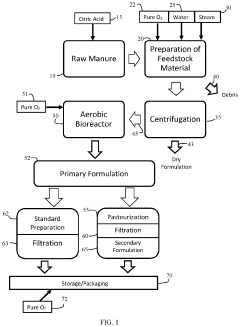
[0130]Depicted in FIG. 1 is an embodiment of the production process described herein for producing liquid and solid compositions from chicken manure. The production process depicted in FIG. 1 produced pathogen-free products that retained the primary and secondary nutrients, as well as micro-nutrients, present in layer manure. In addition, the process described herein removed potentially problematic phosphorus and hydrogen sulfide from the products.

[0131]As shown in FIG. 1, the process began 10 when raw chicken manure was transported to the location directly from the farm(s) in covered live bottom trailers. The trucks were unloaded into mix tanks at the location and combined with citric acid 15 and water to form a homogeneous slurry. The citric acid bound the natural organic ammonia in raw manure.

[0132]The next step in the process involved the preparation of feedstock material 20. In this step, the stored slurry was m...

example 2

r Kinetics During ATAB

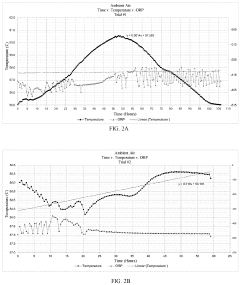
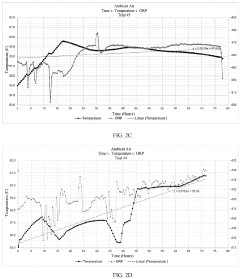
[0139]The rate of organic matter decomposition of during ATAB is adversely impacted by increasing foaming in the bioreactor, which interferes with the oxygen supply. In turn, inadequate oxygen supply to the liquid stream during ATAB makes less oxygen available and reduces efficiency of organic matter decomposition. The oxygen reduction potential (ORP) can be used to measure the efficiency of oxygen delivery, which results in increased oxidation of compounds in the liquid stream and lowering of the ORP value. As such, ORP can be used to measure organic matter decomposition kinetics in the bioreactor.

[0140]To compare the ATAB kinetics of pure oxygen versus atmospheric oxygen, a bioreactor utilizing pure oxygen delivery was compared a bioreactor with utilizing ambient air. Five separate ATABs were carried out for 80-90 hours in a bioreactor equipped with 2 micron sintered stainless steel spargers that injected the liquid stream with pure oxygen at a rate of 1.0 CF...

example 3

r Foam Production During ATAB

[0145]The level of foam produced during ATAB performed in a bioreactor utilizing atmospheric oxygen delivery was compared to the level foam produced in a bioreactor with a pure oxygen or oxygen enriched delivery system as disclosed herein. The liquid fertilizer production process was carried out for two different bioreactor oxygen delivery systems. In Process A, the production process was carried out as described in Example 1. Two bioreactors used in sequence facilitated the ATAB. Each bioreactor in Process A was equipped with 2 micron sintered stainless steel spargers that injected the liquid stream with pure oxygen at a rate of 1.0 CFM per 1,000 gallons. In Process B, the bioreactors were each equipped with a jet aeration device to supply ambient air to the liquid stream. As shown in Table 8, the delivery of pure oxygen significantly reduced the foam level in the bioreactors as compared to ambient air delivery.

TABLE 8Bioreactor Foam LevelsProcessBiorea...

the structure of the environmentally friendly knitted fabric provided by the present invention; figure 2 Flow chart of the yarn wrapping machine for environmentally friendly knitted fabrics and storage devices; image 3 Is the parameter map of the yarn covering machine
Login to View More

PUM

PropertyMeasurementUnit
temperatureaaaaaaaaaa
timeaaaaaaaaaa
temperatureaaaaaaaaaa
Login to View More

Abstract

Processes for manufacturing compositions for plants and soils, such as liquid biofertilizers and solid biostimulants, from animal manure is disclosed. The processes include the delivery of pure oxygen or oxygen-enriched air to a liquid fraction of animal manure and further include subjecting the liquid fraction to an autothermal thermophilic aerobic bioreaction. Nutritional compositions to enhance the effectiveness of synthetic fertilizers in conventional agriculture and / or for use in organic farming that are manufactured by these processes are also disclosed.

Description

CROSS REFERENCE TO RELATED APPLICATIONS[0001]This claims benefit of U.S. Provisional Application No. 62 / 713,325, filed Aug. 1, 2018, the entire contents of which are incorporated by reference herein.FIELD OF THE INVENTION[0002]The present invention relates generally to fertilizers and compositions useful for promoting plant growth and healthy soil structure. In particular, processes for manufacturing such fertilizers and compositions are disclosed.BACKGROUND OF THE INVENTION[0003]Two main categories of crop input products are used in agriculture: fertilizers and pesticides. A fertilizer is typically described as any organic or inorganic material of natural or synthetic origin that is added to supply one or more nutrients essential to the growth of plants. Fertilizers provide, in varying proportions, the macronutrients, secondary nutrients, and micronutrients required or beneficial for plant growth.[0004]During the last century, there has been extensive use of synthetic fertilizers a...

Claims

the structure of the environmentally friendly knitted fabric provided by the present invention; figure 2 Flow chart of the yarn wrapping machine for environmentally friendly knitted fabrics and storage devices; image 3 Is the parameter map of the yarn covering machine
Login to View More

Application Information

Patent Timeline
no application Login to View More
Patent Type & Authority Applications(United States)
IPC IPC(8): C05F17/20C05F3/00C05F17/40C05F17/70C05F17/979C05G5/20
CPCC05F17/20C05F3/00C05G5/20C05F17/70C05F17/979C05F17/40C05F17/50Y02P20/145Y02W30/40
Inventor BHALLA, SUSHIL K.HOOPER, DEVON K.
Owner ENVIROKURE