Mangiferin-containing herbal compositions for improving sports performance
a technology of mangiferin and herbal compositions, which is applied in the field of mangiferin-containing herbal formulations, can solve the problems of not having determined the efficacy of natural polyphenols in mitigating deterioration, and achieve the effects of increasing sports performance, preventing fatigue, and increasing brain oxygenation
- Summary
- Abstract
- Description
- Claims
- Application Information
AI Technical Summary
Benefits of technology
Problems solved by technology
Method used
Image

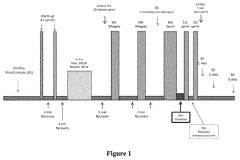
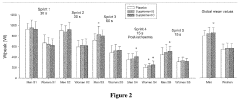
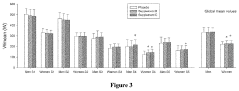
Examples
embodiments
[0068]1) A particular embodiment is directed to a formulation for increasing sports performance, comprising:[0069]a. an effective amount of mangiferin; in combination with[0070]b. an effective amount of an active ingredient selected from the group consisting of luteolin, quercetin, an ethyl acetate extract of Cyperus esculentus tubers and mixtures thereof.[0071]2) The formulation according to embodiment 1; wherein the formulation comprises:[0072]from 5 parts to 1000 parts of mangiferin, in combination with either:[0073]from 2 to 1000 parts of luteolin,[0074]from 20 to 2000 parts of quercetin,[0075]from 1 to 1000 parts of an ethyl acetate extract of Cyperus esculentus tubers;[0076]or with mixtures thereof.[0077]3) The formulation according to any of the previous embodiments, wherein the formulation comprises from 10 to 1000 parts of mangiferin and from 2 to 1000 parts of luteolin.[0078]4) The formulation according to any of the previous embodiments, wherein the formulation comprises ...
example 1
n Human Patients: Experimental Procedure
[0146]A. Subjects
[0147]Data on the effect of mangiferin-containing compositions was obtained from 17 men and 13 women. Subjects were requested to avoid strenuous exercise 48 h before the laboratory test and not to drink beverages containing caffeine or taurine during the 24 h preceding the test.
TABLE 1Wmax, maximal intensity during the incremental exercisetest to exhaustion; Wpeak1, instantaneous peak poweroutput during the Wingate test; LLM, lean mass of the lowerextremities; Wmean, mean power output during a 30 sWingate test; Accumulated VO2, total amount ofO2 consumed); % Anaerobic Energy, percentageof the energy obtained through anaerobic pathways.Men (n = 17)Women (13)PAge (years)22.7 ± 2.127.0 ± 2.20.005Height (cm)176.9 ± 4.2 164.4 ± 4.6 0.000Weight (kg)71.2 ± 5.256.5 ± 5.40.000% body fat18.4 ± 3.726.0 ± 4.90.000Lean; mass of both legs (kg)19.8 ± 2.013.6 ± 2.50.000Hemoglobin (g · dL−1)15.0 ± 0.813.2 ± 0.90.000HRmax (Beats / min)191.7 ± 7.5...
example 2
n Human Patients: Experimental Procedure
[0175]A. Subjects
[0176]Twelve healthy male physical education students (age=21.3±2.1 yr, height=176.6±5.8 cm, body mass=75.7±9.9 kg, body fat=20.3±5.3%, VO2max: 3.69±0.47 L / min and 49.4±8.2 mL / (Kg·min)) agreed to participate in this investigation (Table 1). Before volunteering, subjects received full oral and written information about the experiments and possible risks associated with participation. Written consent was obtained from each subject. The study was performed by the Helsinki Declaration and approved by the Ethical Committee of the University of Las Palmas de Gran Canaria (CEIH-2016-02). The sample size required to allow detecting a 5% improvement of performance with a statistical power of 0.8 (α=0.05), assuming a coefficient of variation for the ergometric test below 5%, was eight subjects. To account for potential dropouts twelve subjects were finally recruited.
General Procedures
[0177]The inclusion criteria for participation in the...
PUM
 Login to View More
 Abstract
Description
Claims
Application Information
 Login to View More