Check patentability & draft patents in minutes with Patsnap Eureka AI!

Method for determining the spatiotemporal distribution of activity of a proteolytic enzyme in a heterogeneous system (variations), a device for realizing same and a method for diagnosing the defects in the hemostatic system on the basis of a change in the spatiotemporal distribution of activity of a proteolytic enzyme in a heterogeneous system

a proteolytic enzyme and heterogeneous system technology, applied in the field of medicine and biology, can solve the problems of inability to adequately study processes using methods, inability to diffuse far away from the activator, and rapid inhibition of factor xa, and achieve the effect of accurate determination of the spatiotemporal distribution of activity and high degree of accuracy

Active Publication Date: 2018-04-10
OBSCHESTVO S OGRANICHENNOY OTVETSTVENNOSTYU GEMATOLOGICHESKAYA KORPORATSIYA
View PDF4 Cites 0 Cited by
  • Summary
  • Abstract
  • Description
  • Claims
  • Application Information

AI Technical Summary

Benefits of technology

This approach enhances the sensitivity to disorders in blood coagulation, enabling more accurate diagnosis of hemostatic system disorders, evaluation of drug activity, and assessment of coagulation factor roles in different phases of blood coagulation, allowing for the detection of hyper-coagulation states and predisposition to pathologies like thromboses and strokes.

Problems solved by technology

A big problem currently exists in studying the dynamics of complex biological systems and processes occurring in them, where there is spatial heterogeneity.
However, factor Xa is inhibited rapidly and cannot diffuse far away from the activator.
Clotting in the body is not uniform.
These processes cannot be adequately studied using the methods carried out in a homogeneous medium.
Thus, there is currently a problem of experimental modeling of blood coagulation in-vitro, as it is desirable to more fully simulate the spatial situation in which a blood clot coagulates directly in a blood vessel.
The problem exists both for fundamental studies of thrombosis and hemostasis, and for application-specific diagnostic and pharmacological tasks.
The problem of determining the changes of the proteolytic enzyme concentration in time and space, i.e. at different points within the volume of the test sample, has not been solved yet.
The disadvantage of the abovementioned device and method is the formation of gas bubbles in the cuvette within the registration area when the test samples are heated, which distorts the light scattering signal from the fibrin clot.
Moreover, the device and method described above do not provide the possibility to record the process of formation and spatial distribution of separate clotting factors, such as IIa, Xa, VIIa, XIa, which regulate the process of spatial fibrin clot growth.
Disadvantages of this method include the ability of measuring only contact activation factors (particularly, factors XIa, XIIa, kallikrein) with poor ability of differentiating between contributions of these factors into signal and without the possibility of measuring the spatial dynamics of coagulation process, i.e. formation of a fibrin clot.
Disadvantages of the apparatus include: inconvenience of the used dish for high efficiency studies; use of unstable illumination with a mercury lamp, which doesn't allow taking precise measurements; formation of gas bubbles in the area where the process is recorded while the test samples are heated, distorting the fluorescence signal.
The method does not allow modeling in-vitro systems that are similar in their physiological properties to in-vivo systems, and does not allow a more accurate diagnosis of disorders in the blood coagulation system.
Moreover, the above method doesn't allow adequate investigation of the spatial kinetics of coagulation factors, first of all thrombin, during the process of fibrin clot growth, and does not provide the opportunity to evaluate the role of coagulation factor in the different phases of the blood coagulation process in a heterogeneous system.

Method used

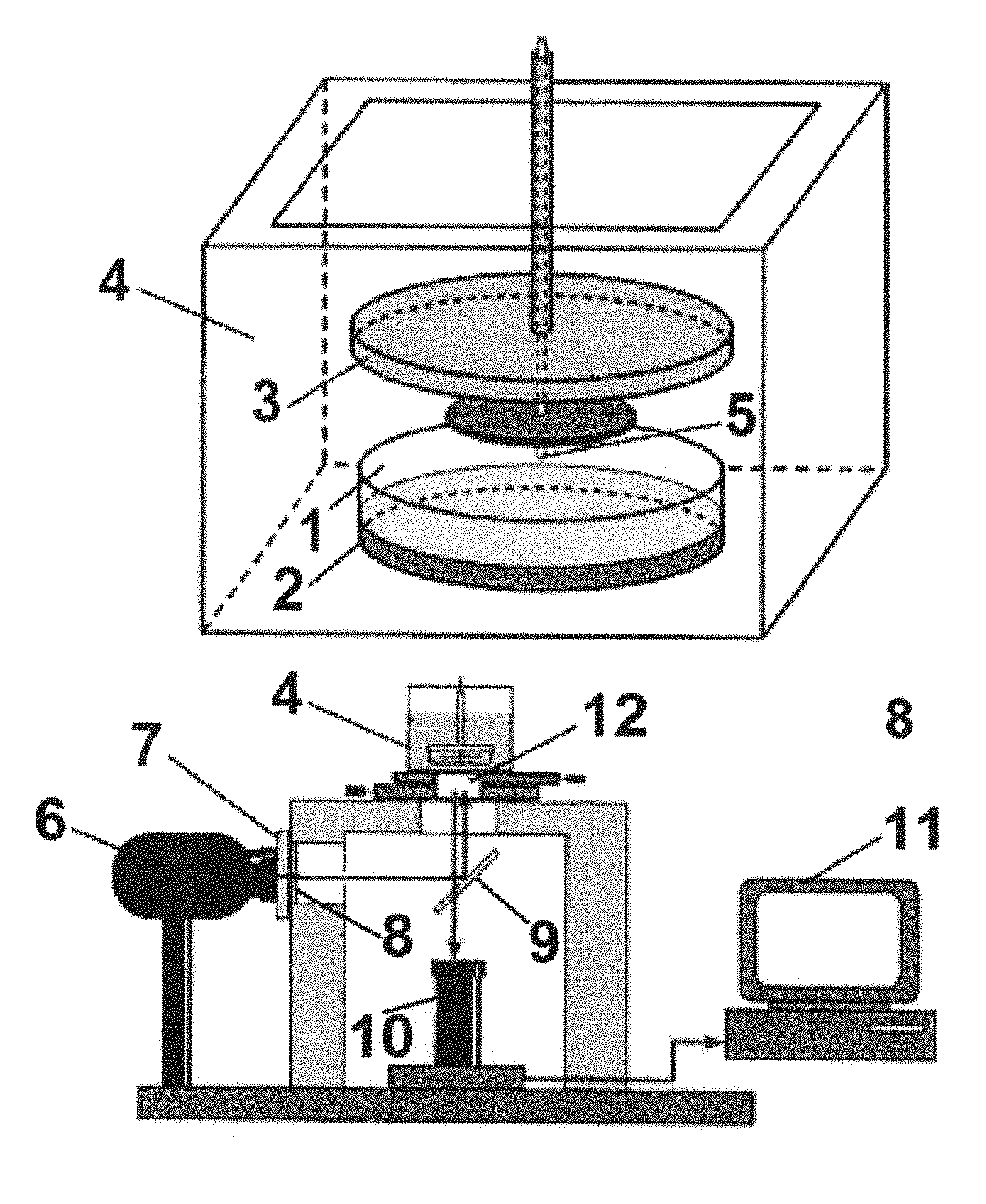
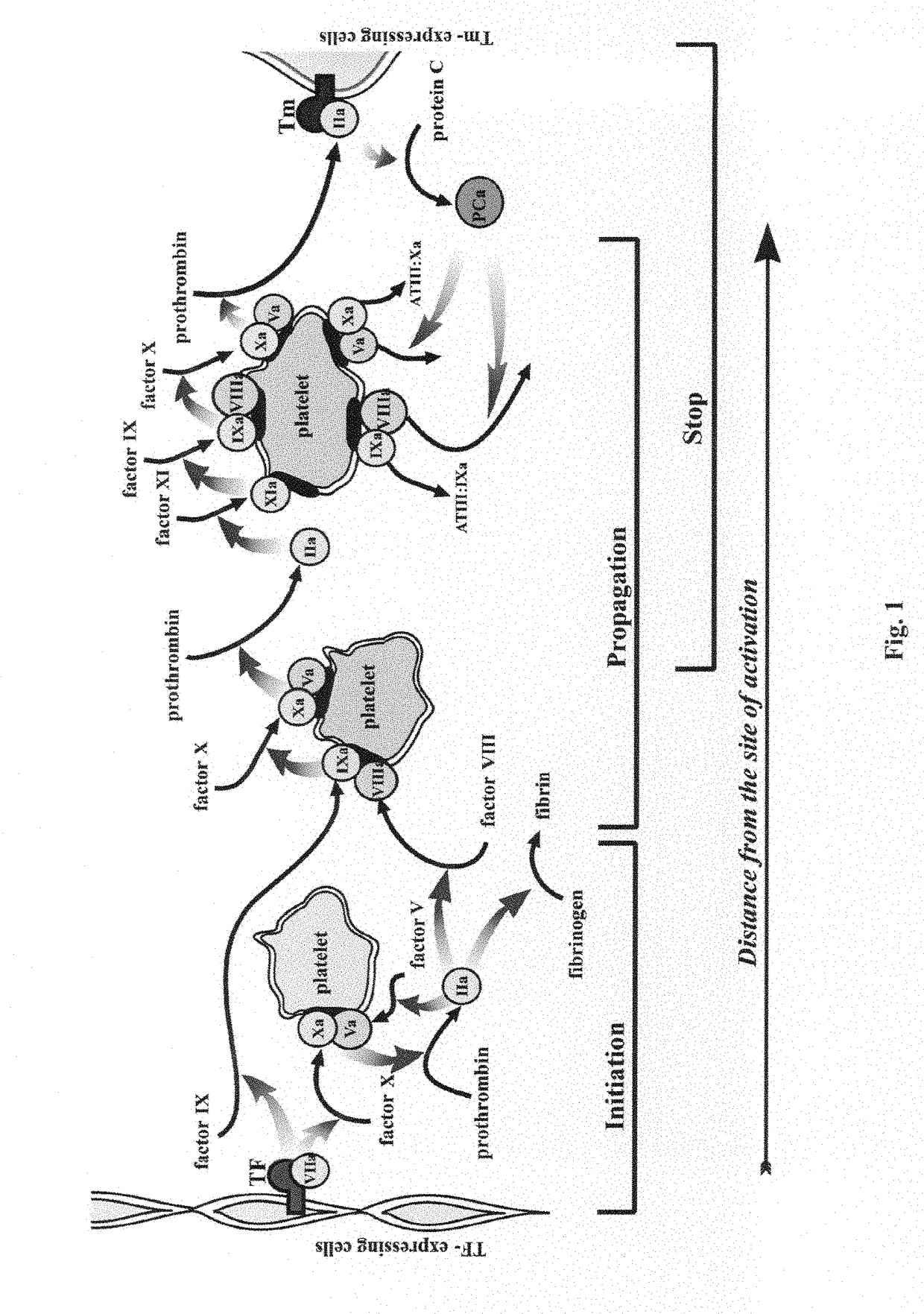
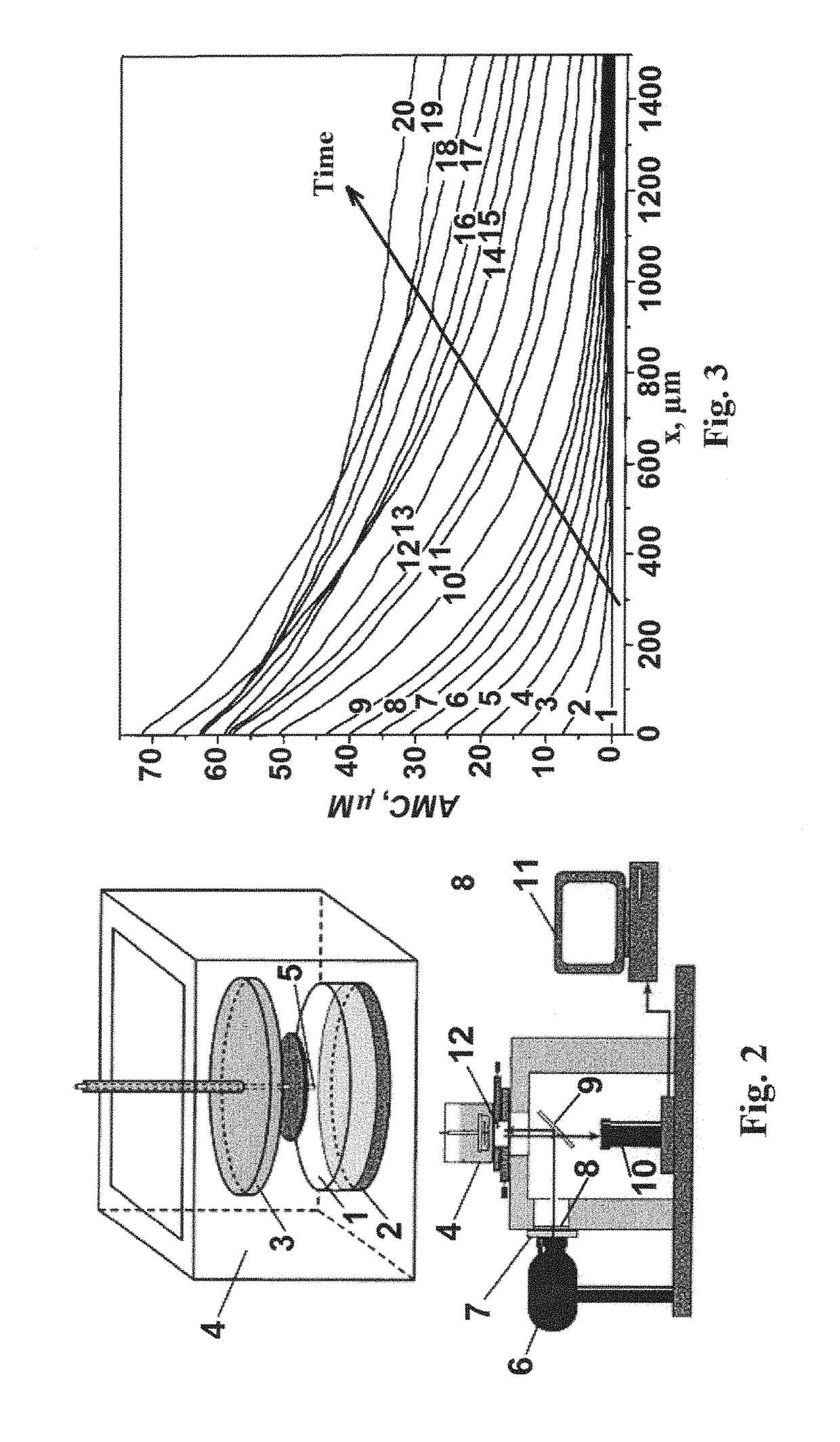
the structure of the environmentally friendly knitted fabric provided by the present invention; figure 2 Flow chart of the yarn wrapping machine for environmentally friendly knitted fabrics and storage devices; image 3 Is the parameter map of the yarn covering machine
View more

Image

Smart Image Click on the blue labels to locate them in the text.
Viewing Examples
Smart Image
  • Method for determining the spatiotemporal distribution of activity of a proteolytic enzyme in a heterogeneous system (variations), a device for realizing same and a method for diagnosing the defects in the hemostatic system on the basis of a change in the spatiotemporal distribution of activity of a proteolytic enzyme in a heterogeneous system
  • Method for determining the spatiotemporal distribution of activity of a proteolytic enzyme in a heterogeneous system (variations), a device for realizing same and a method for diagnosing the defects in the hemostatic system on the basis of a change in the spatiotemporal distribution of activity of a proteolytic enzyme in a heterogeneous system
  • Method for determining the spatiotemporal distribution of activity of a proteolytic enzyme in a heterogeneous system (variations), a device for realizing same and a method for diagnosing the defects in the hemostatic system on the basis of a change in the spatiotemporal distribution of activity of a proteolytic enzyme in a heterogeneous system

Examples

Experimental program
Comparison scheme
Effect test

first embodiment

[0121 of the Method

[0122]According to the invention, a method provided for determining the spatiotemporal distribution of activity of a proteolytic enzyme in a heterogeneous system is implemented as follows.

[0123]An in-vitro system that includes a sample of a test medium, wherein the test medium is selected from the group consisting of blood plasma, whole blood, water, lymph, colloidal solution, crystalloid solution and gel, and a proteolytic enzyme or its zymogen, wherein the proteolytic enzyme or its zymogen is distributed in the sample of the test medium.

[0124]A fluorogenic substrate is combined (or immersed, or contacted) with the in-vitro system.

[0125]In reaction between the proteolytic enzyme and the fluorogenic substrate, the fluorogenic substrate is cleaved by the proteolytic enzyme, and a fluorescent mark (fluorophore) is released upon cleavage of the fluorogenic substrate.

[0126]The sample of the test medium is illuminated with exciting radiation (in determined times) to ex...

second embodiment

[0135 of the Method

[0136]The second embodiment differs from the first embodiment in that the substrate is a chromogenic substrate.

[0137]In reaction between the proteolytic enzyme and the chromogenic substrate, the substrate is cleaved and releases a chromophore. The system is illuminated with light having a wavelength at which the light is substantially absorbed by the chromophore. Spatial distribution of the change of color of the test medium is recorded in determined times. Spatial distribution of the chromophore in the sample is determined from the spatial distribution of the change of color of the sample. Spatiotemporal distribution of the proteolytic enzyme activity is calculated by using the set of spatial distributions of the chromophore and solving the inverse “reaction-diffusion-convection” problem. The step of calculating includes correcting the spatiotemporal distribution by taking into account the binding of the mark to components of the test medium.

[0138]In determined t...

third embodiment

[0139 of the Method

[0140]The third embodiment of the method is different from the first embodiment in that the substrate is a substrate which is cleaved in reaction with the proteolytic enzyme to release a chemiluminescent product. Spatial distribution of luminescence intensity in the sample is recorded in determined times. Spatiotemporal distribution of activity of the proteolytic enzyme is calculated by using the set of spatial distributions of the luminescence and solving the inverse “reaction-diffusion-convection” problem. The step of calculating includes correcting the spatiotemporal distribution by taking into account the binding of the mark to components of the test medium.

[0141]In determined times, the test medium sample is illuminated, and optical characteristics of the test sample, selected from the group consisting of: the spatial distribution of light scattering, the spatial distribution of optical transmission in the sample, or a combination thereof are recorded by the ...

the structure of the environmentally friendly knitted fabric provided by the present invention; figure 2 Flow chart of the yarn wrapping machine for environmentally friendly knitted fabrics and storage devices; image 3 Is the parameter map of the yarn covering machine
Login to View More

PUM

PropertyMeasurementUnit
pressureaaaaaaaaaa
pHaaaaaaaaaa
pressureaaaaaaaaaa
Login to View More

Abstract

The invention relates to the field of biotechnology. The method for determining the spatial and temporal distribution of the activity of a proteolytic enzyme in an in vitro heterogeneous system, such as blood or blood plasma, involves the introduction of a luminescent, fluorogenic or chromogenic substrate into a sample with the subsequent release of a detectable tag as the proteolytic enzyme cleaves the substrate, and the recording of the optical characteristics of the sample, which makes it possible to assess the spatial and temporal distribution of the activity of the enzyme. The device for the implementation of the above method comprises an in vitro system, a means for illuminating the sample, a recording means and a control means. A method for diagnosing homeostatic imbalances according to a change in the spatial and temporal distribution of the activity of a proteolytic enzyme in a blood sample is also proposed.

Description

[0001]This application is a 35 U.S.C. § 371 national phase application of PCT / RU2012 / 000570, which was filed Jul. 16, 2012, and claims the benefit of Russian patent application No. 2011131293, filed Jul. 26, 2011, both of which are incorporated herein by reference as if fully set forth.TECHNICAL FIELD[0002]The present invention relates to medicine and biology and can be used, in particular, for diagnostic and research purposes to determine coagulation characteristics of blood and its components, as well as in biotechnology, pharmacology, and in fundamental biological research.BACKGROUND ART[0003]A big problem currently exists in studying the dynamics of complex biological systems and processes occurring in them, where there is spatial heterogeneity. Such processes include, in particular, blood coagulation, complement, apoptosis, digestion, fibrinolysis, in which proteolytic enzymes (proteinases) play a key role.[0004]Concentration of proteolytic enzymes can be measured if this value...

Claims

the structure of the environmentally friendly knitted fabric provided by the present invention; figure 2 Flow chart of the yarn wrapping machine for environmentally friendly knitted fabrics and storage devices; image 3 Is the parameter map of the yarn covering machine
Login to View More

Application Information

Patent Timeline
no application Login to View More
Patent Type & Authority Patents(United States)
IPC IPC(8): C12Q1/56C12Q1/37G01N21/64
CPCC12Q1/56C12Q1/37G01N21/6408G01N21/6456G01N2333/974G01N2021/6439G01N2333/95
Inventor ATAULLAKHANOV, FAZOIL INOYATOVICHDASHKEVICH, NATALJYA MIKHAJLOVNAOVANESOV, MIKHAIL VLADIMIROVICHSARBASH, VASILII IVANOVICHPANTELEEV, MIKHAIL ALEKSANDROVICHKARAMZIN, SERGEY SERGEEVICHKONDRATOVICH, ANDREY YURJEVICH
Owner OBSCHESTVO S OGRANICHENNOY OTVETSTVENNOSTYU GEMATOLOGICHESKAYA KORPORATSIYA
Features
  • R&D
  • Intellectual Property
  • Life Sciences
  • Materials
  • Tech Scout
Why Patsnap Eureka
  • Unparalleled Data Quality
  • Higher Quality Content
  • 60% Fewer Hallucinations
Social media
Patsnap Eureka Blog
Learn More