
Preparation method and application of alpha-manganese oxide loaded nickel-magnesium catalyst
A technology for supporting nickel and catalyst is applied in the field of preparation of manganese oxide supported nickel-magnesium catalyst Ni/Mg-α-MnO2, and can solve the problem of high reaction temperature for completely catalyzing elimination of benzene series compounds
- Summary
- Abstract
- Description
- Claims
- Application Information
AI Technical Summary
Problems solved by technology
Method used
Image

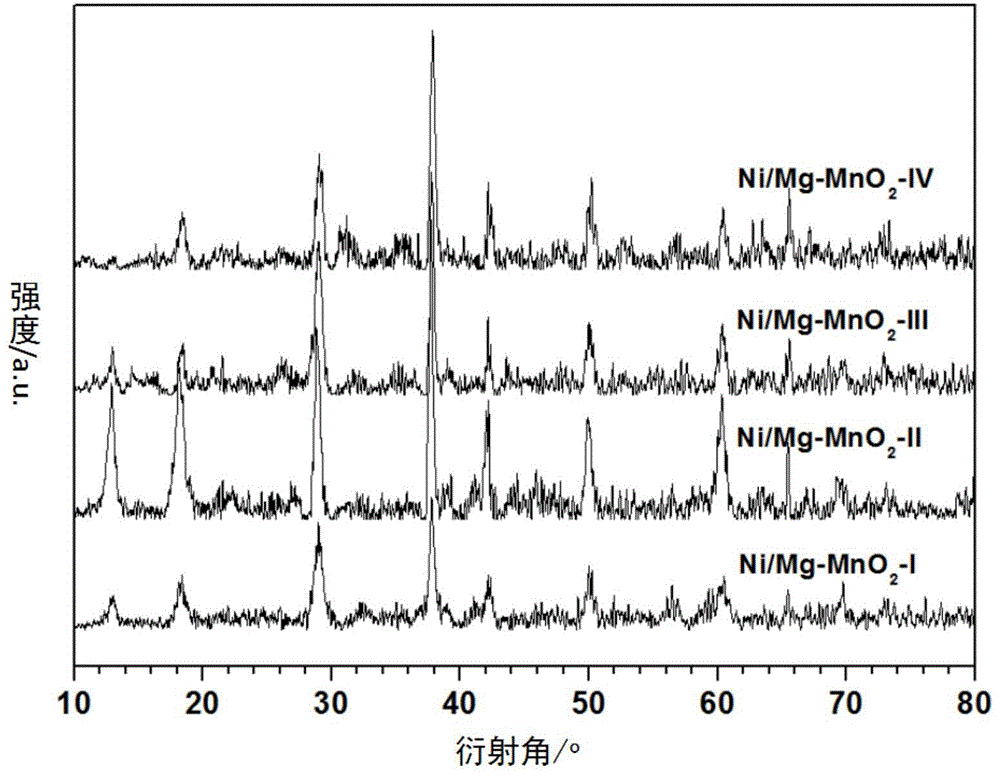
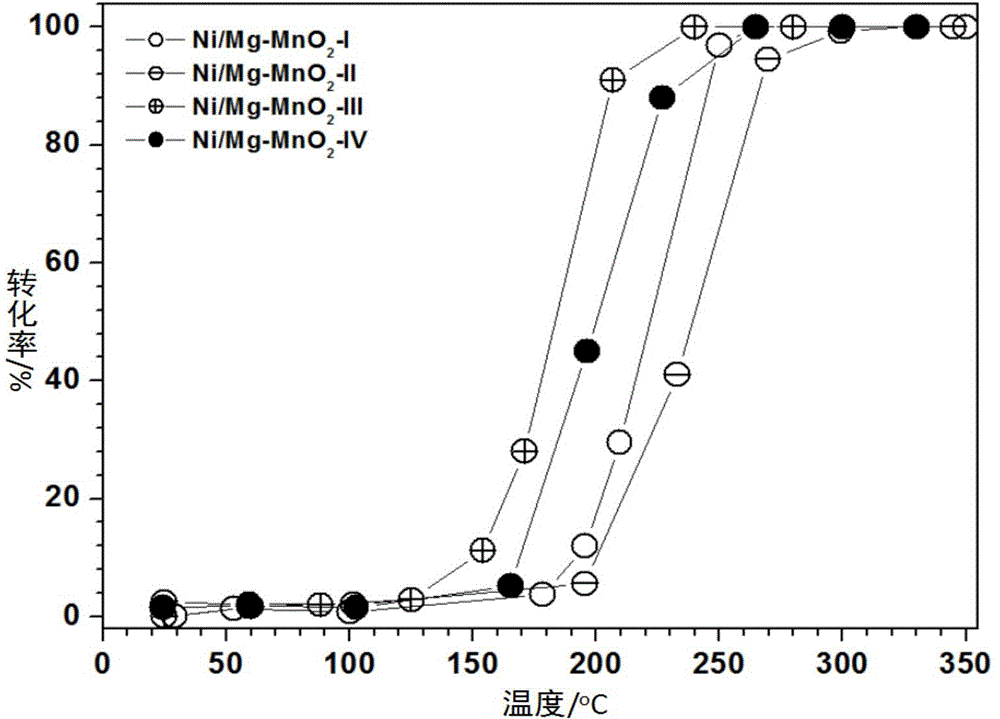
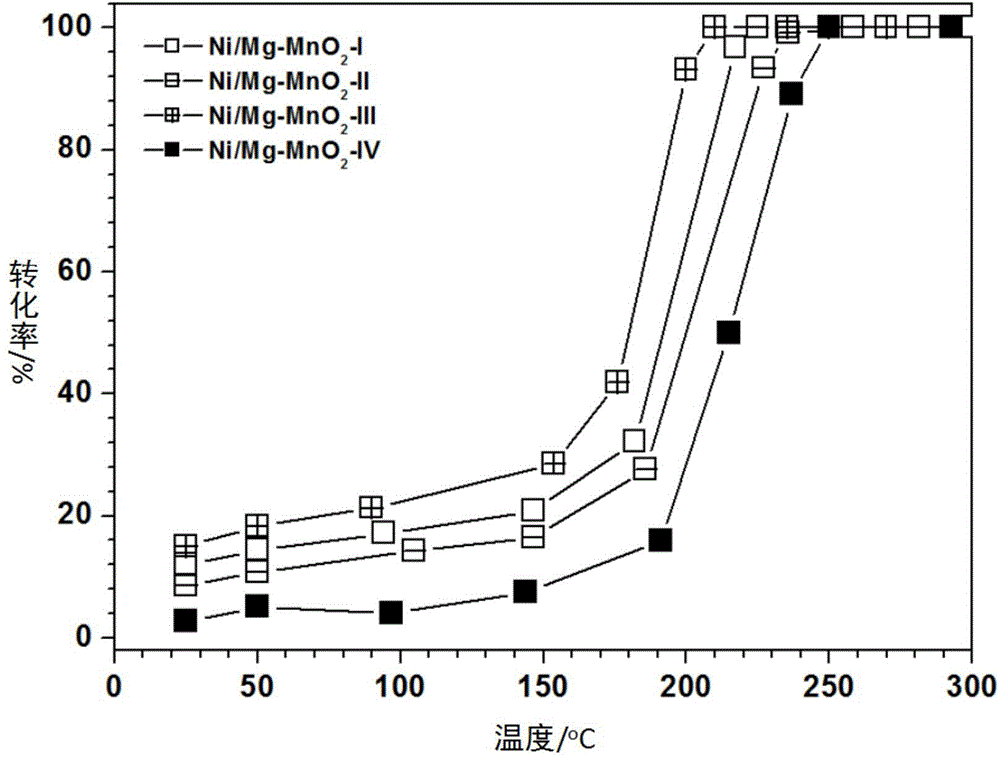
Examples
Embodiment 1
[0017] (1) the preparation method of above-mentioned catalyst provided by the present invention, comprises the steps:
[0018] The KAc solution and the HAc solution were mixed into a buffer solution according to the ratio of KAc / HAc molar ratio=0.1, and the pH was adjusted at about 3.74, and then 0.01 g of Mg(NO 3 ) 2 ·6H 2 O and 0.29g Ni(NO 3 ) 2 ·6H 2 O was dissolved in the above 40ml acetic acid buffer solution. The above buffer solution containing metal salts was added to 24ml with a concentration of 1.0mol / L Mn(Ac) 2 solution, mix well. Then 120ml concentration of 0.1mol / L KMnO 4 The solution was dropped into the above mixed solution, in which KMnO 4 / Mn(Ac) 2 (molar ratio) = 0.5, stirred for 2 hours, sealed and aged for 12 hours, refluxed at 80°C for 20 hours, rotary steamed for 3 hours until it became powdery, washed with deionized water until neutral, dried at 100°C for 10 hours to obtain a black precursor body, and then ground into powder. Take the above pr...
Embodiment 2
[0021] (1) the preparation method of above-mentioned catalyst provided by the present invention, comprises the steps:
[0022] The KAc solution and the HAc solution were mixed into a buffer solution according to the ratio of KAc / HAc molar ratio=1.0, and the pH was adjusted at about 4.74, and then 0.03g of Mg(NO 3 ) 2 ·6H2 O and 1.50g Ni(NO 3 ) 2 ·6H 2 O was dissolved in the above 40ml acetic acid buffer solution. With 0.5g of PVP (molecular formula (C 6 h 9 NO) n , molecular weight 1000) dissolved in 28.5ml concentration is 1.5mol / L Mn(Ac) 2 in solution. Add the above buffer solution containing metal salts to this solution and mix well. Then 150ml concentration of 0.2mol / L KMnO 4 The solution was dropped into the above mixed solution, in which KMnO 4 / Mn(Ac) 2 (molar ratio) = 0.7, stirred for 2 hours, sealed and aged for 12 hours, refluxed at 80°C for 20 hours, rotary steamed for 3 hours until it became powdery, washed with deionized water until neutral, dried at 1...
Embodiment 3
[0025] (1) the preparation method of above-mentioned catalyst provided by the present invention, comprises the steps:
[0026] The KAc solution and the HAc solution are mixed into a buffer solution according to the ratio of KAc / HAc molar ratio=5.0, the pH is adjusted at 5.4, and then 0.04g of Mg(NO 3 ) 2 ·6H 2 O and 2.50g Ni(NO 3 ) 2 ·6H 2 O was dissolved in the above 40ml acetic acid buffer solution. With 1.5g of PVP (molecular formula (C 6 h 9 NO) n , molecular weight 1000) dissolved in 37.5ml concentration is 1.5mol / L Mn(Ac) 2 in solution. Add the above buffer solution containing metal salts to this solution and mix well. Then 150ml concentration of 0.3mol / L KMnO 4 The solution was dropped into the above mixed solution, in which KMnO 4 / Mn(Ac) 2 (molar ratio) = 0.8, stirred for 4 hours, sealed and aged for 12 hours, refluxed at 120°C for 26 hours, rotary steamed for 4 hours until it became powder, washed with deionized water until neutral, dried at 140°C for 12...
PUM
 Login to View More
 Abstract
Description
Claims
Application Information
 Login to View More