A method for preparing ε-polylysine by ring-opening polymerization
A technology of polylysine and ring-opening polymerization, which is applied in the field of ring-opening polymerization to prepare ε-polylysine, which can solve the problems of low cost, limited application fields of ε-polylysine, and high production cost, and achieve low cost Effect
- Summary
- Abstract
- Description
- Claims
- Application Information
AI Technical Summary
Problems solved by technology
Method used
Image

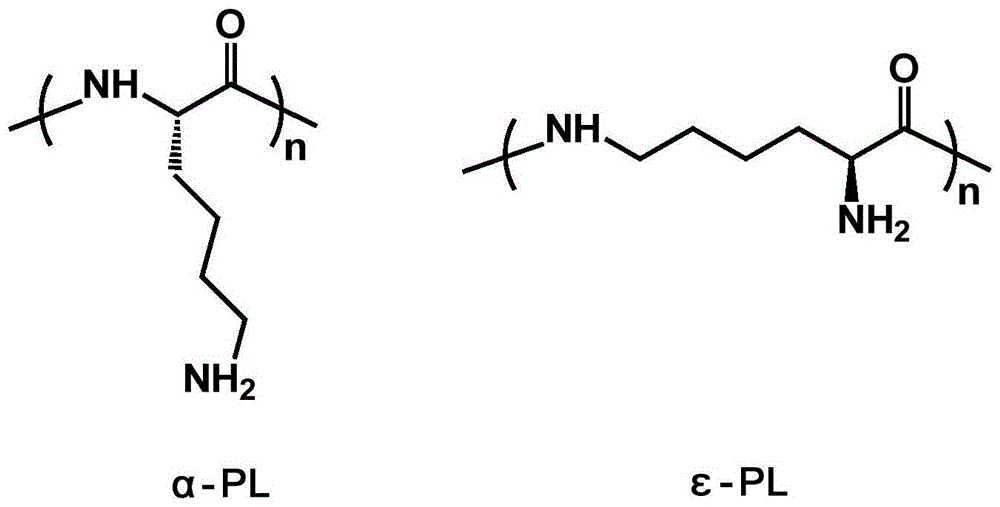
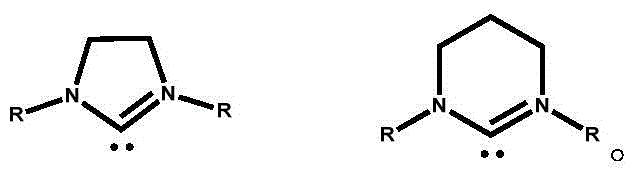
Examples
preparation example Construction
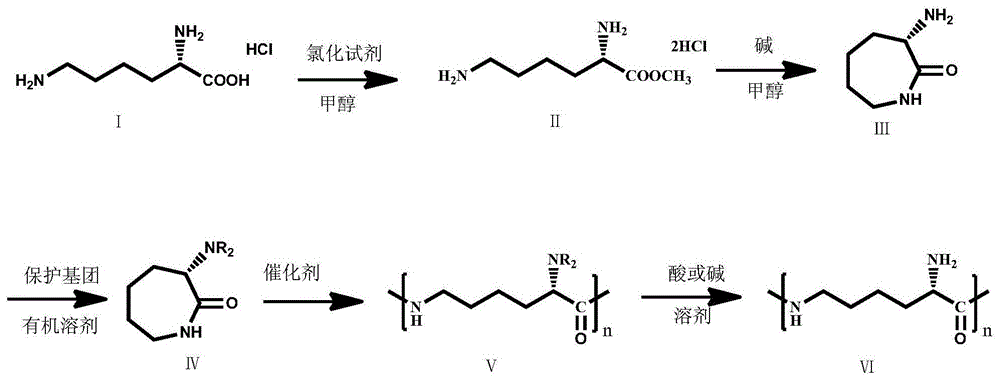
[0047] (5) Preparation of formula (Ⅵ) epsilon-polylysine:
[0048] Remove the protective group from the poly(S)-α-protected amino-lysine prepared in step (4), the reaction temperature is 20°C-130°C, and the time is 1-30 days to obtain ε-polylysine ;
[0049] The deprotection solvent used is one or more of tetrahydrofuran, DMF, DMSO, methanol, ethanol, ethylene glycol dimethyl ether, chloroform, dichloromethane and water.
[0050] The deprotection method used in step (5) corresponds to that in step (3).
[0051]After the reaction is completed, the polymer is obtained by dialysis and then freeze-drying. Or directly freeze-dry, add a small amount of water to remove excess inorganic salt, and obtain the polymer after centrifugation.
Embodiment 1
[0054] (1) Preparation of L-lysine methyl ester dihydrochloride
[0055] Dry the 500ml single-necked flask, add 36.5g of L-lysine hydrochloride, add 500ml of methanol, and add 60ml of benzoyl chloride dropwise under ice-water bath conditions. After the dropwise addition, continue the reaction at room temperature for 45 minutes , then placed in a 50°C oil bath and heated for 12 hours, then cooled at room temperature overnight, crystals were precipitated, filtered, washed with ether, and vacuum-dried at 20°C for 12 hours to obtain 29.2g of L-lysine methyl ester dihydrochloride , yield 80%. 1 H NMR (DMSO-d 6 ,300MHz) δ8.69(s,2H), 8.13(s,2H), 4.05(t,J=6Hz,1H), 3.73(s,3H), 2.89(t,J=7.2Hz,2H), 1.90 -1.87 (m, J=6.8Hz, 2H), 1.60 (m, J=7.2Hz, 2H), 1.40-1.38 (m, J=6.8Hz, 2H).
[0056] (2) Preparation of (S)-α-aminocaprolactam
[0057] Dry the 500ml three-neck flask, weigh 23.3g of L-lysine methyl ester dihydrochloride, dissolve it in 320ml of methanol, add 16mL of pyridine dropwise ...
Embodiment 2
[0065] (1) Preparation of L-lysine methyl ester dihydrochloride
[0066] Dry the 500ml single-necked flask, add 36.5g of L-lysine hydrochloride, add 500ml of methanol, and add 42.8ml of thionyl chloride dropwise at -78°C for more than 1 hour. The system becomes clear first and then cloudy. After the dropwise addition, the reaction was carried out at room temperature for 30 minutes, and then placed in an oil bath at 90°C and heated to reflux for 2 hours, and the system became clear and transparent. Then it was cooled at room temperature overnight, and crystals were precipitated, filtered, and washed with diethyl ether. Vacuum drying at 20° C. for 12 hours gave 33.6 g of L-lysine methyl ester dihydrochloride with a yield of 92%. 1 HNMR (DMSO-d 6 ,300MHz) δ8.69(s,2H), 8.13(s,2H), 4.05(t,J=6Hz,1H), 3.73(s,3H), 2.89(t,J=7.2Hz,2H), 1.90 -1.87 (m, J=6.8Hz, 2H), 1.60 (m, J=7.2Hz, 2H), 1.40-1.38 (m, J=6.8Hz, 2H).
[0067] (2) Preparation of (S)-α-aminocaprolactam
[0068] Dry the...
PUM
 Login to View More
 Abstract
Description
Claims
Application Information
 Login to View More
 - R&D
- Intellectual Property
- Life Sciences
- Materials
- Tech Scout
- Unparalleled Data Quality
- Higher Quality Content
- 60% Fewer Hallucinations
Browse by: Latest US Patents, China's latest patents, Technical Efficacy Thesaurus, Application Domain, Technology Topic, Popular Technical Reports.
© 2025 PatSnap. All rights reserved.Legal|Privacy policy|Modern Slavery Act Transparency Statement|Sitemap|About US| Contact US: help@patsnap.com