Degradable organic/inorganic hybrid two-dimensional flaky molybdenum carbide nano composite material and preparation method and application thereof
A technology of nanocomposite materials and two-dimensional sheets, which is applied in the field of nanomaterials and biomedical applications to achieve good biocompatibility and high-efficiency light-to-heat conversion
- Summary
- Abstract
- Description
- Claims
- Application Information
AI Technical Summary
Problems solved by technology
Method used
Image

Examples
preparation example Construction
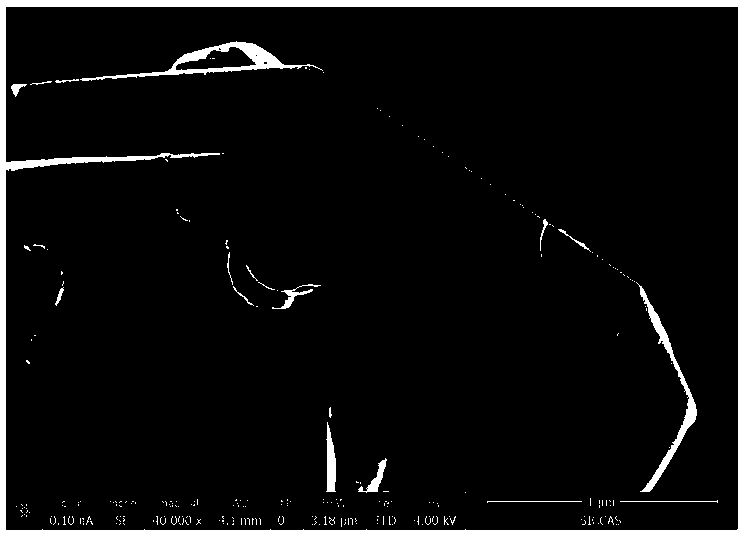
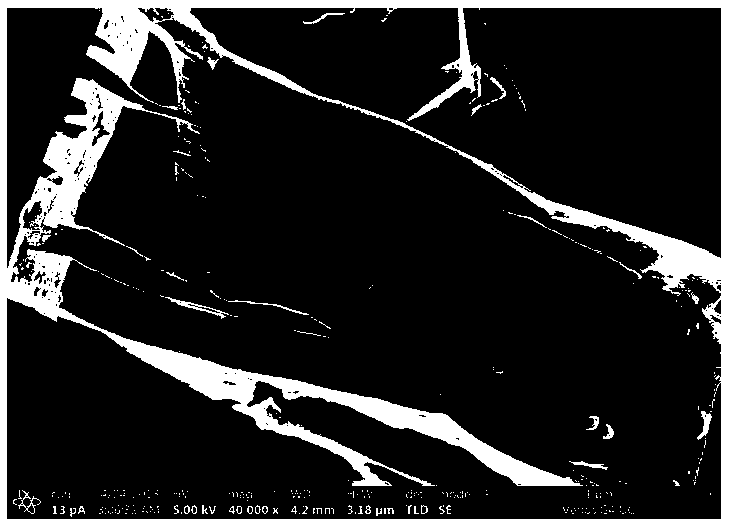
[0038] The invention relates to a degradable organic / inorganic hybrid two-dimensional molybdenum carbide nanocomposite material and its preparation method and application, more specifically to the preparation and surface modification of two-dimensional molybdenum carbide. The nanocomposite material has good The biocompatibility and high-efficiency photothermal conversion can be used for the diagnosis and efficient treatment of human or other mammalian tumors or cancers. The composite material is made of two-dimensional sheet-layer molybdenum carbide as a matrix, and a polymer with good biocompatibility is selected for surface modification to obtain a composite nano sheet with a size of 50-500 nm. The preparation method of the nanocomposite material comprises: firing molybdenum gallium carbon (molybdenum gallium carbide); removing redundant gallium and gallium intercalation to prepare multi-layer molybdenum carbide; preparing single-layer molybdenum carbide through washing and s...
Embodiment 1
[0058]First, molybdenum gallium carbon (molybdenum gallium carbide) is fired. That is, molybdenum powder, metal gallium, and carbon powder were mixed uniformly in a mass ratio of 16:40:1, placed in a quartz tube furnace, and heated at 12°C / The heating rate of min was heated to 800°C, and kept at this temperature for 380h. The mass ratio of molybdenum, gallium, and carbon in the fired molybdenum gallium carbon was measured by inductively coupled plasma atomic emission spectrometry and energy spectrometer. 16:12:1. Then, the preparation of multi-layer molybdenum carbide sheet is to immerse 1g of gallium molybdenum carbide in 25mL of hydrochloric acid aqueous solution with a concentration of 11mol / L, soak for 48h, and after removing excess gallium, add 1.2g of lithium fluoride to 20mL of After mixing in 12mol / L hydrochloric acid solution, add gallium molybdenum molybdenum carbide from which excess gallium has been removed, and keep at 45°C for 600h. Then wash with 80 mL of 1.2...
Embodiment 2
[0065] Disperse the polyvinyl alcohol-modified molybdenum carbide nanocomposite photothermal agent in deionized water, put it into a cuvette, and obtain suspensions with molybdenum concentrations of 25, 50, 100, and 200 μg / mL in the diagnostic agent, and take distilled water as comparison. Respectively with a power density of 1.0W / cm 2 The NIR I (808nm) and NIR II (1064nm) wavelengths of near-infrared lasers are irradiated, and the changes in water temperature over time are recorded by an infrared camera.
[0066] Take tumor-bearing nude mice (the tumor diameter is about 0.6-1 cm), and inject 150 μL of polyvinyl alcohol-modified molybdenum carbide nanocomposite photothermal agent physiological saline dispersion and physiological saline respectively through the tail vein. Then, at a power density of 1.0W / cm 2 Under the conditions of NIR I (808nm) and NIR II (1064nm) near-infrared lasers were used to irradiate the tumor site, and the changes of tumor temperature over time were...
PUM
| Property | Measurement | Unit |
|---|---|---|
| radius | aaaaa | aaaaa |
| size | aaaaa | aaaaa |
| thickness | aaaaa | aaaaa |
Abstract
Description
Claims
Application Information
 Login to View More