
A kind of nanocomposite marine anticorrosion coating and preparation method thereof
A marine anti-corrosion and nano-composite technology, applied in anti-corrosion coatings, anti-fouling/underwater coatings, epoxy resin coatings, etc., can solve problems such as weak interface binding force, poor compatibility, and affecting coating performance
- Summary
- Abstract
- Description
- Claims
- Application Information
AI Technical Summary
Problems solved by technology
Method used
Image

Examples
preparation example Construction
[0060] Preparation of Hydroxy Epoxy Phosphate Dispersant (HEP):
[0061] A solution of bisphenol A epoxy resin E44 (20 g in 40 mL of acetone) was added dropwise to a solution of phosphoric acid (9.22 g of phosphoric acid in 20 mL of acetone, the molar ratio of phosphoric acid to epoxy group was 1:1) in 30 minutes vigorously After stirring for 30 minutes, the mixture was vigorously stirred until the acid value remained constant (97.23 mg KOH / g), after which N,N-dimethylethanolamine (11.27 g) and water were added dropwise to the mixture. After the reaction was completed, the solvent acetone was removed using a rotary vacuum evaporator to obtain a hydroxy epoxy phosphate dispersant.
Embodiment example 1
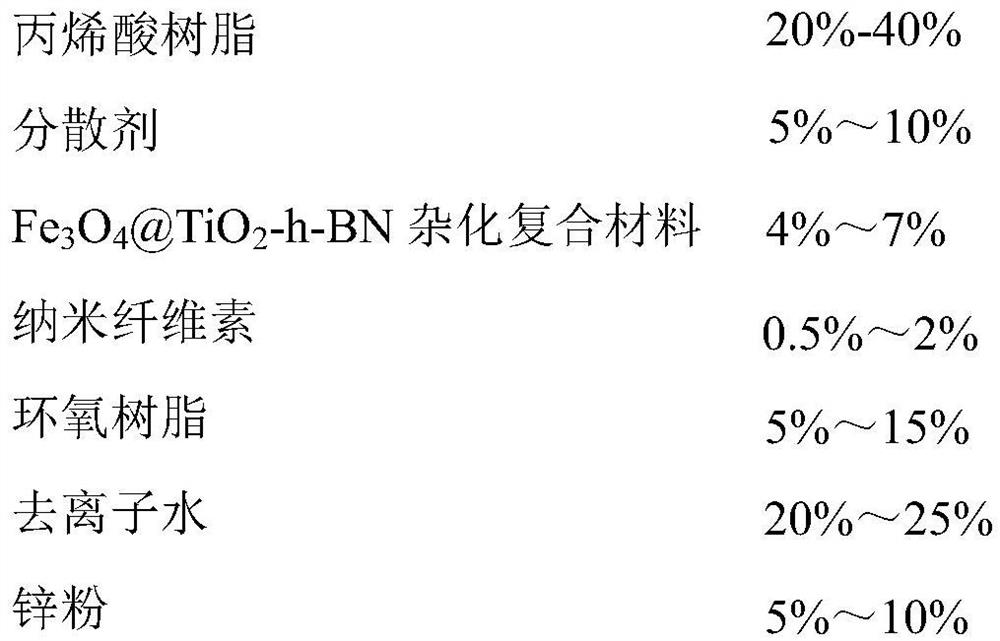
[0063] Add 32% water-based hydroxyl acrylic resin, 10% deionized water, pigments and fillers (calcium carbonate 4%, zinc powder 10%), other additives (defoamer 0.1%, adhesion promoter 0.2%, leveling 0.7% wetting and dispersing agent, 0.2% wetting and dispersing agent) high-speed stirring and mixing evenly, then add 7% water-based epoxy resin, and continue to stir for 30 minutes;
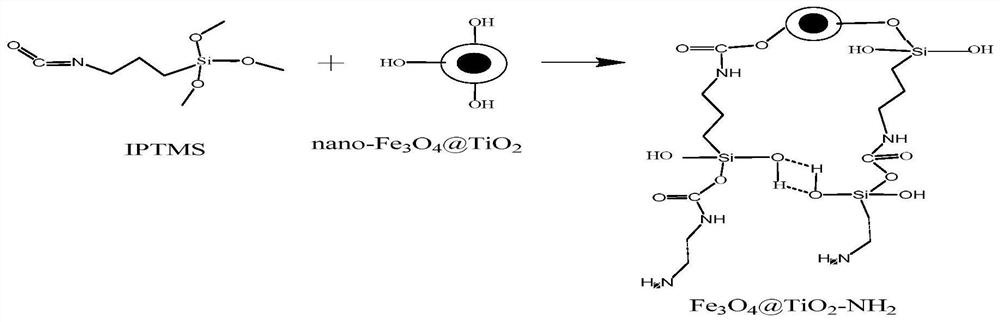
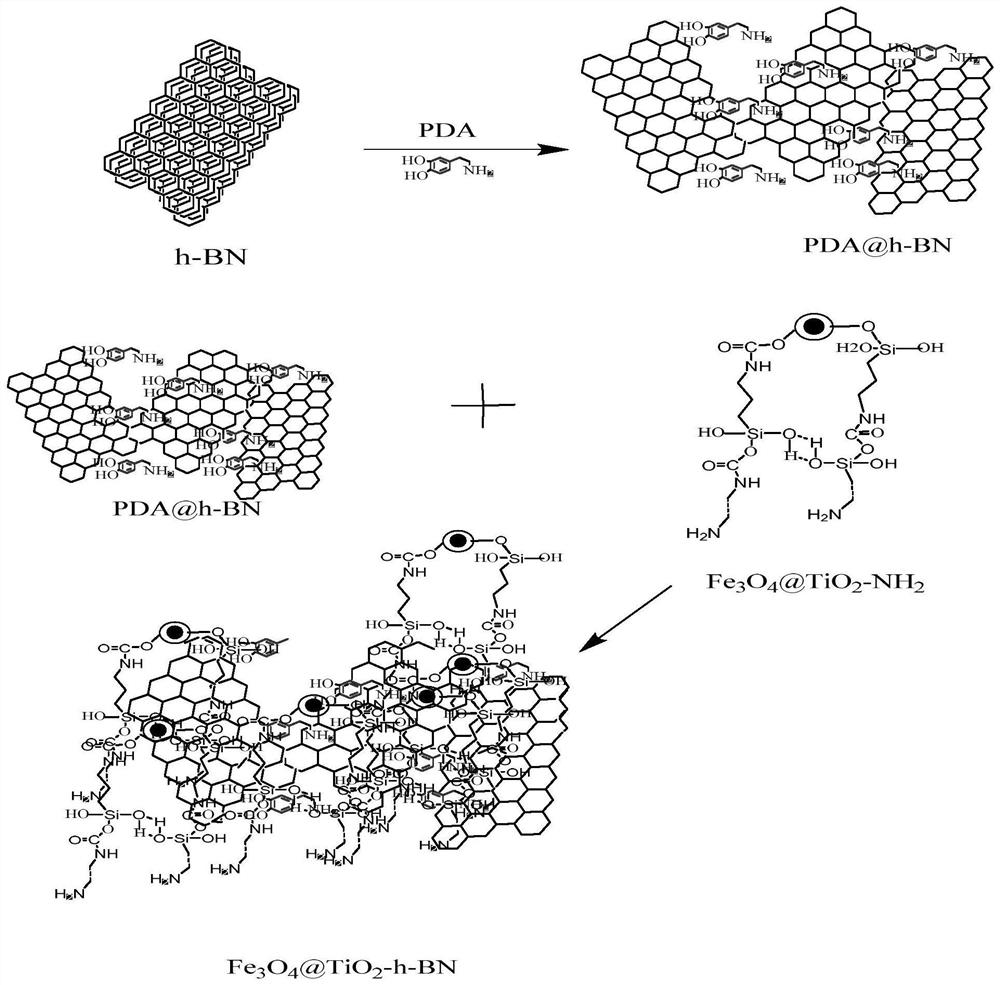
[0064] Step 2: Take 5% to implement case 1 to prepare Fe 3 o 4 @TiO 2 -h-BN hybrid composite material, 0.8% nano cellulose (NCC), 6% hydroxyl epoxy phosphate dispersant are mixed evenly, 10% deionized water is added to the mixed solution and ultrasonic dispersion is equipped with a cooling device at 500W Ultrasound in the instrument for 1h, get Fe 3 o 4 @TiO 2 -h-BN hybrid composite material mixed dispersion;
[0065] Step 3: Add the mixed dispersion obtained in Step 2 into the mixed solution obtained in Step 1 and continue ultrasonically dispersing evenly to obtain the A component of the nanoc...
Embodiment example 2
[0067] Add 25% water-based hydroxyl acrylic resin, 10% deionized water, pigments and fillers (calcium carbonate 3%, zinc powder 7%), other additives (defoamer 0.2%, adhesion promoter 0.2%, leveling 1%, wetting and dispersing agent 0.3%) high-speed stirring and mixing, then add 13% water-based epoxy resin, continue to stir for 30min;
[0068] Step 2: Take 4% Fe 3 o 4 @TiO 2 -h-BN hybrid composite material, 1.3% nano cellulose (NCC), 5% hydroxyl epoxy phosphate dispersant are mixed evenly, add 12% deionized water to the mixed solution and use a 500W ultrasonic disperser equipped with a cooling device Ultrasound for 1h, get Fe 3 o 4 @TiO 2 -h-BN hybrid composite material mixed dispersion;
[0069] Step 3: Add the mixed dispersion obtained in Step 2 into the mixed solution obtained in Step 1 and continue ultrasonically dispersing evenly to obtain Component A of the nanocomposite marine anti-corrosion coating, and finally add Component B, which is 18% water-based isocyanate c...
PUM
 Login to View More
 Abstract
Description
Claims
Application Information
 Login to View More