
Magnetic thin film, magnetoresistance effect device and magnetic device using the same
a technology of magnetoresistance effect and thin film, which is applied in the field of magnetic thin film, magnetoresistance effect device and magnetic device using the same, can solve the problems of insufficient tmr value, no reports that the so far fabricated thin film is a half metal, and inability to be practically used. to achieve the effect of high speed and large capacity
- Summary
- Abstract
- Description
- Claims
- Application Information
AI Technical Summary
Benefits of technology
Problems solved by technology
Method used
Image

Examples
example 1
[0091]Examples of the present invention are explained hereafter.
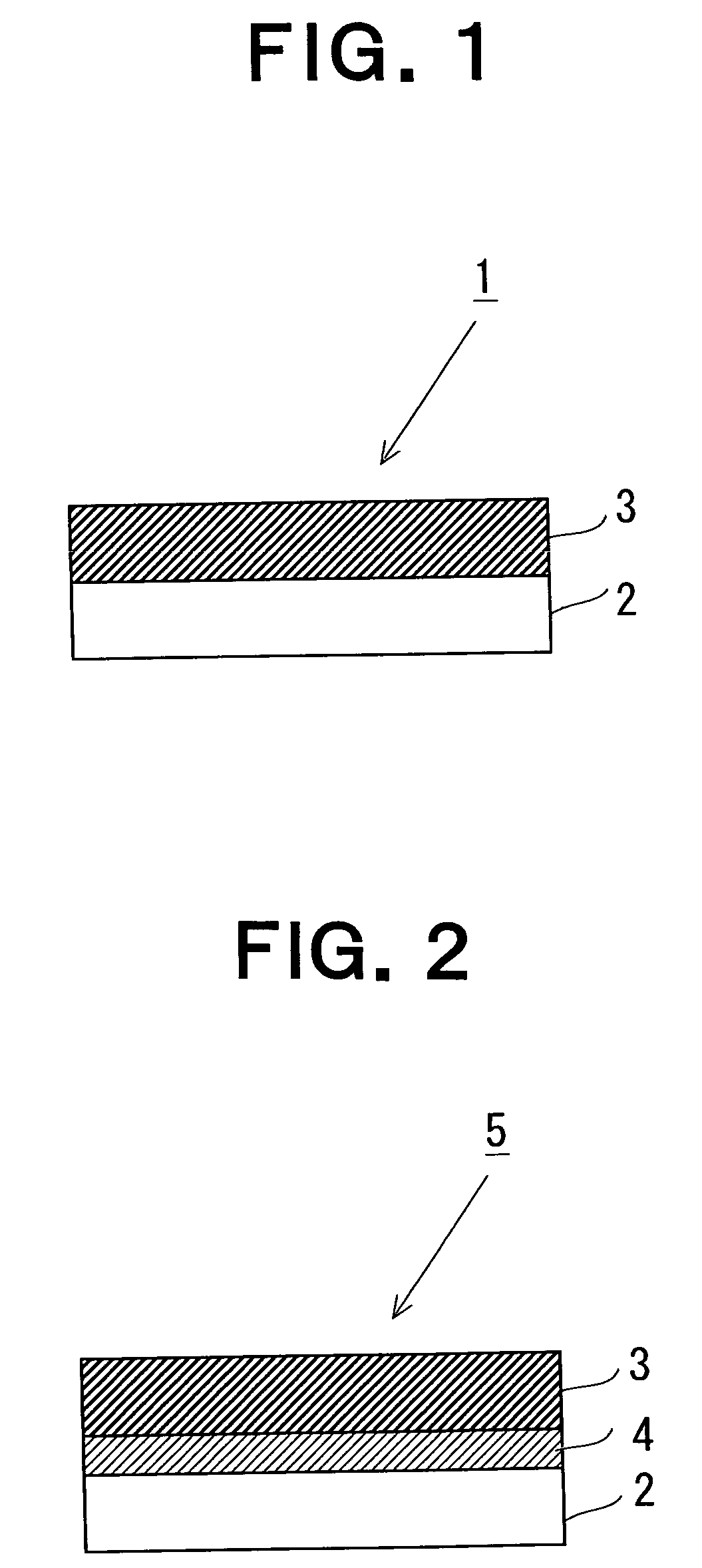
[0092]As the magnetic thin film of the present invention Co2MGa1-xAlx, Co2CrGa was fabricated with Cr as M and composition x=0. In this case, the average valence electron concentration Z in M is 6.
[0093]The fabrication of the alloy Co2CrGa as the material of the magnetic thin film of the present invention will be explained first. Co, Cr, and Ga of high purity were input into an arc melting apparatus by the composition ratio of 25%, 25%, and 50%, respectively, melted at 1100° C. for 24 hours, and hardened in ice water to fabricate Co2CrGa alloy.
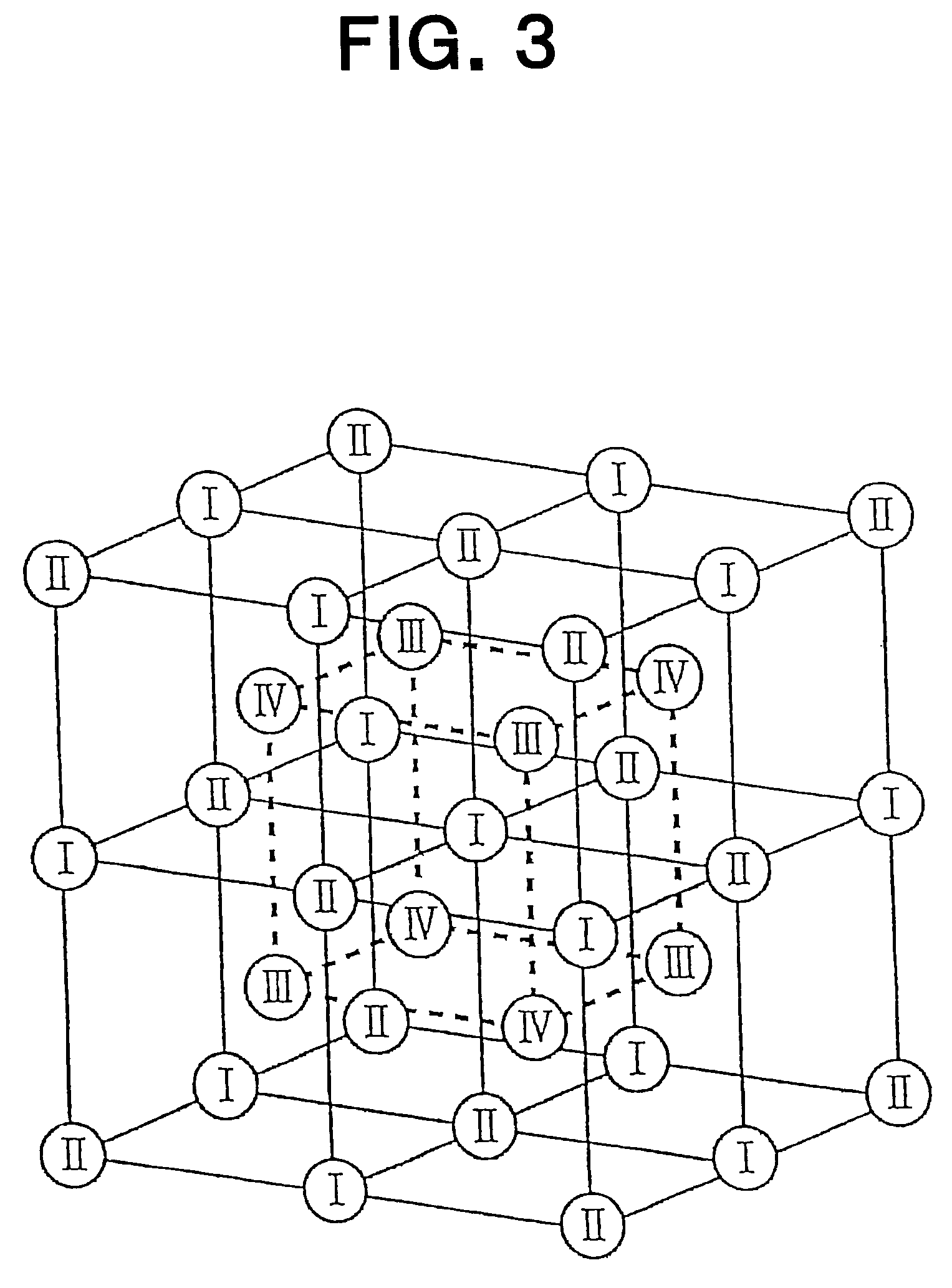
[0094]FIG. 10 is a view illustrating electron beam diffraction of [01-1] incoming radiation of Co2CrGa alloy prepared in Example 1. The acceleration voltage of electron beam was 200 kV, and the numbers in the figure show diffraction from (200), (111), and (022) planes, respectively. As is obvious from the figure, both regular reflections from (200) and (111) planes appeared, and t...
example 2
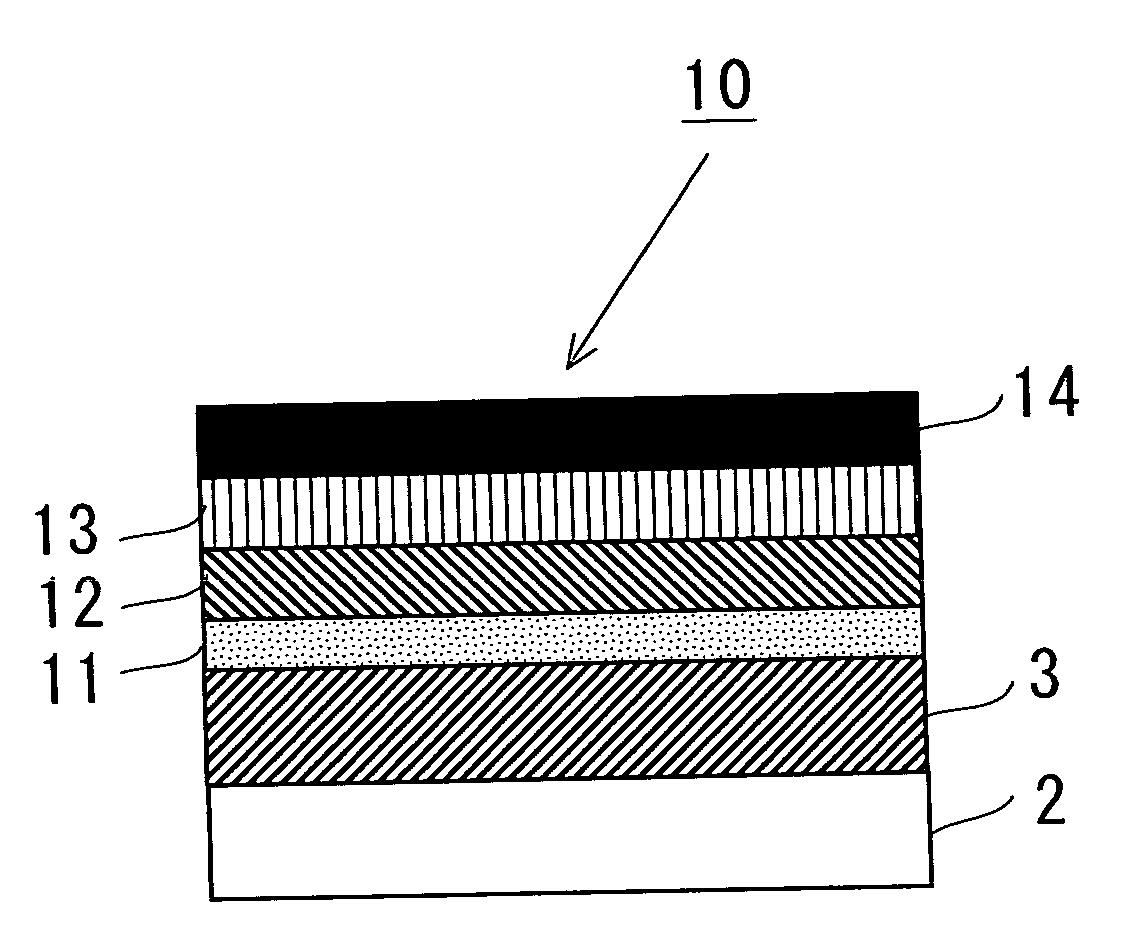
[0096]The tunnel magnetoresistance effect device 15 of the spin valve type as shown in FIG. 5 was fabricated at room temperature. The tunnel magnetoresistance effect device 15 was fabricated by using a magnetron sputtering apparatus and a metal mask, with Ta as a buffer layer 4, and sequentially depositing Ta (10 nm) / Co2CrGa (300 nm) / AlOx (1.6 nm) / Co90Fe10 (10 nm) / NiFe (2 nm) / IrMn (20 nm) / Ta (10 nm) onto the thermally oxidized Si substrate 2. The numbers in parentheses are respective film thicknesses. Ta is the buffer layer 4, Co2CrGa thin film 3 is the ferromagnetic free layer, AlOx is the tunnel insulation layer 11, Co90Fe10 and NiFe are ferromagnets comprising a complex film made of pin layers of the ferromagnetic layer 12, IrMn is the antiferromagnetic layer 13 and has a role to fix the spins of the ferromagnetic layer 12 of Co90Fe10 / NiFe. Ta on IrMn as the antiferromagnetic layer 13 is the protective layer 14.
[0097]The high frequency power of the magnetron was 100 W for respect...
example 3
[0099]The tunnel magnetoresistance effect device 15 of the same spin valve type as Example 2 was fabricated by using Co2CrGa thin film 3 except that its film thickness was 100 nm. By applying the external magnetic field to said tunnel magnetoresistance effect device 15, the magnetoresistance was measured at room temperature. FIG. 12 is a view illustrating the magnetic field dependency of the resistance of the tunnel magnetoresistance effect device 15 of Example 3. The abscissa of the figure shows the external magnetic field H (Oe), and the ordinate shows the resistance (Ω). The magnetoresistance including also its hysteresis characteristics was measured by sweeping the external magnetic field. Hereby, the TMR was determined as 3.2%.
[0100]In Examples 2 and 3, no plateau was seen in TMR curves, and the perfect antiparallel state of spins was not realized. By optimizing the fabrication conditions of the tunnel magnetoresistance effect device 15, a TMR will be made dramatically larger.
PUM
| Property | Measurement | Unit |
|---|---|---|
| thickness | aaaaa | aaaaa |
| temperature | aaaaa | aaaaa |
| electrical resistivity | aaaaa | aaaaa |
Abstract
Description
Claims
Application Information
 Login to View More