
Methods for manufacturing dielectric films
a dielectric film and film manufacturing technology, applied in the direction of vacuum evaporation coating, transistors, coatings, etc., can solve the problems of plasma damage, sputtering methods, in-plane uniformity, reproducibility, etc., and achieve the effect of reducing the thickness of equivalent oxides
- Summary
- Abstract
- Description
- Claims
- Application Information
AI Technical Summary
Benefits of technology
Problems solved by technology
Method used
Image

Examples
example 1
Co-Sputtering Example
[0117]A first example of the invention is described in detail with reference to the drawings.
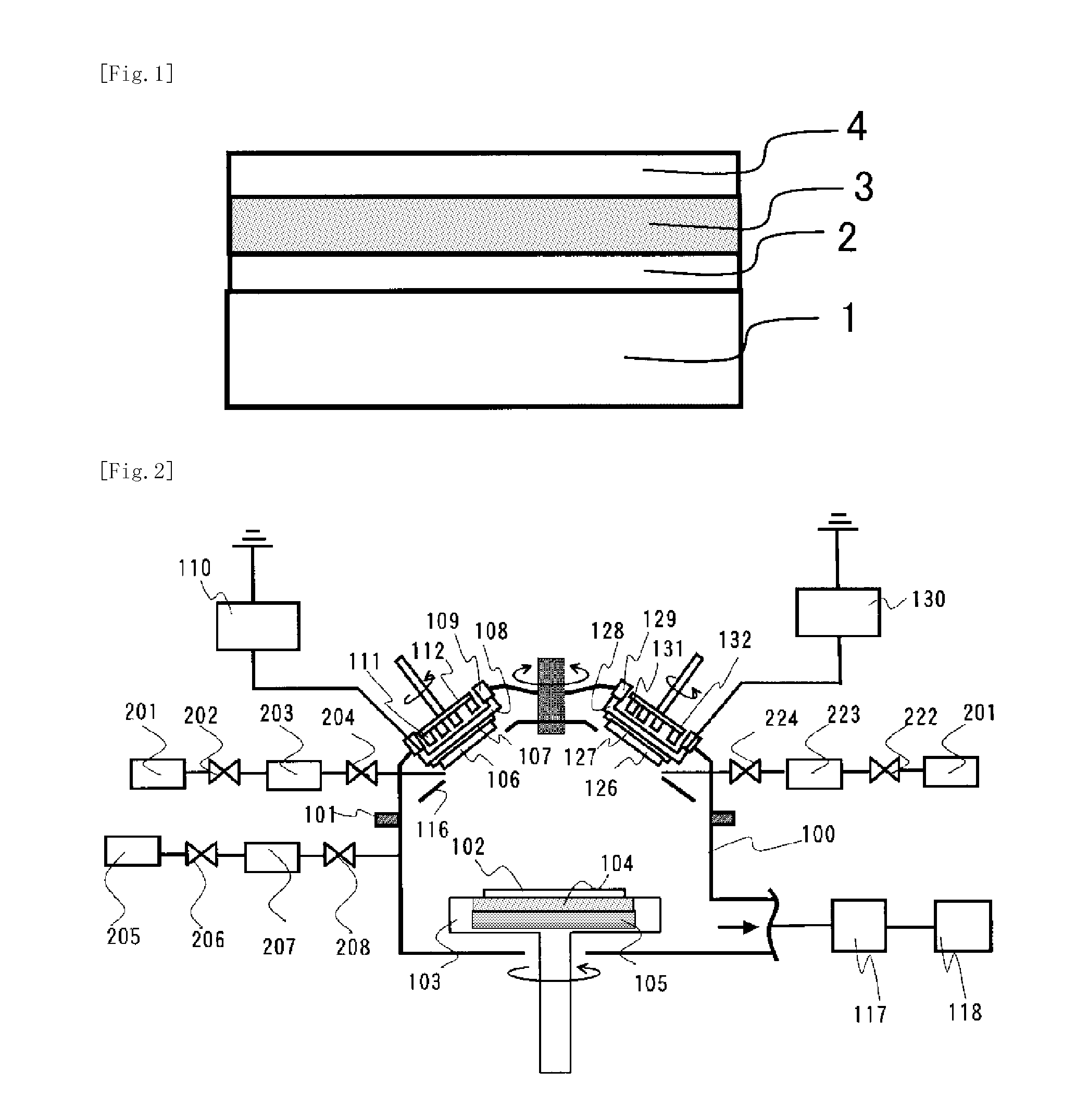
[0118]FIG. 14 is a diagram showing a MIS capacitor having a dielectric film formed by the method of the invention. An HfAlO film having an amorphous structure was deposited by sputtering method on a silicon substrate 301 having a silicon oxide film 302 with a thickness of 3 nm to 5 nm at the surface. The targets used were Hf and Al metal targets, and argon, oxygen and nitrogen were used as sputtering gas.
[0119]The substrate temperature, the target power, the sputtering gas pressure, the Ar gas flow rate, and the oxygen gas flow rate may be appropriately determined in the ranges of 27° C. to 600° C., 50 W to 1,000 W, 0.02 Pa to 0.1 Pa, 1 sccm to 200 sccm, and 1 sccm to 100 sccm, respectively.
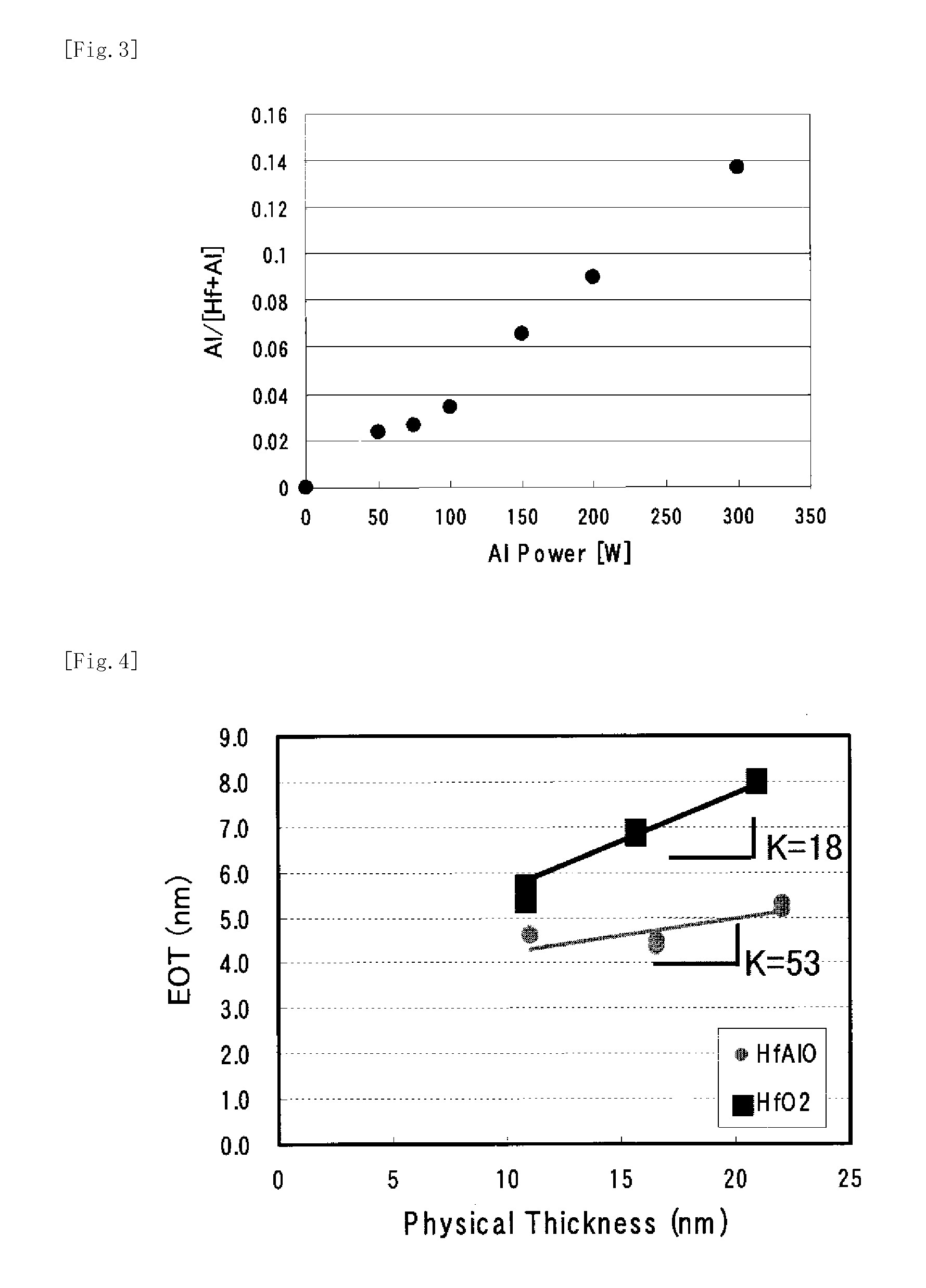
[0120]In this example, the deposition was performed at a substrate temperature of 30° C., a Hf target power of 600 W, an Al target power of 50 W to 500 W, a sputtering gas pressure of...
example 2
Example Applied to Gate Insulating Film
[0134]A second example of the invention is described in detail with reference to the drawings.
[0135]FIGS. 15(a) to 15(c) are diagrams showing the steps of the method of the second example of the invention for manufacturing a semiconductor device.
[0136]As shown in FIG. 15(a), an isolation region 402 was first formed on the surface of a silicon substrate 401 using STI (Shallow Trench Isolation) technique. Subsequently, a silicon oxide film 403 with a thickness of 1.8 nm was formed on the isolated surface of the silicon substrate 401 by thermal oxidation method. An HfAlO film with a thickness in the range of 1 nm to 10 nm was then formed by the same method as in Example 1. Subsequently, the HfAlO film was annealed at 1,000° C. for 10 seconds in a nitrogen atmosphere, so that it was crystallized to form a dielectric film 404.
[0137]A gate electrode 405 of poly-Si with a thickness of 150 nm was then formed on the dielectric film 404. Thereafter, as s...
example 3
Example Applied to Blocking Film of Nonvolatile Memory Device
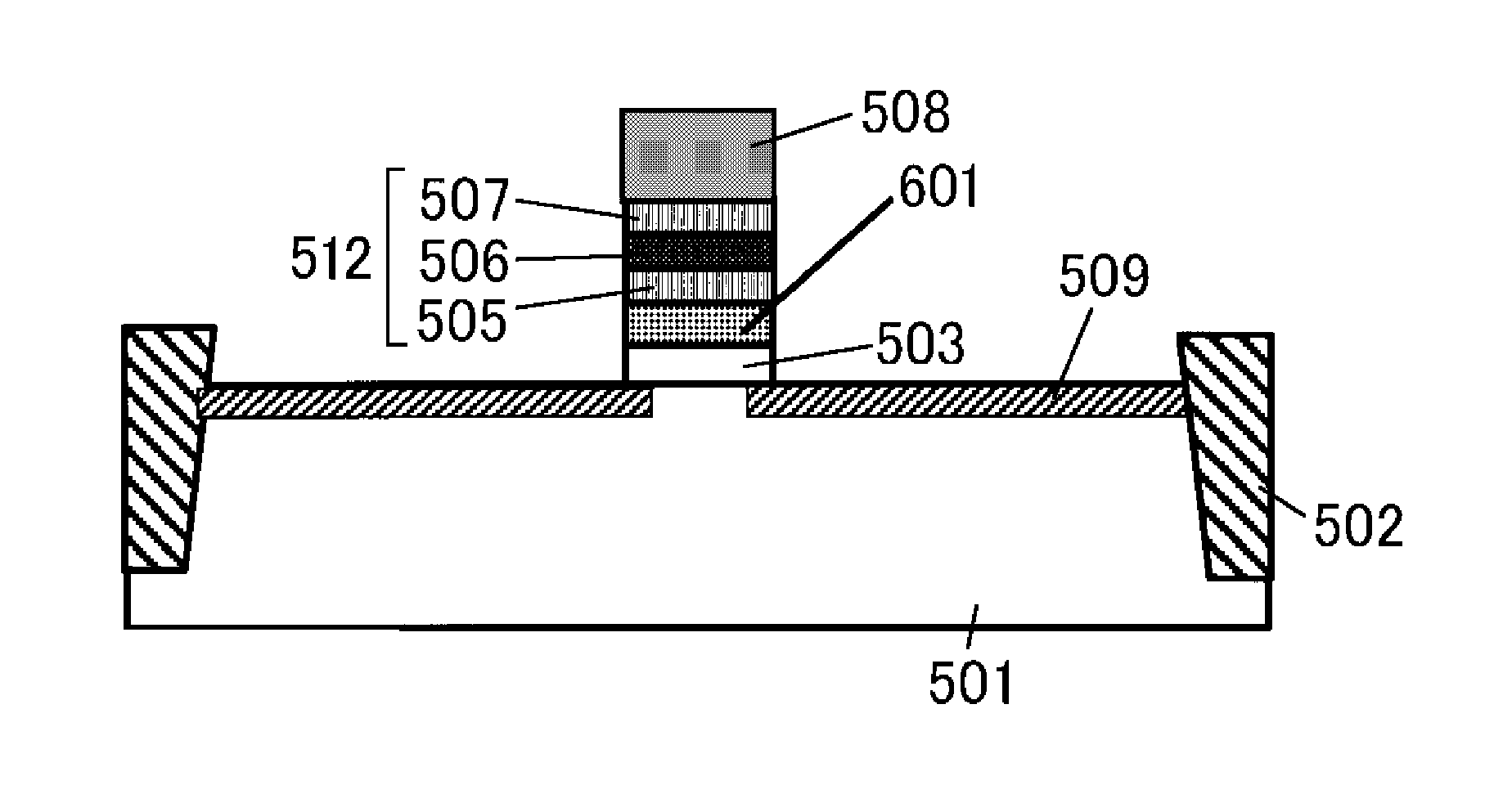
[0141]FIGS. 16(a) to 16(c) are cross-sectional views showing the process of a third example of the invention for the manufacture of a semiconductor device.
[0142]As shown in FIG. 16(a), an isolation region 502 was first formed on the surface of a silicon substrate 501 using STI (Shallow Trench Isolation) technique. Subsequently, a silicon oxide film with a thickness of 30 Å to 100 Å was formed as a first insulating film 503 by thermally-oxidized film method on the isolated surface of the silicon substrate 501. Subsequently, a silicon nitride film with a thickness of 30 Å to 100 Å was formed as a second insulating film 504 by LPCVD (Low Pressure Chemical Vapor Deposition) method. Subsequently, an aluminum oxide film with a thickness of 5 Å to 50 Å was formed as a third insulating film 505. The aluminum oxide film may be formed using MOCVD method, ALD (Atomic Layer Deposition) method, or PVD (Physical Vapor Deposition) method...
PUM
| Property | Measurement | Unit |
|---|---|---|
| pressure | aaaaa | aaaaa |
| relative dielectric constant | aaaaa | aaaaa |
| dielectric constant | aaaaa | aaaaa |
Abstract
Description
Claims
Application Information
 Login to View More