Unlock instant, AI-driven research and patent intelligence for your innovation.

Magnetic tunnel junction, spintronics device using same, and method for manufacturing magnetic tunnel junction

Active Publication Date: 2020-02-06
NAT INST FOR MATERIALS SCI
View PDF0 Cites 7 Cited by
  • Summary
  • Abstract
  • Description
  • Claims
  • Application Information

AI Technical Summary

Benefits of technology

The invention provides a method for making a magnetic tunnel junction (MTJ) element that has a large tunneling magnetoresistive ratio (TMR) ratio and a better bias voltage dependence. A barrier layer made of Mg—Al—O is used to create the MTJ element, which can be used in various spintronics devices such as hard disk magnetic heads and spin torque rewritable MRAM. The MTJ element has improved electrical output and can provide a better bias voltage dependence indication.

Problems solved by technology

On the other hand, because there is lattice mismatch of about 3 to 4% between MgO and CoFeB, there is a problem in which many misfit dislocation defects are introduced at the interface of MgO and CoFeB.
Therefore, there is a limit to improving the TMR ratio in a CoFeB / MgO / CoFeB structure.
For example, because of the large lattice mismatch of 3 to 6% for a Co-based Heusler alloy such as Co2FeAl, Co2MnSi, etc., which are high spin polarization materials and 8 to 10% for FePt, MnGa, etc., which are perpendicular magnetization materials, it is difficult to make a MTJ element having a pronounced coherent tunneling effect by using these ferromagnetic layers with MgO as the barrier layer.
Also, a problem is known in which the TMR ratio decreases due to the application of a bias voltage in a MTJ element; and this is a practical problem (bias voltage dependence).
Therefore, there were problems in applications such as the utilizable substrates and underlayer materials being extremely limited.
Especially, there was a problem in which an amorphous MgAl2O4 layer is obtained if the MgAl2O4 layer is formed on amorphous CoFeB; therefore, the crystallization of the MTJ element cannot be realized; therefore, the coherent tunneling effect is not obtained; and a high TMR ratio such as a TMR ratio exceeding 100% cannot be realized using the CoFeB layer and the MgAl2O4 barrier layer (Non-Patent Literature 2 and Non-Patent Literature 3).

Method used

the structure of the environmentally friendly knitted fabric provided by the present invention; figure 2 Flow chart of the yarn wrapping machine for environmentally friendly knitted fabrics and storage devices; image 3 Is the parameter map of the yarn covering machine
View more

Image

Smart Image Click on the blue labels to locate them in the text.
Viewing Examples
Smart Image
  • Magnetic tunnel junction, spintronics device using same, and  method for manufacturing magnetic tunnel junction
  • Magnetic tunnel junction, spintronics device using same, and  method for manufacturing magnetic tunnel junction
  • Magnetic tunnel junction, spintronics device using same, and  method for manufacturing magnetic tunnel junction

Examples

Experimental program
Comparison scheme
Effect test

first embodiment

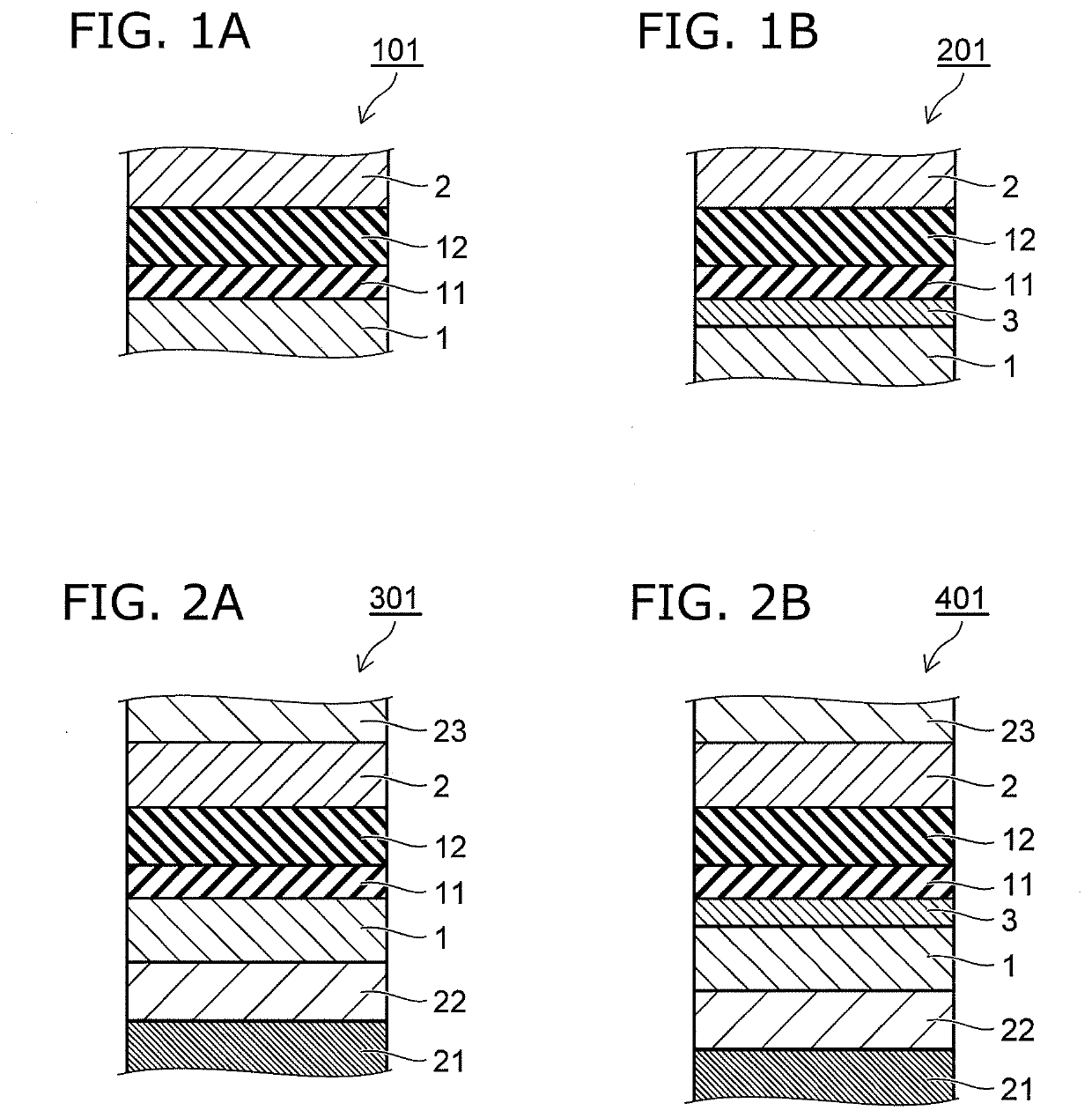
[0056]A MTJ film first embodiment 101 which is the basic structure of a first embodiment is shown in FIG. 1A. The MTJ film first embodiment 101 has a multilayer film structure; and a first magnetic layer 1, a first insulating layer 11, a second insulating layer 12, and a second magnetic layer 2 are stacked in order from the bottom. Either of the first magnetic layer 1 and the second magnetic layer 2 may be a fixed magnetic layer or a free magnetic layer. Also, the magnetization direction may be either a film in-plane direction or a film out-of-plane direction. The fabrication method and the effects of the structure of the MTJ film first embodiment 101 will now be described.

[0057]The first magnetic layer 1 is, for example, a layer made of Co—Fe—B formed by physical vapor deposition such as sputtering, vapor deposition, etc. The Co—Fe—B has an amorphous structure at this stage. It is sufficient for the composition of Co and Fe to be Co1-nFen (0≤n≤1); and the composition of Co and Fe i...

second embodiment

[0066]A second embodiment is shown as a MTJ film second embodiment 201 in FIG. 1B and will now be described. The MTJ film second embodiment 201 is the MTJ film first embodiment 101 in which a magnetic insertion layer 3 is newly provided between the first magnetic layer 1 and the first insulating layer 11. Otherwise, a structure, a composition, and a manufacturing method equivalent to those of the MTJ film first embodiment 101 can be used. The magnetic insertion layer 3 is a thin insertion layer made of Co1-mFem (03 has the effect of promoting the crystallization of both the first insulating layer 11 and the second insulating layer 12, and causes the improvement of the TMR ratio. It is favorable for the film thickness of this layer to be thinner than the first magnetic layer 1, e.g., 0.1 to 1.5 nm. The magnetic insertion layer 3 can be made using the same technique as Co—Fe—B such as sputtering, vacuum vapor deposition, etc. To improve the flatness of the magnetic insertion layer 3, ...

third embodiment

[0067]As shown typically as a MTJ film third embodiment 301 in FIG. 2A, a third embodiment is the MTJ film first embodiment 101 in which a lower structure of the first magnetic layer 1 and an upper structure of the second magnetic layer 2 are newly provided. First, a substrate 21 is provided; and an underlayer structure layer 22 is provided on the substrate 21. The MTJ film first embodiment 101 is provided on the underlayer structure layer 22. Also, an upper structure layer 23 is provided on the MTJ film first embodiment 101.

[0068]It is desirable for the substrate 21 to be flat and homogeneous. As the material, for example, a Si-based material such as Si, Si having a thermal oxide film (Si / SiO2), SiN, SiC, etc., a compound semiconductor such as GaAs, etc., or an oxide crystal such as MgO, MgAl2O4, sapphire, etc., can be used.

[0069]The underlayer structure layer 22 is provided between the substrate 21 and the first magnetic layer 1, is used as an electrode layer on the lower side, an...

the structure of the environmentally friendly knitted fabric provided by the present invention; figure 2 Flow chart of the yarn wrapping machine for environmentally friendly knitted fabrics and storage devices; image 3 Is the parameter map of the yarn covering machine
Login to View More

PUM

No PUM Login to View More

Abstract

According to an embodiment, a magnetic tunnel junction includes a tunnel barrier layer provided between a first magnetic layer and a second magnetic layer. The tunnel barrier layer is a crystal body made of a stacked structure of a first insulating layer and a second insulating layer. The crystal body is oriented. The first insulating layer is made of an oxide of Mg1-xXx (0≤x≤0.15). X includes at least one element selected from the group consisting of Al and Ti. The second insulating layer is made of an oxide of an alloy including at least two elements selected from the group consisting of Mg, Al, Zn, and Li. Both the first magnetic layer and the second magnetic layer are made of an alloy including B and at least one element selected from the group consisting of Co and Fe.

Description

TECHNICAL FIELD[0001]An embodiment of the invention relates to a magnetic tunnel junction, a spintronics device (a magneto-resistance effect element and a magnetic memory device) using the magnetic tunnel junction, and a method for manufacturing a magnetic tunnel junction.BACKGROUND ART[0002]A magnetic tunnel junction (MTJ) that is made of a three-layer structure of a ferromagnetic layer / insulator layer (barrier layer) / ferromagnetic layer is used as, for example, the magnetic head of a hard disk device or the information recording cell of nonvolatile random access memory (MRAM: Magneto-resistive random access memory). Also, utilization is possible as a compact highly-sensitive magnetic sensor. A MTJ element has a tunnel magneto-resistance effect (TMR: Tunnel magneto-resistance) in which the tunnel resistance value changes via a barrier layer according to the relative magnetization angles of two ferromagnetic layers. In such a field of application, it is desirable to have a high magn...

Claims

the structure of the environmentally friendly knitted fabric provided by the present invention; figure 2 Flow chart of the yarn wrapping machine for environmentally friendly knitted fabrics and storage devices; image 3 Is the parameter map of the yarn covering machine
Login to View More

Application Information

Patent Timeline
no application Login to View More
IPC IPC(8): H01L43/02H01L43/10H01L27/22H01L43/12
CPCH01L43/12H01L43/02H01L27/226H01L43/10G11B5/3909G11C11/161G01R33/098H10N50/85H10N50/10H10N50/01H01L27/105H10B99/00H10B61/20H10N50/80
Inventor SUKEGAWA, HIROAKIIKHTIARKASAI, SHINYAHONO, KAZUHIROXU, XIANDONG
Owner NAT INST FOR MATERIALS SCI
Features
  • R&D
  • Intellectual Property
  • Life Sciences
  • Materials
  • Tech Scout
Why Patsnap Eureka
  • Unparalleled Data Quality
  • Higher Quality Content
  • 60% Fewer Hallucinations
Social media
Patsnap Eureka Blog
Learn More