
Preparation method and product of red blood cell-shaped hollow carbon
A technology of red blood cells and hollow carbon, which is applied in the preparation/purification of carbon, structural parts, electrical components, etc., can solve the problems of high cost, poor cycle stability, low specific capacity of secondary batteries, etc., and achieve the effect of high yield
- Summary
- Abstract
- Description
- Claims
- Application Information
AI Technical Summary
Problems solved by technology
Method used
Image

Examples
preparation example Construction
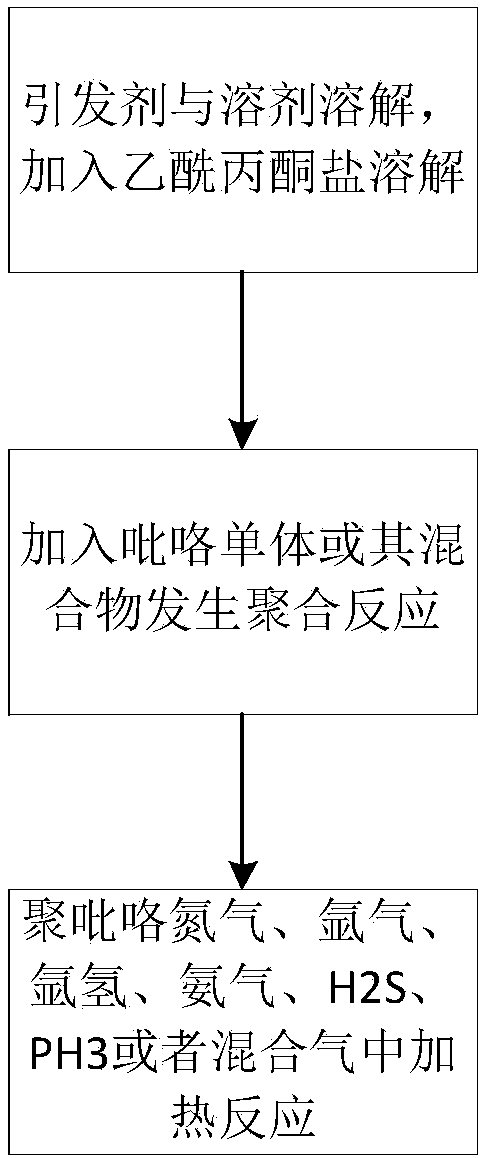
[0032] figure 1 It is a flow chart of the preparation method of the red blood cell-shaped hollow carbon constructed according to the preferred embodiment of the present invention, such as figure 1 Shown, a kind of preparation method of red blood cell shape hollow carbon comprises the steps:
[0033] Step 1: disperse the initiator in a solvent, the solvent is deionized water or a mixture of ethanol and deionized water, and stir evenly to obtain the first mixture A;
[0034] Wherein, the molar ratio of initiator to solvent is 0.001~20:1, and when the molar ratio is 0.1~5:1, the effect is better; the initiator can be an azo initiator (such as azobisisobutyronitrile), h 2 o 2 , benzoyl, nitric acid, persulfate (such as ammonium persulfate), FeCl 3 one or more of these;
[0035] Step 2: adding a certain amount of acetylacetonate into the first mixture A and stirring evenly to obtain the second mixture B;
[0036] Among them, the concentration of acetylacetonate relative to the ...
preparation Embodiment 1
[0049] In the first step, disperse 15ml of concentrated nitric acid in 30ml of deionized water, and stir evenly to obtain solution A; in the second step, add 0.3g of molybdenum acetylacetonate to solution A, stir in a magnetic stirrer until dissolved, and obtain solution B; in the third step, add 100ul pyrrole monomer to the solution B, let it stand at 20°C for 24h, centrifuge the obtained solid product, and dry it to obtain solid C; in the fourth step, put the product C in the tube Carry out carbonization treatment in the furnace, raise the temperature to 800°C at a rate of 1.5°C / min in an argon atmosphere, keep it warm for 2 hours, and then naturally cool to room temperature, and finally obtain a nitrogen-doped red blood cell-shaped hollow carbon material.
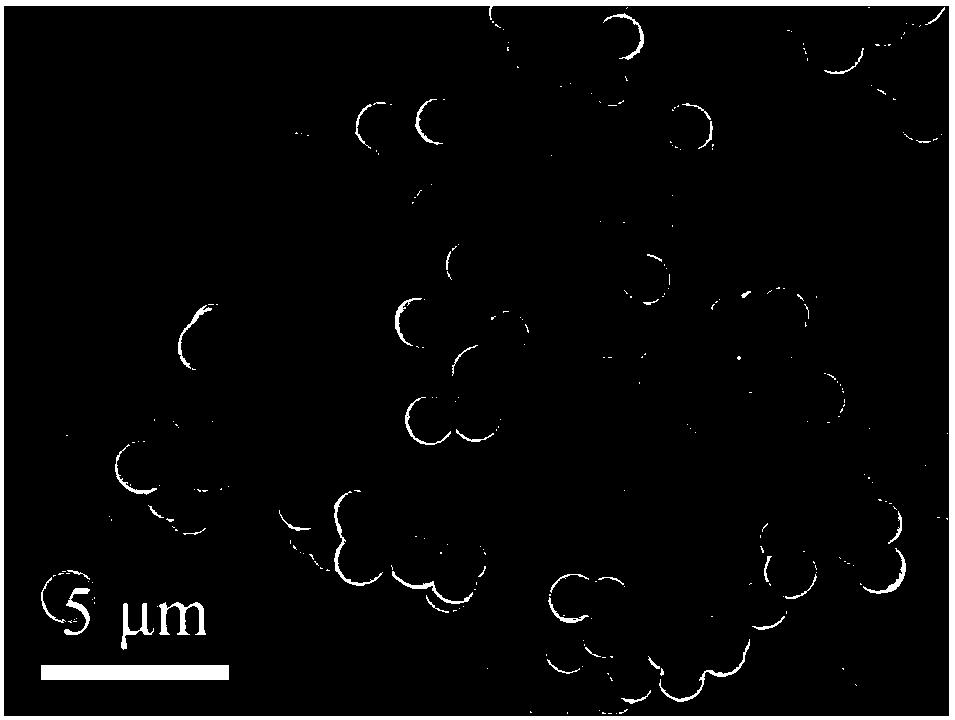
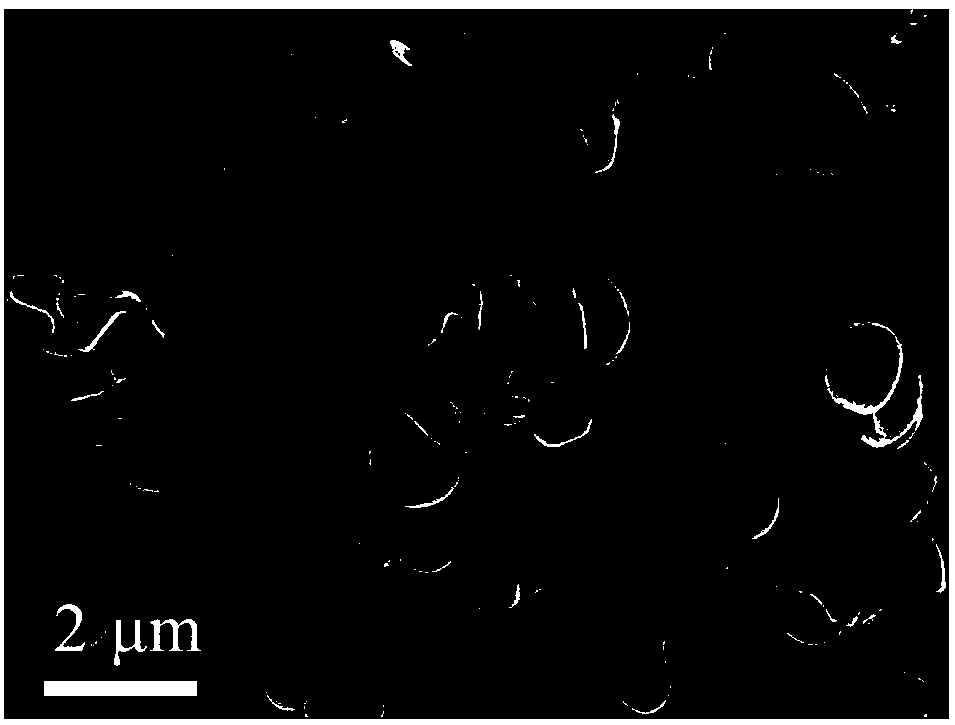
[0050] figure 2 It is a scanning electron microscope (SEM) figure of the polypyrrole ball precursor prepared in the preferred embodiment 1 constructed according to the present invention, as figure 2 Shown is the scann...
preparation Embodiment 2
[0052] In the first step, 10ml of H 2 o 2 Disperse in 200ml of deionized water, stir evenly to obtain solution A; in the second step, add 0.3g iron acetylacetonate and 0.3g molybdenum acetylacetonate to solution A, stir in a magnetic stirrer until dissolved, and obtain solution B; Step 3: Add 200uL of pyrrole monomer to solution B, let it stand at 30°C for 0.5h, centrifuge the obtained solid product, and dry it to obtain solid C; step 4, put product C in a tube furnace Carry out carbonization treatment, raise the temperature to 1400°C at a rate of 1°C / min in a nitrogen atmosphere, keep it warm for 1min, and then naturally cool to room temperature, and finally obtain a red blood cell-shaped hollow carbon material.
PUM
| Property | Measurement | Unit |
|---|---|---|
| thickness | aaaaa | aaaaa |
| diameter | aaaaa | aaaaa |
| size | aaaaa | aaaaa |
Abstract
Description
Claims
Application Information
 Login to View More