Recombinant saccharomyces cerevisiae strain for producing vitamin C, construction method and fermentation method
A technology of Saccharomyces cerevisiae and recombinant engineering strains, which is applied in the field of fermentation and production of vitamin C by Saccharomyces cerevisiae strains, and can solve the problem that the maturity and application breadth of genetic manipulation is not as good as that of Saccharomyces cerevisiae
- Summary
- Abstract
- Description
- Claims
- Application Information
AI Technical Summary
Problems solved by technology
Method used
Image



Examples
Embodiment 1
[0037] Example 1 Construction of VC production strains
[0038] 1. Construction of coding exogenous gene elements
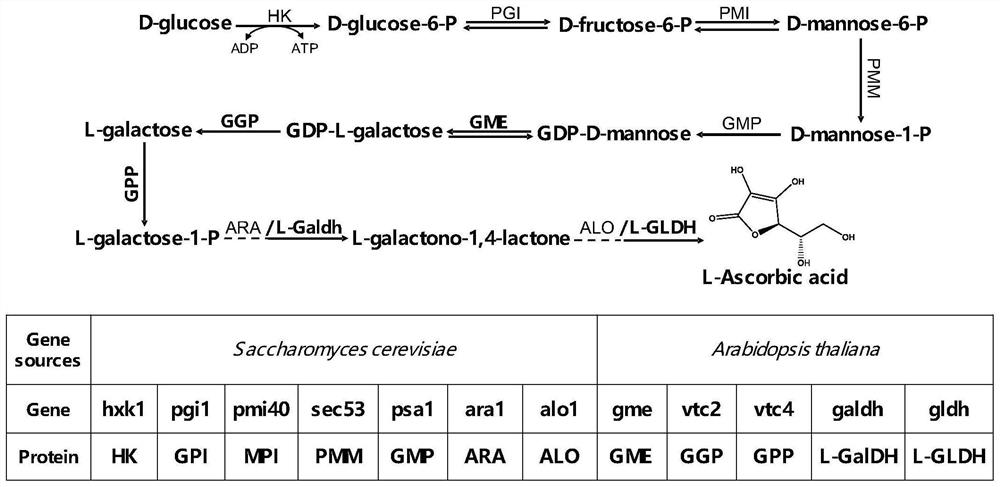
[0039]The present invention provides 5 genes encoding VC synthesis pathway-related enzymes derived from Arabidopsis thaliana, which are respectively the gene encoding GDP-mannose 3,5-phosphatase (GME) and the encoding GDP-L-galactose phosphorylase (GGP ), the gene encoding L-galactose 1-phosphate phosphatase (GPP), the gene encoding L-galactose dehydrogenase (L-GalDH), the gene encoding L-galactose-1,4-lactone dehydrogenase The gene of the enzyme (L-GLDH) is abbreviated as gme, vtc2, vtc4, galdh and gldh in turn. After codon optimization, each gene was paired with yeast endogenous constitutive promoter and terminator, and five exogenous gene elements were obtained by overlap extension PCR.
[0040] 2. Construction of VC production strains
[0041] The plant's VC synthesis pathway starts with glucose and includes ten reaction processes ( figure 1 ), Saccharomy...
Embodiment 2
[0056] Example 2 Optimizing Metabolic Pathways Improves VC Production
[0057] 1. Construction of galdh and gldh fusion overexpression strains
[0058] The fusion protein has the complete coding sequence of each enzyme molecule, so it has the respective catalytic functions of the enzyme molecules that make up the enzyme, using (GGGGS) 3 Flexible linker, L-GLDH and its adjacent step protein L-GalDH are fused and overexpressed to construct a recombinant strain. The fragment TDH3p-galdh-linker-gldh-ENO2t was obtained by overlap extension PCR, cloned into the PRS425 plasmid linearized with XhoI and HindIII by Gibson assembly, transformed into Escherichia coli, and positive clones were screened, and the plasmid was extracted and transformed into Saccharomyces cerevisiae Strain YLAA', the galdh and gldh fusion overexpression strain YLAAMF-1 was obtained. The whole build process is as follows Figure 4 shown.
[0059] 2. Construction of potential rate-limiting step-related gene o...
Embodiment 3
[0065]Example 3 Effect of exogenous addition of intermediate metabolites and GSH on VC production
[0066] Comparing the effects of different intermediate metabolites and GSH on VC production
[0067] In order to study which intermediate metabolites are still missing during VC synthesis, 250 mg / L L-galactose or L-galactose-1,4-lactone was added exogenously to the shake flask. In addition, glutathione (GSH) can promote thiamine / thiamine pyrophosphate (TPP) and GSH transport, increase the metabolism of the tricarboxylic acid cycle and pentose phosphate pathway, and up-regulate reactive oxygen species (ROS) detoxification proteins , at the same time, it is also an antioxidant, so this instruction also adds 200mg / L GSH to the shake flask exogenously, hoping that it can reduce the loss of VC.
[0068] Experimental material: VTC2-M
[0069] Experimental method: except that no leucine was added to the seed medium, other conditions were the same as in Example 1.
[0070] Experiment...
PUM
 Login to View More
 Abstract
Description
Claims
Application Information
 Login to View More
 - R&D
- Intellectual Property
- Life Sciences
- Materials
- Tech Scout
- Unparalleled Data Quality
- Higher Quality Content
- 60% Fewer Hallucinations
Browse by: Latest US Patents, China's latest patents, Technical Efficacy Thesaurus, Application Domain, Technology Topic, Popular Technical Reports.
© 2025 PatSnap. All rights reserved.Legal|Privacy policy|Modern Slavery Act Transparency Statement|Sitemap|About US| Contact US: help@patsnap.com