
Formula and technique for extracting potassium carbonate and aluminum hydroxide and preparing siliceous fertilizer using slate with rich kalium
A technology of potassium-rich slate and aluminum hydroxide, applied in the field of fertilizer manufacturing, can solve the problems of poor economic benefits, low potassium and aluminum extraction rates, and inability to produce silicon fertilizer at the same time, achieving high economic added value and good The effect of economic and social benefits
- Summary
- Abstract
- Description
- Claims
- Application Information
AI Technical Summary
Problems solved by technology
Method used
Image

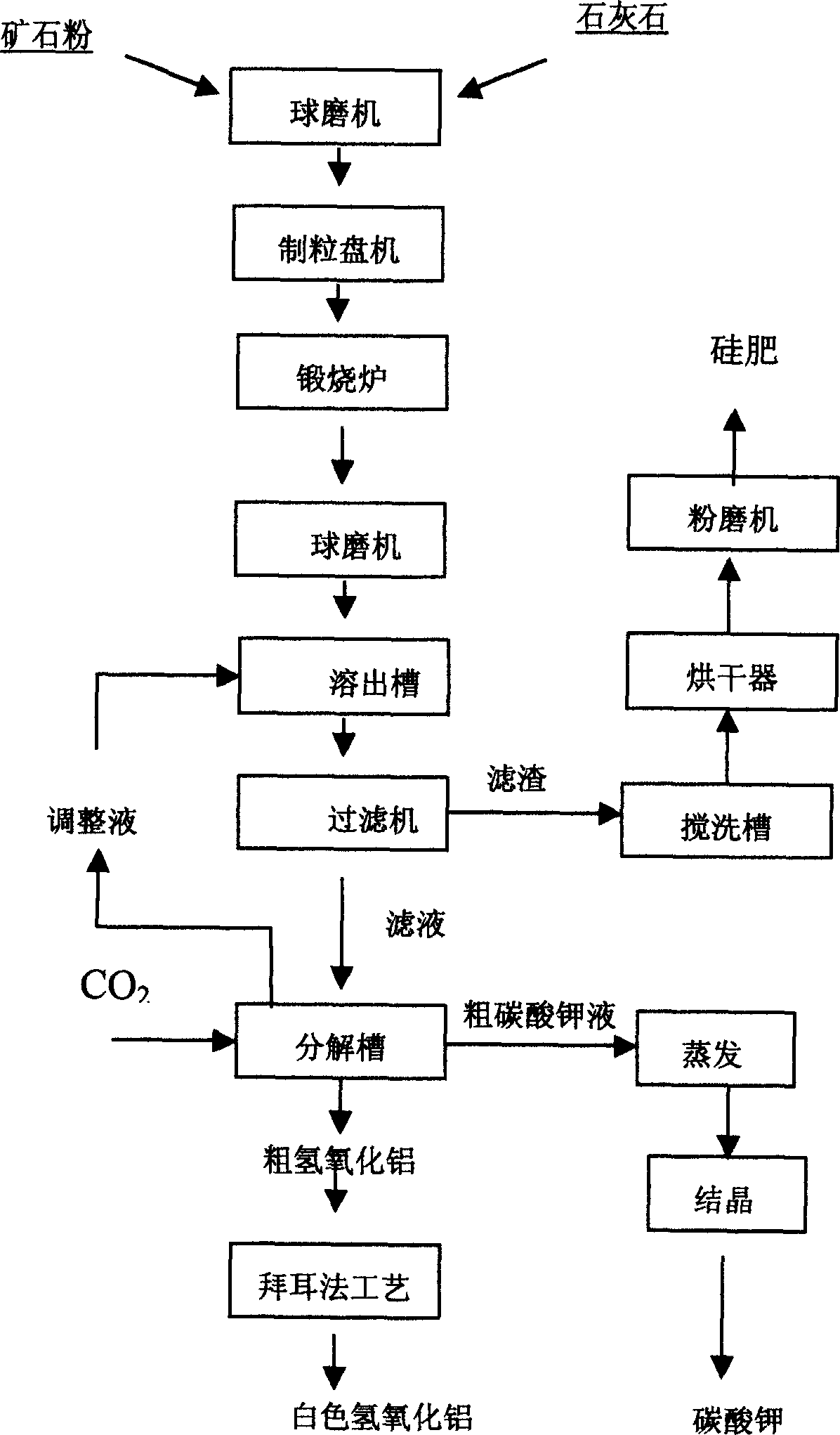
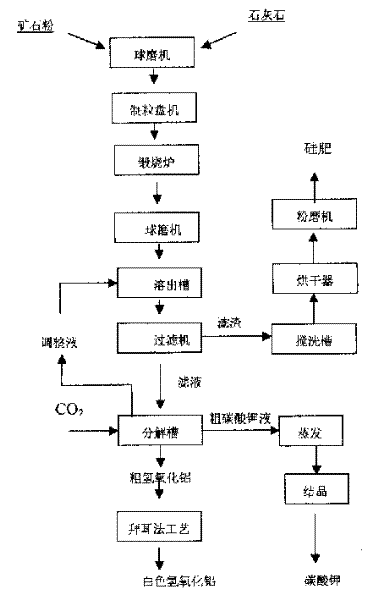
Examples
Embodiment 1
[0023] (1) Take potassium-rich slate ore (SiO 2 Content: 55%): 33 tons; Limestone (CaO content: 54%): 67 tons. The potassium-rich slate powder and limestone are mixed in a ball mill.
[0024] (2) Feed it into the granulating pan machine through the conveying device, make pellets with a diameter of 10-12mm in the granulating pan machine, and then feed them into the rotary kiln calciner from the kiln tail through the belt and screw feeder, and the raw meal Raise the temperature in the rotary kiln calciner, and after calcination at a high temperature of 1260-1300°C for 30 minutes, it is transported to the ball mill by the conveying device, and is pulverized by the ball mill to a particle size of 100-120 mesh for later use.
[0025] (3) prepare the adjusting solution with the thick potassium carbonate solution in the back stage process, adjust the K in the liquid composition 2 O is 29-31g / l, add the prepared clinker powder and adjustment solution into the dissolution tank, the ra...
Embodiment 2
[0029] (1) Take potassium-rich slate ore (SiO 2 content: 45%): 34.1 tons; limestone (CaO content: 50%): 65.9 tons, the potassium-rich slate powder and limestone are mixed in a ball mill.
[0030] (2) Feed it into the granulating tray machine through the conveying device, make pellets with a diameter of 8-10mm in the granulating tray machine, and then feed them into the rotary kiln calciner from the kiln tail through the belt and screw feeder, and the raw meal Raise the temperature in the rotary kiln calciner, and after calcination at a high temperature of 1260-1300 ° C for 40 minutes, it is transported to the ball mill by the conveying device, and is pulverized by the ball mill to a particle size of 100-120 mesh for later use.
[0031] (3) K in the composition of the adjustment solution 2 O is 25-28g / l, add the prepared clinker powder and adjustment solution into the dissolution tank, the ratio of adjustment solution to clinker powder is 2.3, dissolution temperature: 80°C, di...
Embodiment 3
[0035] (1) Take potassium-rich slate ore (SiO 2 content: 36%): 42.2 tons; limestone (CaO content: 54%): 57.8 tons, the potassium-rich slate powder and limestone are mixed in a ball mill.
[0036] (2) Feed it into the granulating tray machine through the conveying device, and make material balls with a diameter of 12-16mm in the granulating tray machine, and then enter the rotary kiln calciner from the kiln tail through the belt and screw feeder, and the raw meal Raise the temperature in the rotary kiln calciner, and after calcination at a high temperature of 1230-1280°C for 20 minutes, it will be transported to the ball mill by the conveying device, and crushed by the ball mill to a particle size of 100-120 mesh for later use.
[0037] (3) K in the composition of the adjustment solution 2 O is 34-36g / l, add the prepared clinker powder and adjustment solution into the dissolution tank, the ratio of adjustment solution to clinker powder is 2, dissolution temperature: 88°C, diss...
PUM
| Property | Measurement | Unit |
|---|---|---|
| particle size | aaaaa | aaaaa |
Abstract
Description
Claims
Application Information
 Login to View More