
Multi-channel, self-calibrating fiber-coupled raman spectrometers including diagnostic and safety features
a fiber-coupled, raman spectrometer technology, applied in the field oframan spectroscopy, can solve the problems of less stable emission wavelengths of solid-state lasers more common in process raman, insufficient wavelength calibration of the spectrograph alone, and insufficient laser coupling efficiency to analyze raman shifts with the greatest possible accuracy, etc., to achieve quasi-simultaneous or sequential calibration/data acquisition, optimize laser coupling efficiency, and high density multi-channel channel operation
- Summary
- Abstract
- Description
- Claims
- Application Information
AI Technical Summary
Benefits of technology
Problems solved by technology
Method used
Image

Examples
Embodiment Construction
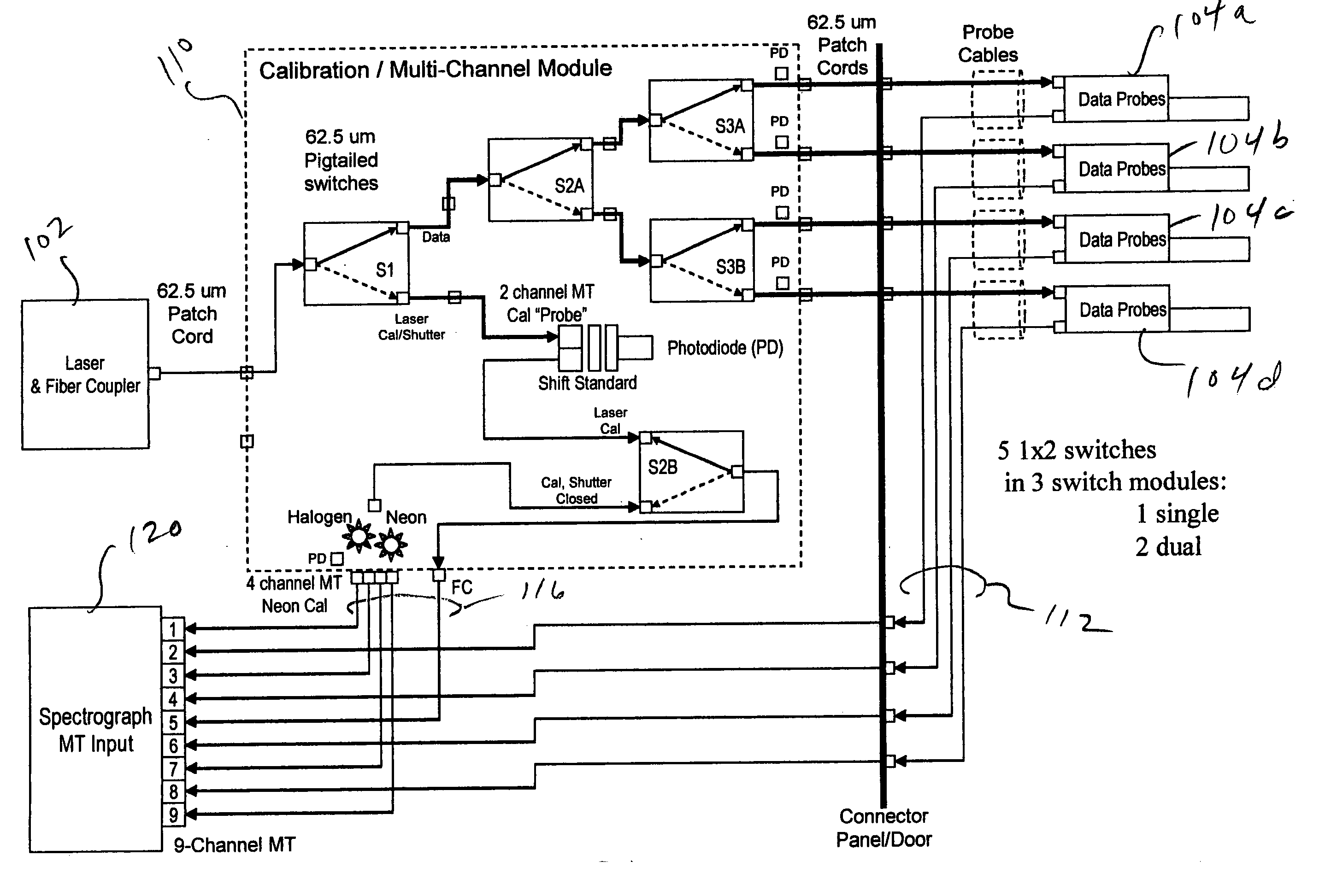
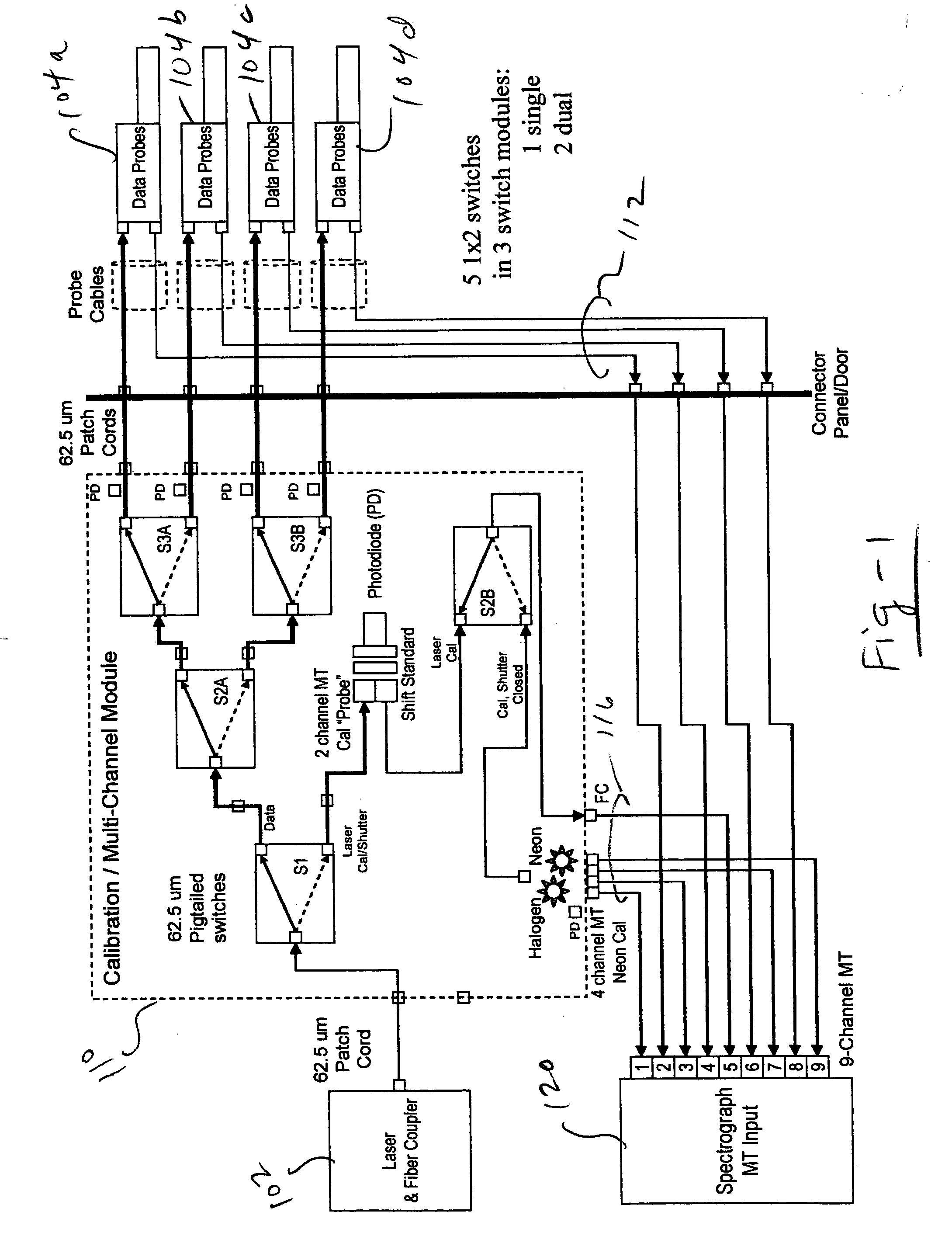
[0038]FIG. 1 is a system block diagram of a 1 laser, 4 probe configuration according to the invention. The laser and fiber coupler is shown at 102, and the probes are shown at 104A through 104D. The probes may use any fiber-coupled type of configuration, including those depicted in U.S. Pat. Nos. 5,377,004; 5,862,273; 5,943,128; 5,974,211; 6,038,363; 6,351,306; and 6,603,545, the entire of content of each being incorporated herein by reference. More particularly, the various filters contained in the probes 104A, 104B, 104C, and 104D may utilize holographic, dielectric, fiber-integrated, and so forth.
[0039] The laser 102 and probes 104 are interfaced to a calibration / multi-channel module 110 through optical cables and patch cords. The module 110 in this case includes five low-loss 1×2 optical switches which may be procured from Luminos Industries. The switches, S-1, S-2A, S-3A, S-3B and S-2B route the laser to the data probes and calibration sources, as explained in further detail b...
PUM
 Login to View More
 Abstract
Description
Claims
Application Information
 Login to View More