
Transgenic animals and uses thereof
a technology of transgenic animals and transgenic cells, applied in the field of transgenic animals, can solve the problems of short lifespan of primary cells, limited methods for selecting properly targeted cells, and difficulty in generating viable offspring, so as to reduce the amount of endogenous, functional antibodies produced, and increase the chance of generating viable offspring.
- Summary
- Abstract
- Description
- Claims
- Application Information
AI Technical Summary
Benefits of technology
Problems solved by technology
Method used
Image

Examples
example 1
Targeting of the IgμU Gene
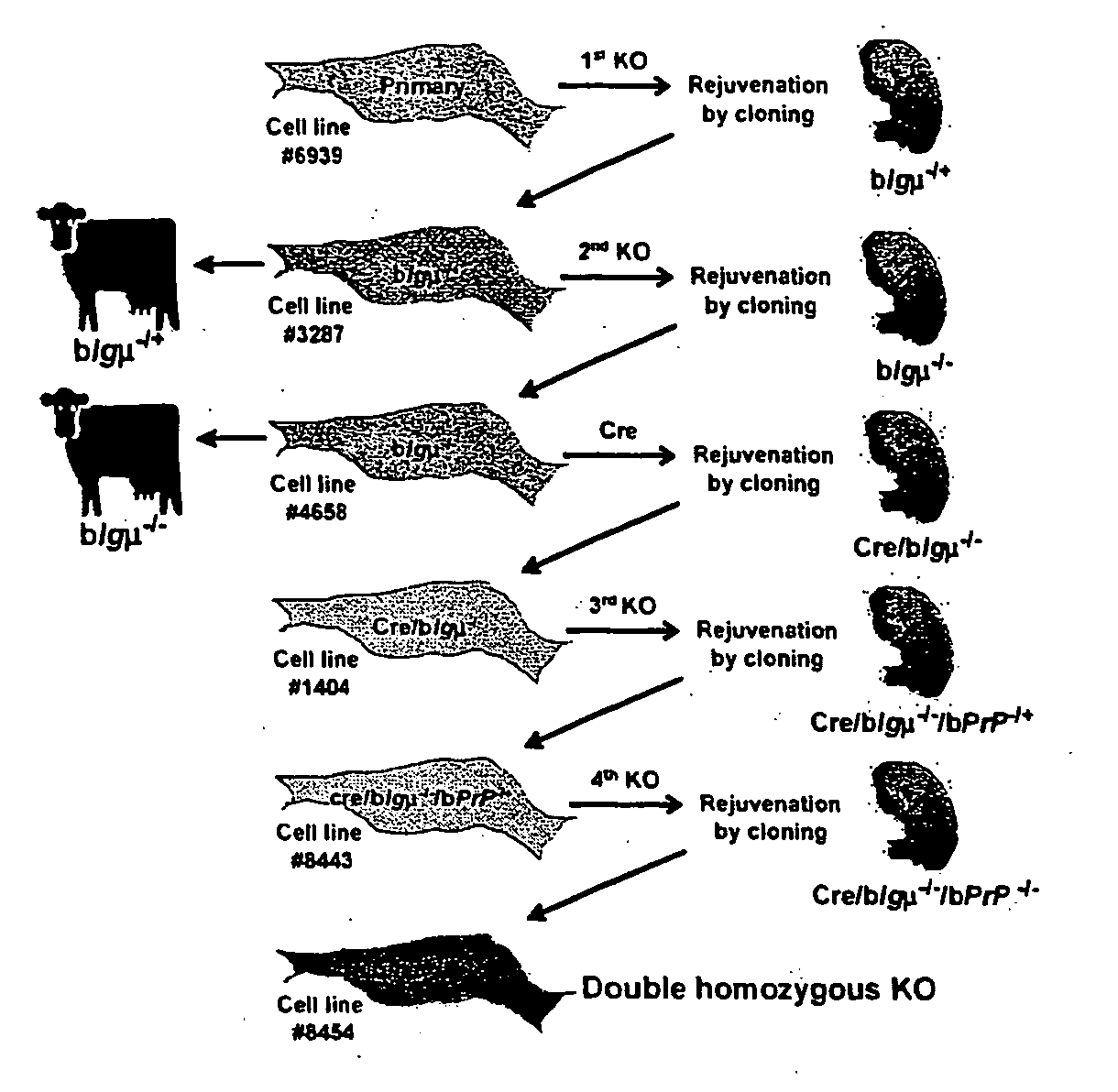
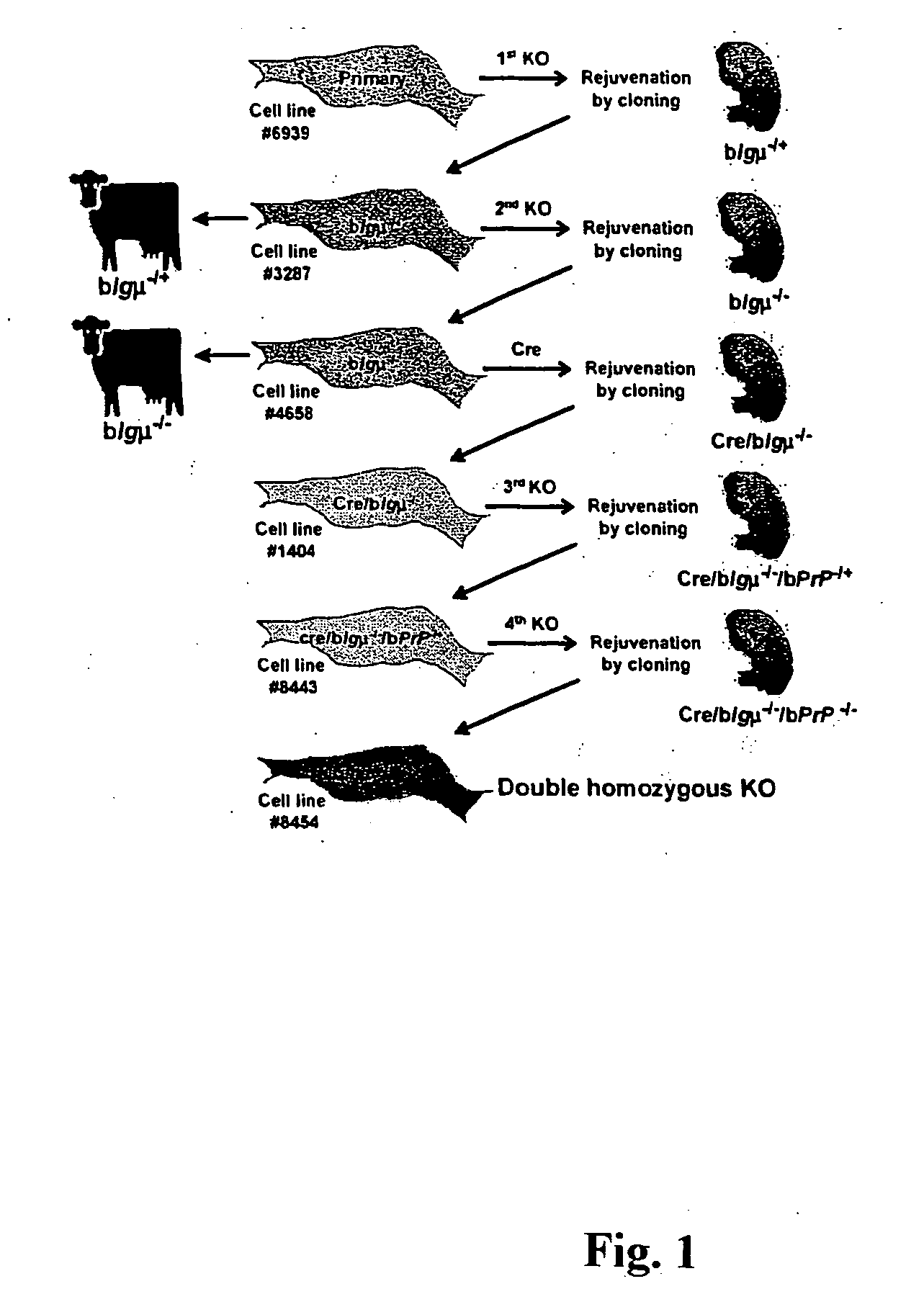
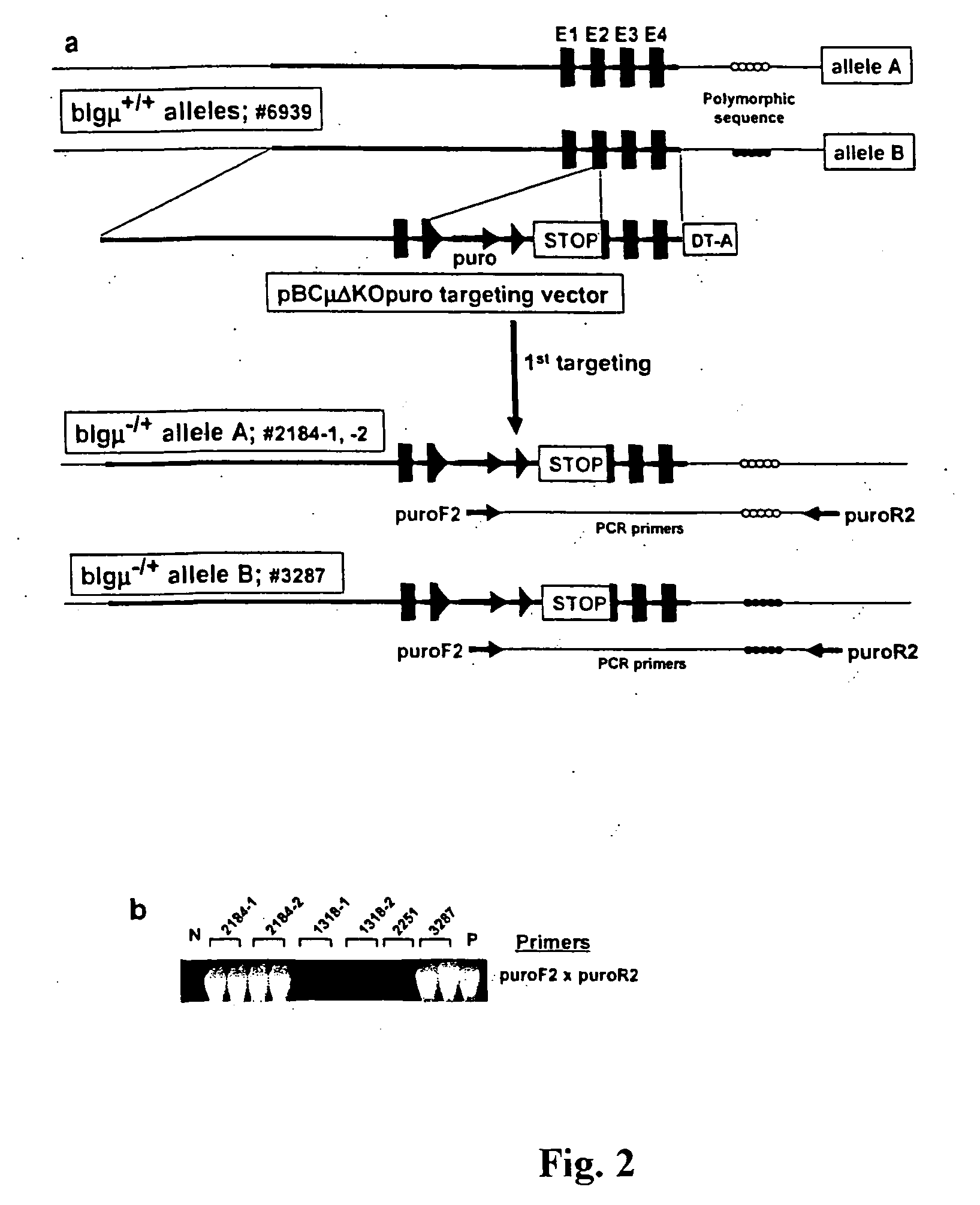
[0170] We have developed a broadly applicable and rapid method for generating multiple gene targeting events. As discussed above, sequential application of a highly efficient targeting system and rejuvenation of cell lines by production of cloned fetuses (FIG. 1) were employed. We chose to target the IgμU gene, which is transcriptionally silent in fibroblasts. This gene was characterized in a male Holstein fetal fibroblast cell line (#6939) to identify a polymorphic marker DNA sequence, outside the KO vector sequence, which could be used to distinguish the two alleles (FIG. 2A; allele A and allele B as indicated). Fetal fibroblasts from cell line #6939 were electroporated with the first KO vector (pBCμΔKOpuro; FIG. 2A) to produce 446 wells resistant to puromycin. Wells were split on day 14 and half of the cells were used for screening by PCR (primer pairs; puroF2×puroR2, FIG. 2A) to identify wells containing correctly targeted cells. Initially, six wells w...
example 2
Removal of Selection Markers Using the Cre / LoxP System
[0176] Sequential targeting requires a strategy for antibiotic selection of a newly integrated targeting vector in a cell line that already contains one or multiple antibiotic selection markers. The simplest approach is to use a different selection marker gene for each targeting event. This approach however, limits the number of targeting events that may be performed in a cell line. Another approach is to remove the selection markers using a Cre-loxP recombination system, as has been done in murine embryonic stem cells (Abuin and Bradley (1996) Mol. Cell Biol. 16:1851-1856). In our regenerated IgμU targeted fibroblasts, the selection marker genes were not expressed, likely because the IgμU locus is silent in fibroblasts. Although selection marker removal was not necessary for further targeting in our IgμU− / − fibroblasts, we evaluated the possibility of removing the selection markers by transfection with a Cre recombinase express...
example 3
Targeting of the PrP Gene
[0178] To evaluate the possibility of sequentially targeting a second gene, Cre-excised IgμU− / − (Cre / IgμU− / −) fibroblasts (cell line #1404) were subjected to a third round of targeting to disrupt the PrP gene. This gene was first characterized to identify a polymorphic sequence, outside the KO vector sequence, to distinguish the two alleles (FIG. 5A; allele C and allele D as indicated). Cells were transfected with the third KO vector (pBPrP(H)KOneo, FIG. 5A) and 203 G418-resistant wells were screened by PCR.
[0179] Thirteen (6.4%) wells with cells showing a heterozygous KO PrP in Cre / IgμU− / − background (Cre / IgμU− / − / PrP− / +) were identified (primer pairs; neoF7×neoR7; FIG. 5A). Sequence analysis showed that the third KO vector was integrated into allele C of the PrP gene in all the positive wells. Some wells were used for cloning to generate 28 pregnancies at 45 days of gestation (71%; Table 1). Five fetuses were collected and all were positive for targeting ...
PUM
| Property | Measurement | Unit |
|---|---|---|
| time | aaaaa | aaaaa |
| time | aaaaa | aaaaa |
| pH | aaaaa | aaaaa |
Abstract
Description
Claims
Application Information
 Login to View More