

Hydrodeoxygenation catalyst
a technology of hydrogenation catalyst and catalyst, which is applied in the direction of catalyst activation/preparation, metal/metal-oxide/metal-hydroxide catalyst, and hydrocarbon from oxygen organic compounds, etc., and can solve problems such as contamination of downstream products
- Summary
- Abstract
- Description
- Claims
- Application Information
AI Technical Summary
Benefits of technology
Problems solved by technology
Method used
Image

Examples
example 1
Preparation of Niobium Promoted Zirconium Support
[0061]Chromium promoted zirconium support was prepared according to U.S. Publication No. 2011 / 0301021.
[0062]Ammonia niobate oxalate (7.6 g) was measured and dissolved into deionized water (20-30 mL) with slight heat. The solution was dropped into ZrCr support (30 g) with vigorous vibration until the materials were completely wet. The resulting material was dried at 110° C. for 1 h and followed by calcinations at 450° C. for 2 h with a heating ramp rate of 10° C. / min. This yielded about 33.6 g Nb—ZrCr support.
example 2
Preparation of Molybdenum Promoted Zirconium Support
[0063]Mo—ZrCr support was made in the same manner as in Example 1, except ammonium molybdate tetrahydrate ((NH4)6Mo7O24.4H2O, 6.12 g) was used in place of the ammonia niobate oxalate. The resulting wet material was dried at 110° C. for 1 h and followed by calcinations at 650° C. for 2 h with a heating ramp rate of 10° C. / min.
example 3
Preparation o Tungsten Promoted Zirconium Support
[0064]W—ZrCr support was made in the same manner as in Example 1, except ammonia metatungstate hydrate ((NH4)6H2W12O40.xH2O, 4.5 g) was used in place of the ammonia niobate oxalate. The resulting wet material was dried at 110° C. for 1 h and followed by calcinations at 650° C. for 2 h with a heating ramp rate of 10° C. / min.
Characterization of the Promoted Supports
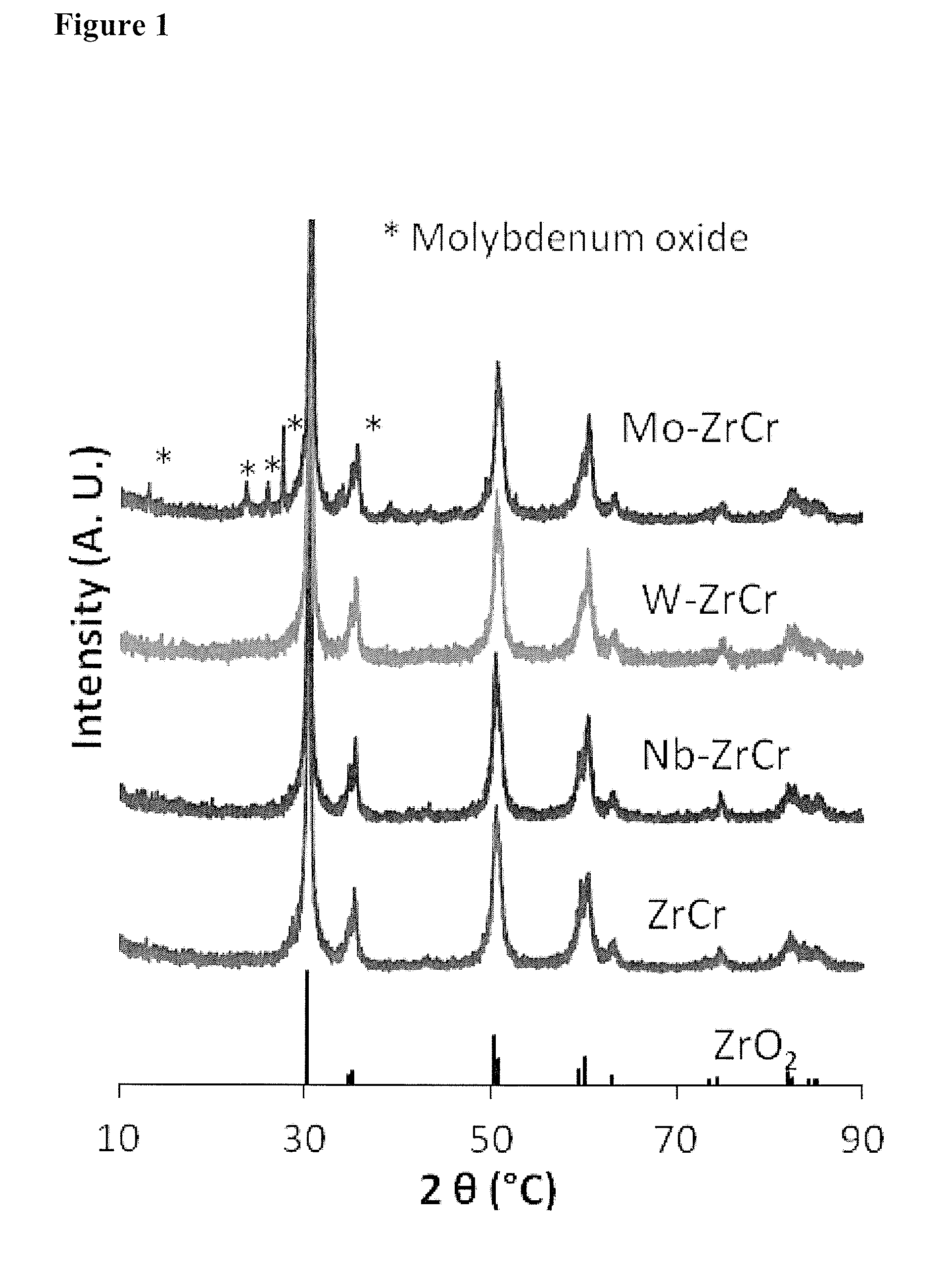
[0065]The XRD patterns (Cu kα) of the promoted ZrCr supports in FIG. 1 show that Nb and W were well dispersed into ZrCr support, thereof XRD amorphous, while Mo oxides particles were observed. The XRD patterns of a tetragonal zirconium oxide and the ZrCr support were also included for comparison. Cr is a textural promoter to stabilize tetragonal phase of ZrO2.
PUM
| Property | Measurement | Unit |
|---|---|---|
| temperature | aaaaa | aaaaa |
| pressure | aaaaa | aaaaa |
| temperature | aaaaa | aaaaa |
Abstract
Description
Claims
Application Information
 Login to View More